Check whether claims match experiments, exact reported results, and stated limitations.Know what the science actually supports before you trust the answer.
Press Enter ↵ to review paper
Explore by Goal
"The important thing in science is not so much to obtain new facts as to discover new ways of thinking about them."
- William Lawrence Bragg
Quick Explanation
Copied
The paper convincingly demonstrates in vitro that hyperbarically loaded gas-in-oil polymer microcapsules allow independent tuning of oxygen payload, burst release, and release time constants via shell thickness, core architecture, and PLGA composition , but the complete absence of in vivo data leaves safety and translational claims untested.
Long Explanation
What the Study Shows
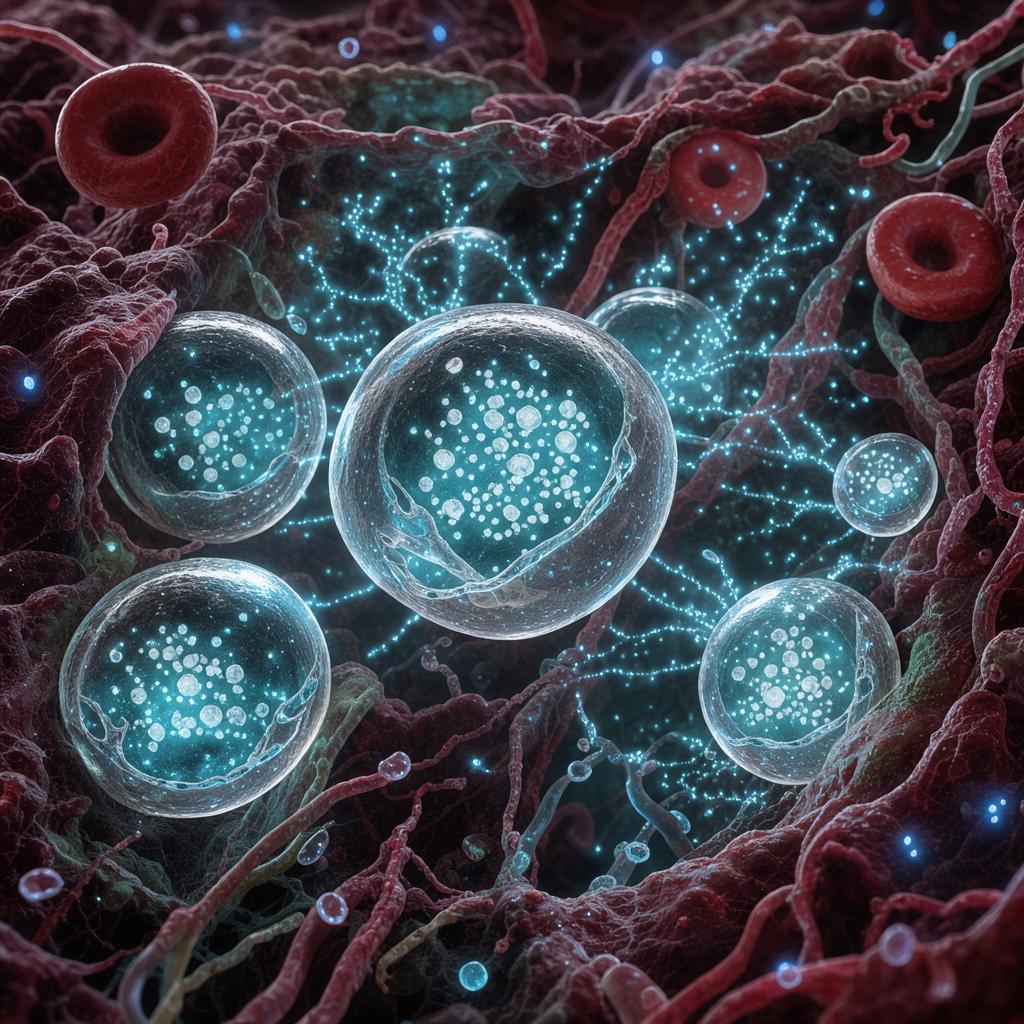
The paper (Nguyen, Peng, Seekell, Kheir, Polizzotti; Journal of Controlled Release, 2020) systematically varies three design levers on PLGA-based polymer microcapsules (PMCs) hyperbarically loaded with O2 at 1, 6, and 10 bar: core architecture (oil-filled o-PMC, gas-in-oil g/o-PMC, gas-filled g-PMC), shell thickness (S:D ratio 81–189), and polymer composition (PLGA 50:50 vs 85:15). Oxygen release was quantified with a desaturated human erythrocyte/hemoglobin assay, fitting cumulative release to an integrated exponential model to extract time constants (τ) .
Key findings (reported): (1) The PFOB oil layer in g/o-PMCs acts as both an oxygen reservoir and a diffusion barrier, blunting the depressurization pressure gradient and yielding apparent zero-order release — the mechanistic centerpiece. (2) Hyperbaric loading at 10 bar doubled g/o-PMC gas content vs atmospheric loading. (3) g-PMCs carried the most oxygen but burst-released rapidly (τ ~11–23 min); g/o-PMCs extended τ up to ~6 h. (4) Thicker shells raised τ and reduced absolute burst; PLGA 85:15 reduced burst release significantly vs 50:50 (p < 0.01) .
Mechanical Integrity Under Pressure
SEM-based buckling analysis revealed S:D ratios ≥104 resisted buckling at all pressures, whereas thinner shells (S:D 81–90) deformed substantially at 6–10 bar — notably worse than ideal elastic-sphere predictions (48–77 bar), attributed to surfactant-driven plasticization and shell defects. Formulation 2, for example, buckled 35.4% at 10 bar despite its thicker shell .
Figure: Reported buckling percentages by formulation and loading pressure (Table 3 data). Note the non-monotonic behavior of Formulation 2 at 6 bar, a possible measurement artifact worth scrutiny.
Critical Assessment
Strengths: Clear factorial design logic; mechanistic reasoning connecting Eq. 1 parameters (permeability, ΔP, area, thickness) to observed kinetics; honest acknowledgment that g/o-PMC payloads reached only ~40–47% of theoretical values under hyperbaric loading, attributed to depressurization microcracking — an author-identified limitation, not a hidden one .
Weaknesses: Entirely in vitro/ex vivo; number of blood donors unspecified; large standard deviations (e.g., τ = 561 ± 461 min for g/o-PMCs at 6 bar) suggest high capsule-to-capsule heterogeneity and weaken the tunability claim; confounding between shell thickness, size, and gas fraction was acknowledged but only partially resolved by comparing just two formulations per variable; no independent verification of the microcrack hypothesis (only inference from burst-release patterns).
Unverified leap: The zero-order kinetics claim rests on visual linearity of release curves rather than formal model comparison against first-order alternatives.
Translational gap: No in vivo efficacy, biodistribution, embolism risk, or biodegradation data — critical for an intravenous oxygen-resuscitation context the group has previously pursued.
Confidence note: The materials-science conclusions are well-supported (moderate strength; controlled in vitro design). Claims about clinical utility remain speculative. Falsification route: if PMC payload recovery and τ prove irreproducible across independent labs or fail in vivo, the tunability framing collapses.
Author Reviews
Feedback:
Updated: October 27, 2026
BGPT Paper Review
Study Novelty
70%
Hyperbaric loading of PMCs was previously shown by Cook et al. (2015); the novelty here is the systematic demonstration that an intermediate PFOB oil layer decouples payload from burst release and enables zero-order kinetics in injectable-sized capsules, which had not been previously isolated as a design variable.
Scientific Quality
70%
Rigorous in vitro characterization with appropriate statistics and honest reporting of payload shortfalls, but weakened by large variance in τ values, unspecified donor numbers, reliance on inferred (not directly observed) microcrack mechanisms, and zero-order claims based on visual curve shape rather than formal model comparison.
Study Generality
70%
The design principles (shell permeability, thickness, pressure gradient, oil barrier) generalize to therapeutic gas delivery broadly, but the specific PLGA/PFOB system is niche and applications span several hypoxia contexts.
Study Usefulness
70%
Provides a practical tunability roadmap for biomaterials researchers designing gas-delivery systems; however, absent in vivo data, practical clinical usefulness remains unproven and downstream users must independently verify biocompatibility under flow conditions.
Study Reproducibility
70%
Formulation tables, fabrication parameters (homogenization speeds, dilution factors), and assay details are documented in depth, supporting reproduction; gaps include unspecified blood donor counts, electrospray parameter omissions, and reliance on custom equipment.
Explanatory Depth
70%
Mechanistic explanation via membrane transport physics (Eq. 1) and the oil-layer pressure-buffering hypothesis is coherent and partially supported by data, but key mechanistic claims (microcracking, plasticization) are inferred rather than directly measured (e.g., no in situ permeability or fracture imaging).
We'll email you the results when your analysis is finished.
Hypothesis Graveyard
Uniformly thicker shells solve the burst problem: rejected because thicker shells reduce gas payload and, per the paper, normalized burst fraction stayed similar (~54-58%) across shell thicknesses — thickness alone does not eliminate uncontrolled release.
Hyperbaric loading pressure alone controls release duration: rejected because τ was pressure-independent across 1-10 bar for all capsule types; architecture, not pressure, dominates kinetics.

 Explore by Goal
 Quick Explanation
 Long Explanation
 Top Data Sources
 Ask a Follow-Up
 Key Insight
 Keep Exploring
 Hypothesis Graveyard
 Potential Experiments
 Discussion
