Check your hypothesis against versioned claims, exact reported results, and stated falsification criteria.Know what falsifiable science actually supports before you trust the answer.
Press Enter ↵ to search evidence
Explore by Goal
"The art and science of asking questions is the source of all knowledge."
- Thomas Berger
BGPT Odds of True
25%
80% Confidence
The hypothesis conflates opposite transcriptional regulation with molecular competition. Orthologues in separate organisms cannot compete for substrates without co-expression. Perturbation could clarify directionality, but not through competitive inhibition.
Hypothesis Novelty
75%
Cross-kingdom comparison of oppositely regulated orthologues in invasive growth is an unusual framing, but the 'competitive inhibitor' mechanism is not supported by existing invadopodia literature.
Quick Analysis Plan
Copied
The "competitive inhibitors" framing is unsupported: oppositely regulated orthologues in different organisms cannot compete for shared substrates without co-expression, so the term is a category error. However, perturbing such conserved modules can clarify regulatory direction, as FILIP1L knockdown increases ECM degradation while decreasing 3D invasion, showing that "up vs. down" is not a simple proxy for pro- vs. anti-invasive function .
Long Analysis Plan
The "competitive inhibitor" framing is a category error
Competitive inhibition requires two molecules competing for the same binding site or substrate inside one biochemical environment. The 27 orthologues reside in S. japonicus hyphae and human invadopodia—separate cells in separate organisms. They never coexist, so they cannot "compete" in the pharmacological sense. What opposite regulation actually signals is divergent regulatory logic acting on a conserved module: the same protein family is transcriptionally pushed in opposite directions during two distinct invasive programmes. This is evidence of convergent mechanisms, not molecular rivalry.
Directionality is real, but it is not a simple up/down switch
The invadopodia literature shows that a single component's contribution flips depending on localization and context—not on gross expression direction. Pyk2 and cortactin dynamically exchange between invadopodia and nascent focal adhesions, with Pyk2 having a residence half-time of 2.3 ± 0.48 s versus actin's 8.57 ± 0.51 s, meaning these proteins are rapidly reallocated between invasion and migration modules . In the same study, FAK inhibition alone reduces migration but can enhance matrix degradation, while dual FAK/Pyk2 inhibition suppresses both—showing that blocking one arm shifts the cell's output in a non-intuitive direction.
FILIP1L knockdown produces the most direct counterexample to a "more expression = more invasion" rule: it increases gelatin degradation but decreases 3D spheroid invasion and wound closure velocity . This means degradation and invasion are separable outputs, and perturbing an oppositely regulated orthologue would tell you which module it gates—not simply which direction is "required."
Lumican is the closest thing to a genuine anti-invasive inhibitor in the supplied data: at 100 nM it suppresses invadopodia markers (cortactin, vinculin, talin) and MMP-14 activity in MDA-MB-231 cells, shifting them toward epithelial morphology . If any of the 27 orthologues behave like a genuine inhibitory ECM component, the "competitive" framing has a target—but only if they share a substrate in the same compartment.
Sourced from FRAP measurements in melanoma cells . Shorter half-times indicate faster exchange and greater dynamic allocation between modules.
What perturbation would clarify
Perturbing each of the 27 orthologues individually—knockdown in human cells, deletion in S. japonicus—would reveal whether each requires upregulation or downregulation for invasion in its own context. But this answers a necessity question, not a competition question. To test competition you would need heterologous co-expression of an orthologue pair in one cell type, or a dominant-negative construct that sequesters a shared partner (e.g., sequestering cortactin away from invadopodia, as Pyk2 relocation does ). Vesicle-trafficking components like SNAP23/syntaxin13 reduce both degradation (>75%) and invasion (67–79%) when perturbed, but this reflects trafficking necessity, not competitive inhibition .
Improved hypothesis
"The 27 oppositely regulated orthologues represent conserved invasion modules whose regulatory direction is context-dependent; perturbing each in its native system will reveal which module (trafficking, actin nucleation, ECM degradation, or migration coupling) must be shifted up vs. down, but competitive inhibition can only be tested by heterologous co-expression of orthologue pairs with a shared binding partner."
Retrieving and ranking the 27 orthologues by cross-kingdom expression direction, mapping them onto invadopodia and hyphal-invasion pathways, and flagging which share binding partners suitable for heterologous competition testing.
Get emailed when your analysis is done!
We'll email you the results when your analysis is finished.
Hypothesis Graveyard
'Upregulated orthologues are pro-invasive; downregulated ones are anti-invasive.' Falsified by FILIP1L knockdown increasing degradation while decreasing 3D invasion, showing direction of expression change does not map simply to invasion outcome.
'The 27 orthologues act as competitive inhibitors of invasive growth.' Unsupported because orthologues in separate organisms cannot share a biochemical environment; no evidence of substrate overlap or dominant-negative behaviour across kingdoms.
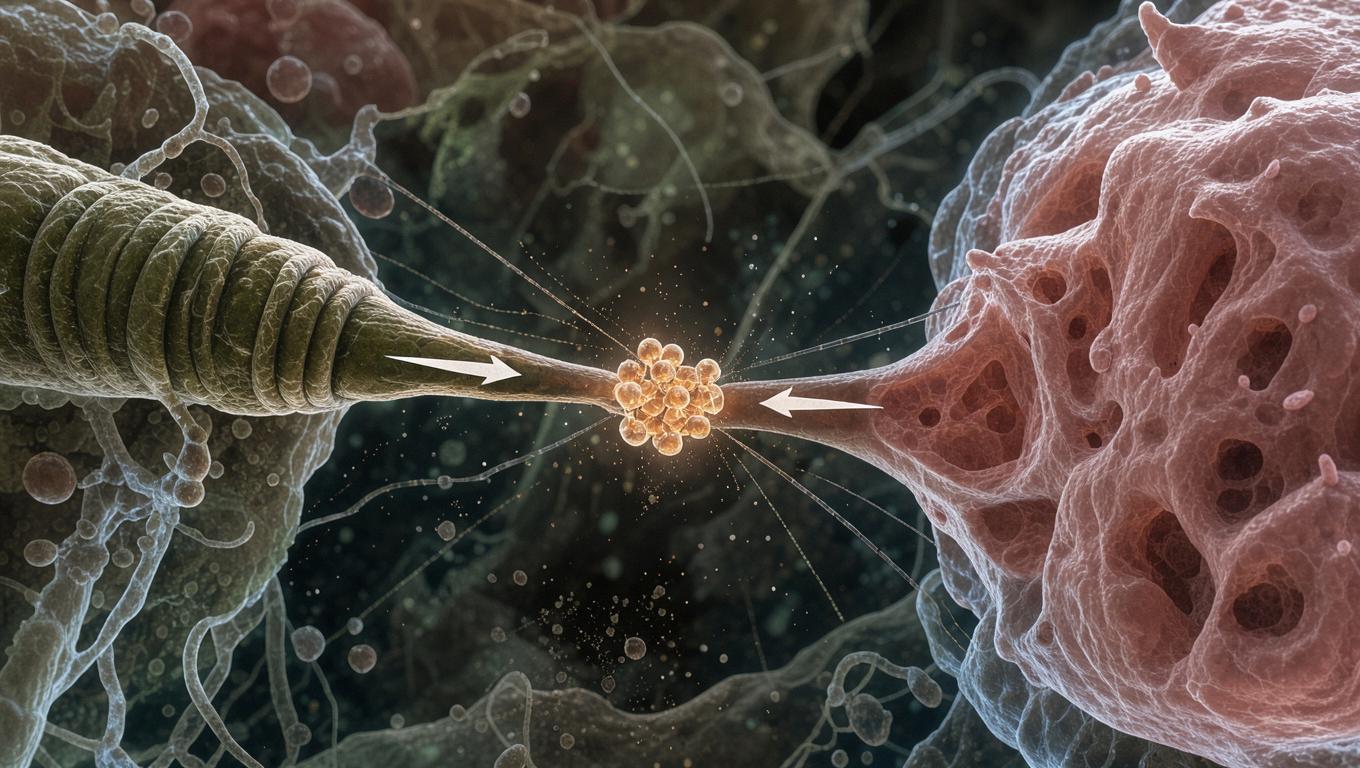
Science Art
Science Movie
Make a narrated HD Science movie for this answer ($64 per minute)

 Explore by Goal

 Hypothesis Novelty
 Quick Analysis Plan
 Long Analysis Plan
 Top Data Sources
 Ask a Follow-Up
 Key Insight
 Keep Exploring
 Analysis
 Hypothesis Graveyard
 Discussion
