Check a paper's claims against linked experiments, exact results, stated scope, and limitations.Know what falsifiable science actually supports before you trust the answer.
Press Enter ↵ to search evidence
Explore by Goal
"Science is the acceptance of what works and the rejection of what does not. That needs more courage than we might think."
- Jacob Bronowski
Quick Explanation
Copied
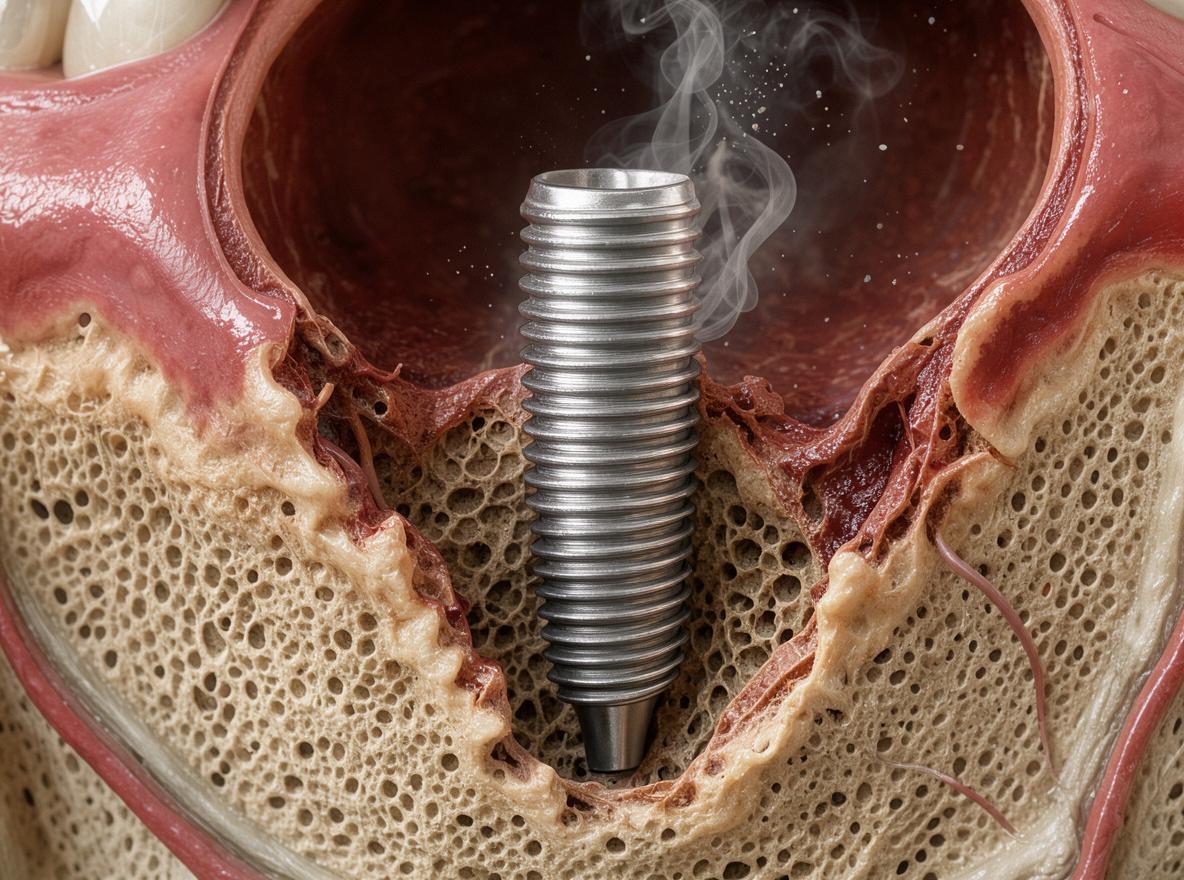
This 1996 retrospective study of 421 patients (1,366 implants) found that smokers had significantly worse maxillary peri-implant pocket depth (~4.3 vs ~2.8 mm), mucosal inflammation, bleeding, and radiographic bone resorption than nonsmokers, with no significant effect detected in the mandible; the evidence is hypothesis-generating only, given the self-reported smoking status, retrospective design, and steep follow-up attrition .
Long Explanation
Core Findings From Reported Data
Haas et al. (University of Vienna) compared 107 smokers with 314 nonsmokers across 1,366 implants (Brånemark and IMZ systems; mean recall ~22 months) using plaque, mucosal, probing-depth, and radiographic bone-resorption parameters analyzed with the Wilcoxon rank test . The maxilla-specific effect was striking — mean probing depth was ~1.5 mm deeper and mesial bone resorption roughly 2.6× higher in maxillary smokers — while hygiene indices did not differ significantly, which the authors took to argue against a purely plaque-mediated mechanism. The authors interpreted the mandibular null result cautiously, noting that the tongue may partially protect the mandible and that restoration type differed by jaw.
Critical Appraisal
Several design weaknesses temper the conclusion. Smoking status was based on patient self-report without cotinine verification, dose was explicitly not recorded, and "nonsmokers" included former smokers — misclassification that would bias toward the null. More importantly, the recall cohort contracted sharply over time: only 4 smokers but 26 nonsmokers remained in recall at year 9 , and Table VI reports more mandibular than maxillary implants (255 vs 105 in smokers), so jaw-specific estimates rest on unequal denominators. Bleeding indices paradoxically ran lower in mandibular nonsmokers, hinting at hidden confounding between jaw, restoration type, and hygiene behavior that the crude Wilcoxon design cannot disentangle. The retrospective design cannot establish causation, as the authors themselves acknowledge.
Consistency With Subsequent Implant Literature
The maxilla-predominant harm pattern has since been broadly replicated: later retrospective cohorts of thousands of implants identified smoking as a significant early-failure predictor , including in 6,946 Brånemark implants where osteoporosis, Crohn's disease, and smoking habits were significant . Modern reviews quantify tobacco-related marginal bone loss around implants at approximately 1.34 mm (credible interval 0.85–1.79 mm) , consistent in magnitude with the ~2.5 mm maxillary resorption gap observed here. A 30-year IMZ follow-up found no detectable smoking–peri-implantitis association, though with 84% dropout and only 32 examined implants, its power to confirm or refute is minimal .
What Would Change This Conclusion
The finding is falsifiable: prospective cohorts with cotinine-verified smoking status, dose quantification, hygiene-matched controls, and jaw-stratified multilevel models could confirm or refute the maxillary effect. If such studies showed no pocket-depth or bone-loss difference after controlling for plaque and restoration type, the smoking–peri-implant connection would weaken substantially. Blind spots include the untested confounders of jaw-specific bone quality, prosthesis type, and periodontal history, none of which were adjusted for beyond comparing group means.
Feedback:
Updated: November 21, 2026
BGPT Paper Review
Study Novelty
60%
Among the earliest studies to assess smoking effects on peri-implant soft tissue and bone parameters rather than failure rates alone, in 1996; the concept was not entirely new (Bain and Moy 1987 preceded it), but the tissue-level, jaw-stratified approach was fresh.
Scientific Quality
60%
Reasonable retrospective methodology with validated clinical indices and nonparametric statistics, but undermined by self-reported smoking status without dose, differential 9-year recall attrition (4 vs 26 implants), unequal jaw denominators, no cotinine verification, no multivariable adjustment, and potential confounding by prosthesis type and hygiene.
Study Generality
60%
Findings generalize to two classic implant systems in a European adult population and connect to broader periodontal smoking literature, but the jaw-specific and prosthesis-specific findings limit straightforward extrapolation to modern implant surfaces.
Study Usefulness
70%
Clinically useful for risk communication: smoking patients can be informed that maxillary implants face measurably worse peri-implant inflammation and bone loss; the study helped justify smoking-cessation counseling in implant dentistry.
Study Reproducibility
40%
Methods are describable (indices, four-point probing, radiographs with magnification correction) but no raw data, no explicit peri-implantitis definition, no calibration procedures, and 1996-era reporting make exact reproduction difficult.
Explanatory Depth
50%
The discussion invokes nicotine vasoconstriction, neutrophil dysfunction, reduced prostacyclin, and animal nicotine-bone data, but offers no direct mechanistic measurement; the mandibular protection explanation (tongue shielding) is speculative.
We'll email you the results when your analysis is finished.
Hypothesis Graveyard
Purely plaque-mediated explanation: hygiene indices did not differ significantly between groups, so smokers' worse peri-implant status is not fully explained by hygiene differences, though the authors themselves note they could not rule plaque out.
Systemic-nicotine-only explanation: uniform systemic exposure should affect both jaws similarly; the selective maxillary effect argues against a purely dose-dependent systemic mechanism.

 Explore by Goal
 Quick Explanation
 Long Explanation
 Top Data Sources
 Ask a Follow-Up
 Key Insight
 Keep Exploring
 Hypothesis Graveyard
 Potential Experiments
 Discussion
