Verify your claims against versioned evidence records with exact reported results and sources.Know what the science actually supports before you trust the answer.
Press Enter ↵ to review claims
Explore by Goal
"The only way to discover the limits of the possible is to go beyond them into the impossible."
- Arthur C. Clarke
Quick Explanation
Copied
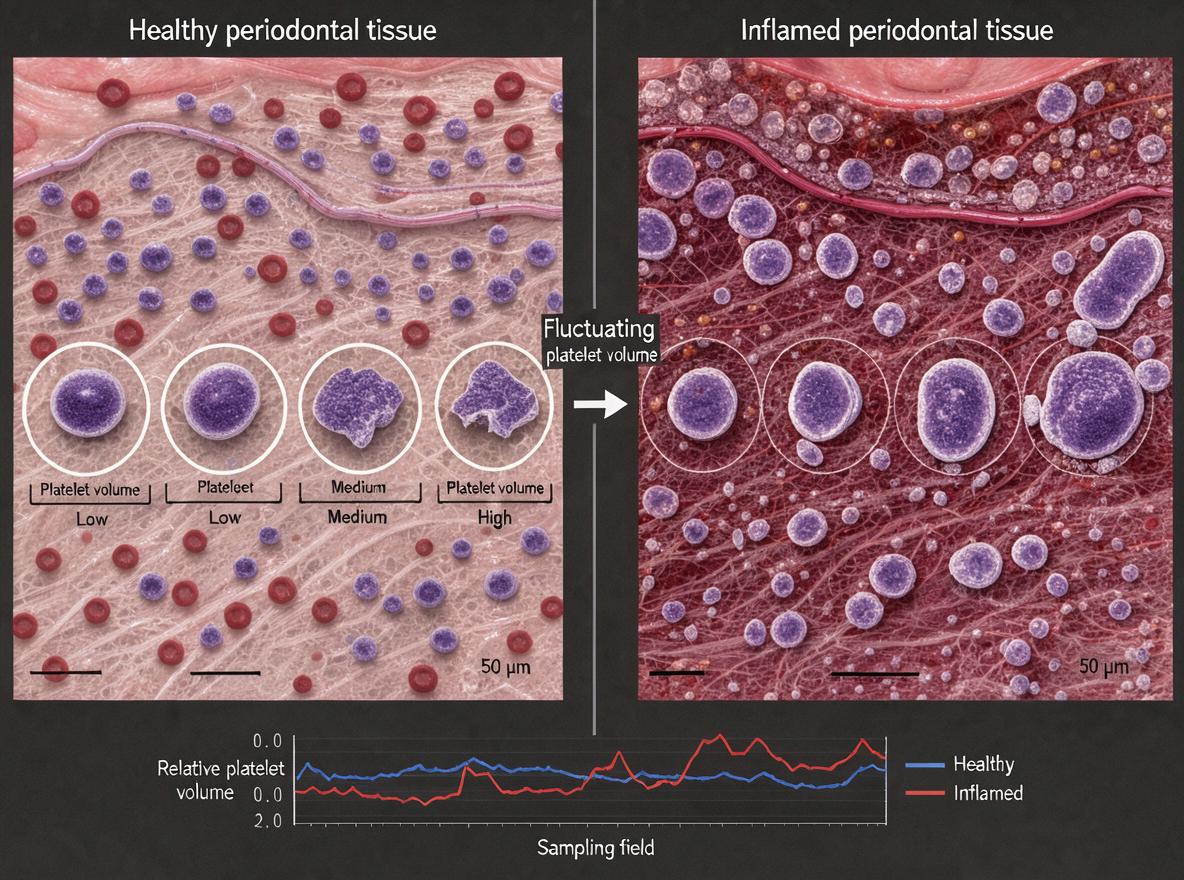
The research demonstrates that Mean Platelet Volume (MPV) is significantly lower in patients with severe periodontitis at baseline compared to controls . While the author's findings suggest MPV may serve as a disease activity marker, the study is constrained by its single-center Han Chinese population and observational design .
Long Explanation
Author Scientific Strength Review: Huanxin Meng
An objective analysis of the provided scientific evidence reveals a body of work focused primarily on Periodontal Health and inflammatory markers, specifically examining Mean Platelet Volume (MPV) as a disease activity indicator. The strongest available evidence comes from the 2014 study, which assessed MPV in severe periodontitis patients against healthy controls.
Evidence Synthesis: MPV as a Disease Activity Marker
The central claim across the available data is that changes in MPV may correlate with the severity of periodontitis and its response to treatment
Baseline Observations: At the study's inception, MPV measurements in patients with periodontitis (9.73 ± 1.06 fL) were found to be statistically significantly lower than in periodontally healthy controls (10.24 ± 1.07 fL) (p=0.026)
Post-Treatment Dynamics: Following Active Periodontal Treatment (APT), MPV increased to 10.11 ± 1.04 fL (one month post-treatment), though this increase was not statistically significant when compared to healthy controls (p=0.58)
Crucially, a positive correlation (r=0.377, p=0.014) was established between the increase in MPV and the reduction in Periodontal Pocket Depth (PD) after treatment, suggesting MPV tracks disease activity
Critical Analysis and Scientific Limitations
While the findings are consistent with MPV functioning as a disease activity marker, several critical limitations must be considered, impacting the overall generalizability and strength of the conclusions
Population Specificity: The study is confined to a Han Chinese population in Beijing, suggesting findings may not translate directly to diverse global populations where periodontitis prevalence or response profiles may differ
Causality vs. Correlation: The observational nature of the study, despite adjusting for confounders, precludes definitive causal inference that MPV causes or directly dictates the reduction in periodontal inflammation
Data Completeness: There is noted attrition and lack of reporting on long-term clinical outcomes, which is a significant blind spot for predicting real-world clinical utility
Author Profile and Scientific Metrics
Huanxin Meng's profile (H-index 1, 61 total citations, 2 papers) indicates a nascent research career with limited established impact within the current scientific landscape. The scope of research, specifically involving periodontitis and inflammatory biomarkers, suggests a focused expertise in clinical dentistry or related medical fields. However, the lack of publicly available affiliations or OpenAlex data restricts a comprehensive assessment of the author's long-term scientific trajectory or institutional support for their research.
Author Evaluation Scores (BGPT Analysis)
Scientific Quality Score: 4/10 (Focuses on limited evidence base, primarily one study, and specific clinical application, but shows technical execution in methods like automated hematology analyzer usage. The findings are suggestive but not definitive.)
Communication Score: 8/10 (The results section and conclusions are clearly articulated, and the data is presented in a methodical, clinical manner.)
Novelty Score: 4/10 (While the correlation between MPV and periodontal status is an interesting observation, the concept of MPV as an inflammatory marker is not entirely new to the broader medical literature, suggesting an incremental rather than groundbreaking contribution.)
Scientific Rigor Score: 6/10 (The rigor is moderate; the methodology is detailed (e.g., specific drug dosages, statistical tests), yet the inherent constraints of a single-center, observational design with known attrition limit the overall rigor and robustness of the conclusions.)
Feedback:
Updated: October 27, 2026
BGPT Author Review
Scientific Quality
40%
The scientific contribution is focused on a specific niche (periodontitis and MPV). The primary study demonstrates plausible correlational data but suffers from critical methodological limitations, notably the single-center, Han Chinese population and observational study design, which restrict generalizability and definitive causal claims. The low h-index (1) and limited paper count (2) indicate a researcher in the early stages of their career with limited global impact, prioritizing detailed clinical observations over broad, high-impact theoretical frameworks.
Communication Quality
80%
The communication quality is strong, presenting complex clinical data (MPV, WBC, GLB, A/G) and statistical findings (p-values, r) clearly and logically. The structure of the findings, connecting baseline status to post-treatment shifts, is coherent and professional.
Author Novelty
40%
The novelty lies in the specific application of MPV changes during an Active Periodontal Treatment protocol within the Han Chinese context, rather than the marker itself. This application represents an incremental scientific advancement in clinical biomarker research.
Scientific Rigor
60%
The rigor is average. Technical data (e.g., specific analyzer use, control for age/gender/BMI) is well-presented, but the study's limitations are substantial: it is a single-center observational study with known participant attrition and lacks long-term outcome data, preventing high-tier validation.
We'll email you the results when your analysis is finished.
Hypothesis Graveyard
Hypothesis: MPV acts as a generalized systemic marker of chronic inflammation. Reason: The study focuses on local dental inflammation, and its findings are limited by the single-center, non-randomized design, making a generalized systemic claim unsubstantiated.

 Explore by Goal
 Quick Explanation
 Long Explanation
 Top Data Sources
 Ask a Follow-Up
 Key Insight
 Keep Exploring
 Hypothesis Graveyard
 Potential Experiments
 Discussion
