Go beyond summaries to locate specific, verifiable claims and sources within research.Know what falsifiable science actually supports before you trust the answer.
Press Enter ↵ to search paper
Explore by Goal
"An expert is a person who has made all the mistakes that can be made in a very narrow field."
- Niels Bohr
Quick Explanation
Copied
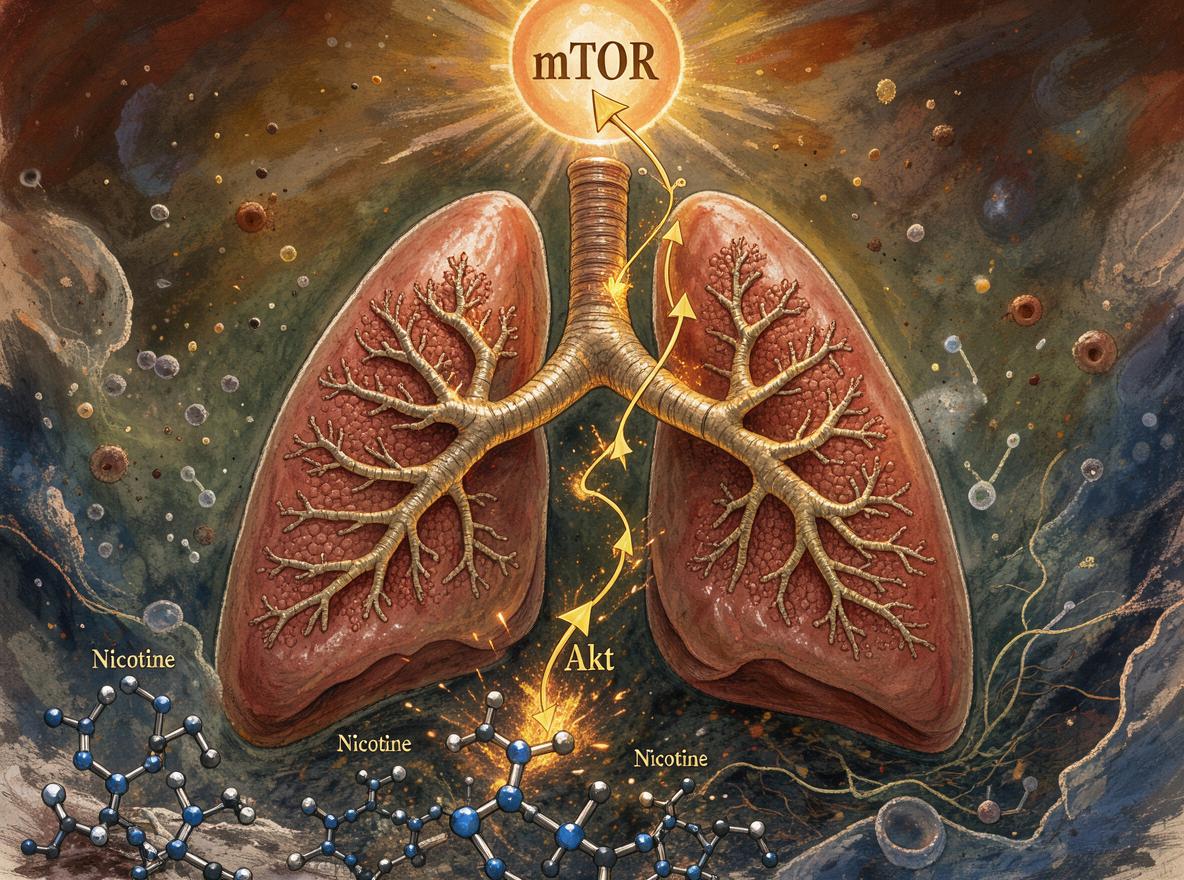
This 2010 Clinical Cancer Research review by Memmott and Dennis synthesizes mechanistic and preclinical evidence that tobacco carcinogens (nicotine, NNK) activate the Akt/mTOR axis in lung epithelium, and that pathway inhibitors (rapamycin, myoinositol, I3C, deguelin) suppress carcinogen-induced lung tumorigenesis in mice, with early clinical signals from myoinositol . The mechanistic narrative is well-supported, but the translational claims rest mainly on A/J mouse models and uncontrolled phase I data.
Long Explanation
Evidence Base: How Strong is the Akt/mTOR–Tobacco Link?
The review's central mechanistic claim—that nicotine and NNK activate Akt via nAChR subunits (α7 for NNK, α3/α4 for nicotine) and PI3K—is anchored in inhibitor-based experiments (LY294002, nAChR antagonists) and in A/J mice where Akt activation correlated with lesion progression . Clinical correlative data add weight: P-Akt was detected in 71% of hyperplastic/metaplastic and 90% of dysplastic bronchial lesions from heavy smokers, tracking with histologic progression .
BGPT note: values are the paper's own reported figures; the myoinositol bar (~60%) is an upper-bound illustration since the source reports only "significantly prevented" without a precise percentage—treat it as qualitative.
Critical Gaps and Blind Spots
Correlation vs. causation: Akt/mTOR activation in human premalignant lesions is associative; the review itself concedes P-Akt (S473) alone may inaccurately reflect Akt activity.
Model limits: A/J mouse NNK/BaP models are K-Ras–driven and strain-restricted; human smoking lung cancer is heterogeneous (KRAS ~25% of adenocarcinomas per the paper). The K-RASLA1 genocopy model partially addresses this but not smoking exposure complexity.
Feedback loops: The authors candidly note mTOR inhibition feedback-activates Akt, and clinical responses to rapalogs in NSCLC were "modest"—a caveat that in hindsight proved prescient, as rapalog monotherapy never succeeded in lung cancer. Later work linking mTOR to PD-L1 expression adds an immune-evasion dimension the 2010 review could not anticipate .
Chemopreventive agents: Deguelin's toxicity (Parkinsonism-related rotenoid concerns) and I3C's capacity to promote carcinogenesis in other models are disclosed but underemphasized relative to their preclinical promise.
Selection bias: This is a narrative review by investigators whose own work populates several cited studies (self-citation of the West, Tsurutani, Granville, Han papers), risking emphasis of favorable results.
Falsifiability and What Would Change the Conclusion
The thesis would be weakened by demonstrating Akt/mTOR–independent tobacco carcinogenesis in pathway-conditional knockouts, or by randomized failure of pathway inhibitors to reverse bronchial dysplasia (the phase II myoinositol trial was the key test). What would strengthen it: biomarker-stratified randomized prevention trials showing Akt-dependent dysplasia regression. Confidence in the mechanistic claims: moderate-high; confidence in clinical translation as of 2010: low—correctly hedged by the authors.
Feedback:
Updated: November 25, 2026
BGPT Paper Review
Study Novelty
60%
A 2010 synthesis of already-published mechanistic work; novel mainly in integrating nAChR→PI3K→Akt→mTOR with chemoprevention strategy, not in new data.
Scientific Quality
80%
Well-organized, candid about feedback activation and S473 readout limits, no COI disclosed; weakened by self-citation density and narrative (non-systematic) structure.
Study Generality
70%
The Akt/mTOR framework applies broadly to cancers and even megalencephaly syndromes, but the tobacco-carcinogen framing is lung- and smoking-specific.
Study Usefulness
80%
Useful translational roadmap for chemoprevention; prescient on rapalog limitations and metformin/AMPK, though rapalog monotherapy later failed in NSCLC.
Study Reproducibility
40%
Review article with no dataset; reproducibility depends entirely on the primary studies cited, several from the authors' own lab.
Explanatory Depth
80%
Detailed mechanistic chain from receptor subunits through TSC2/PRAS40 to mTORC1, with dosing, timing, and biomarker specifics for each inhibitor.
We'll email you the results when your analysis is finished.
Hypothesis Graveyard
'Rapalog monotherapy will translate to NSCLC treatment' — effectively falsified: the review itself noted modest responses and Akt feedback, and subsequent trials confirmed limited single-agent activity.
'P-Akt (S473) IHC reliably measures Akt activity in lesions' — the review concedes S473 alone is an inaccurate readout, undermining several cited correlative studies.

 Explore by Goal
 Quick Explanation
 Long Explanation
 Top Data Sources
 Ask a Follow-Up
 Key Insight
 Keep Exploring
 Hypothesis Graveyard
 Potential Experiments
 Discussion
