Check a paper's claims against linked experiments, exact results, stated scope, and limitations.Know what falsifiable science actually supports before you trust the answer.
Press Enter ↵ to search evidence
Explore by Goal
"Science knows no country, because knowledge belongs to humanity, and is the torch which illuminates the world."
- Louis Pasteur
Quick Explanation
Copied
This preprint provides converging microcosm, pure-culture, genomic, and transcriptomic evidence that chronic hypoosmolarity (<300 µS/cm) selectively inhibits ammonia-oxidizing archaea—especially the Nitrosopumilaceae—while AOB tolerate low salinity, implicating weak osmoregulatory machinery and S-layer-only cell walls . The mechanistic explanation remains partly correlational, and clade-specific caveats (comammox strain origin) warrant caution.
Long Explanation
Evidence Base and Key Findings
The study (Gwak et al., bioRxiv, July 2025) combines soil-slurry and lake-water microcosms, ATU-inhibition experiments, six pure cultures, 463 comparative genomes, and transcriptomics/proteomics of two AOA strains. In soil microcosms, AOB amoA abundance (dominated by Nitrosomonas oligotropha) peaked at the lowest salinity (~60–120 µS/cm), while AOA (Ca. Nitrosotenuis, ASV1979 matching "Ca. N. chungbukensis" MY2) and comammox clade A increased with salinity (p < 0.05, two-way ANOVA) .
Pure-culture data quantify the effect: at 1× MWM (128 µS/cm), AOA-NpF strains retained only 7.9% (N. koreense MY1) and 22.5% ("Ca. N. chungbukensis" MY2) of their growth rate at 10× MWM (795 µS/cm), whereas AOA-NsF strains (N. viennensis EN76, "Ca. N. oleophilus" MY3) retained 82.1% and 76.4%, and the AOB (N. europaea) and comammox (Ca. N. inopinata) strains showed no significant difference between salinities. Lake microcosms (Soyang, Daecheong) with ATU confirmed AOA sensitivity: ammonia oxidation took 90–180 days at 0× MWM but was completed within ~26 days after inoculating N. koreense MY1 at 10× MWM .
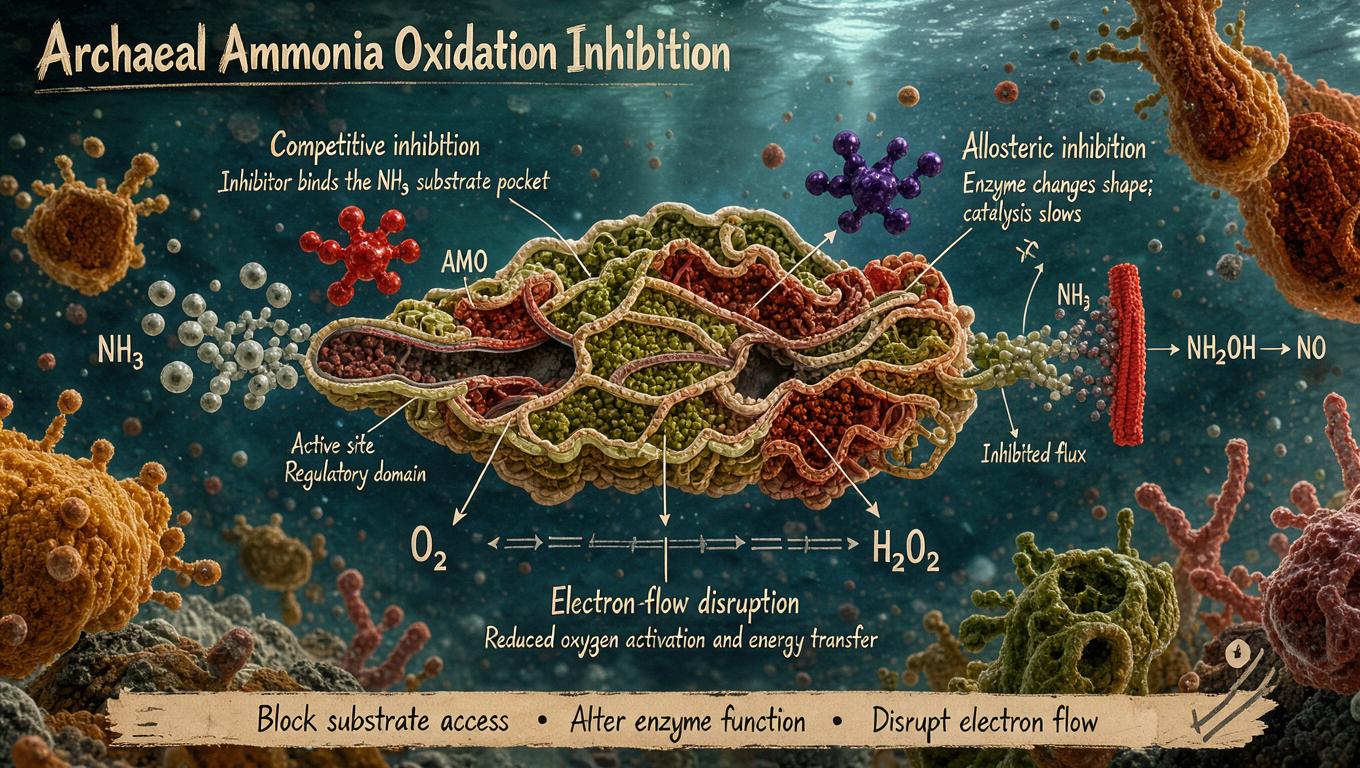
The authors explain AOA sensitivity via (i) fewer K⁺/Na⁺-osmoregulatory transporters than AOB/CMX genomes, and (ii) S-layer-only cell walls lacking peptidoglycan rigidity, consistent with known haloarchaeal S-layer destabilization in dilute media. Transcriptomically, "Ca. N. chungbukensis" MY2 showed broad stress responses under 1× MWM (139 upregulated genes including ice-binding proteins, LPXTG adhesins, VCBS-repeat proteins—interpreted as envelope stabilization), while N. viennensis EN76 responded narrowly (26 upregulated, mostly nutrient transporters). Core osmoregulation genes (Trk, Kdp, mechanosensitive channels, aquaporin) were constitutively expressed, not induced .
Critical Assessment and Blind Spots
Strengths: environmentally calibrated salinity design (EC percentiles from global lake/soil datasets), convergent evidence across community, physiological, genomic, and transcriptomic levels, and a useful inoculation control excluding lake-water-specific inhibition. Data are publicly deposited (PRJNA1265630; PXD064500), and the authors openly report that ATU inhibition of AOB/CMX was incomplete and that proteome depth was too low for interpretation.
Limitations to weigh: (1) The mechanistic model is largely correlational—S-layer genes were not differentially expressed, and causality for hypoosmotic sensitivity is inferred from comparative genomics, not from direct turgor-pressure or channel-knockout experiments. (2) The single comammox strain ("Ca. N. inopinata" ENR4) came from a deep oil well; its lack of hypoosmotic sensitivity conflicts with CMX-A patterns in soil microcosms, which the authors acknowledge but cannot resolve with one isolate. (3) Only four AOA strains (two per clade) were physiologically characterized, limiting clade-level generalization; the exceptionally tolerant "Ca. N. limneticus" of long-residence lakes was not cultured here. (4) Microcosm conditions (25°C, amended NH4⁺ of 25–100 µM) are simplifications of field heterogeneity, and 16S rRNA V4–V5 cannot resolve CMX from Nitrospira NOB. (5) Preprint status—peer review pending; statistics are limited to two-way ANOVA/Tukey without effect-size or power reporting. What would disconfirm the conclusion: demonstration of AOA growth at <350 µS/cm across diverse Nitrosopumilaceae isolates, or peptidoglycan-independent evidence ruling out S-layer fragility (e.g., survival after controlled hypoosmotic shock relative to AOB).
Feedback:
Updated: November 21, 2026
BGPT Paper Review
Study Novelty
70%
Hyperosmotic effects on nitrifiers were well studied, but chronic hypoosmotic stress at environmentally relevant EC as a niche-partitioning factor for AOA vs AOB is a genuinely underexplored, timely angle.
Scientific Quality
80%
Multi-level, well-controlled design with public data; weakened by small strain panel, correlational mechanistic claims, incomplete ATU inhibition, limited proteome depth, and preprint (unreviewed) status.
Study Generality
60%
Findings are tied to two Korean soils and two lakes plus six isolates; the osmoregulation/S-layer hypothesis generalizes broadly but is not yet tested across geographies or uncultured lake AOA clades.
Study Usefulness
80%
Directly informs nitrogen-cycling predictions under intensifying hydrologic cycles, nitrification-inhibitor effectiveness, and suggests salinity/EC as an underappreciated driver of AOA distribution and N2O flux models.
Study Reproducibility
70%
Detailed methods, deposited sequencing/proteomics data (PRJNA1265630, PXD064500), and defined MWM recipe; limited by strain availability and no reported effect sizes/individual data points in main text.
Explanatory Depth
60%
Genomic and transcriptomic evidence is consistent with the osmoregulation/S-layer model, but no direct physiological tests of turgor, channel function, or envelope rupture were performed, so the mechanism remains plausible inference.
Simulation only: values are hypothesis-level approximations anchored loosely on the reported means (7.9%, 22.5%, 82.1%, 76.4%) with arbitrary ±5–12% uncertainty; not measured data.
Generated scientific data; not direct experimental measurements.
Get emailed when your analysis is done!
We'll email you the results when your analysis is finished.
Hypothesis Graveyard
AOB dominance in lakes reflects superior ammonia affinity: refuted as the sole explanation—Nitrosarchaeum has ~270-fold higher NH3+NH4+ affinity (Km ≈ 0.56 µM vs ~150 µM) yet AOB still dominate low-NH4 lakes, implicating salinity instead.
Lake water contains a dissolved inhibitor of AOA: refuted by the inoculation control, where MY1 oxidized ammonia rapidly at 10× MWM in unfiltered lake water but not at 0× MWM.

 Explore by Goal
 Quick Explanation
 Long Explanation
 Top Data Sources
 Ask a Follow-Up
 Key Insight
 Keep Exploring
 DataGen
 Hypothesis Graveyard
 Discussion
