Go beyond summaries to locate specific, verifiable claims and sources within research.Know what falsifiable science actually supports before you trust the answer.
Press Enter ↵ to search paper
Explore by Goal
"The diversity of the phenomena of nature is so great, and the treasures hidden in the heavens so rich, precisely in order that the human mind shall never be lacking in fresh nourishment."
- Johannes Kepler
Quick Explanation
Copied
Drayton & Catto's 2012 review remains a coherent mechanistic framework—reduced drug bioavailability plus attenuated damage response—but its preclinical claims have only partially translated clinically; p53 stratification failed Phase III testing, and post-2012 work (ERCC2 mutations, EMT/macrophage niches, lncRNAs like UCA1/HIF1A-AS2) has substantially expanded the mechanism landscape it could not cover.
Long Explanation
Mechanistic Framework
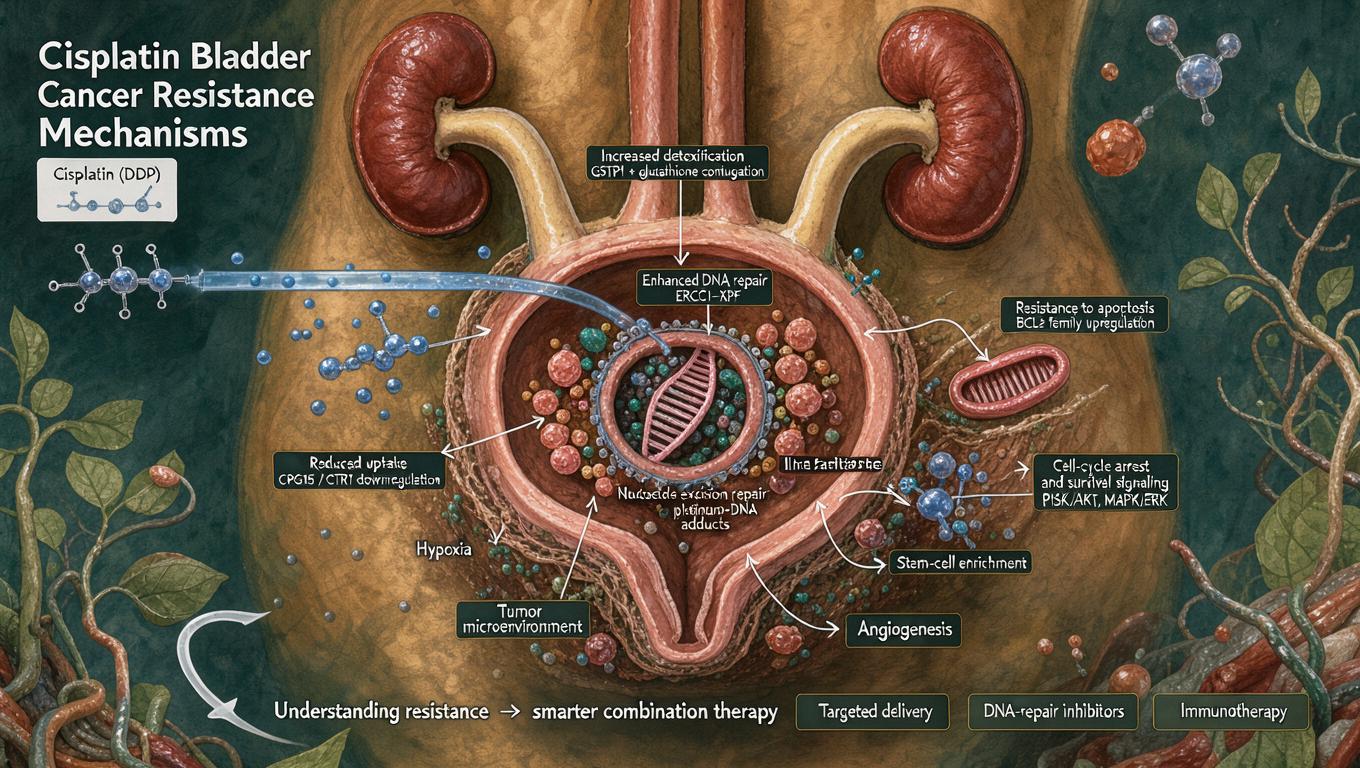
The review organizes cisplatin resistance in urothelial carcinoma into two pillars: reduced intracellular drug availability (Ctr1-mediated uptake; ATP7A/ATP7B and cMOAT/MRP2 efflux; sequestration by glutathione, metallothioneins, and thioredoxin) and defective DNA-damage response (ERCC1-XPF in nucleotide excision repair, XPC downregulation via HDAC4, mismatch repair loss via hMLH1) and apoptosis (Bcl-2 family, p53, Smac/DIABLO, extrinsic TRAIL pathway) . The glutathione and metallothionein evidence is among the stronger clinical links: low/undetectable tumor metallothionein staining predicted complete response to cisplatin-based chemotherapy, and thioredoxin antisense restored sensitivity in resistant RT112/KK47 derivatives .
Critical Limitations
Three caveats stand out. First, translation failure is acknowledged but understated: the authors note in vitro resensitization has "not yet been reliably demonstrated in patients," and the p53 story is the clearest example—early promise contrasts with later null Phase III results. Second, nearly all evidence comes from laboratory-selected resistant cell lines (~12 µM tolerance) rather than clinically acquired resistance—a framing bias common in chemoresistance literature . Third, several claims (ATP7A/ATP7B, MRN complex) explicitly have "no data in UCC"—extrapolated from ovarian or other tumors.
Post-2012 Validation and Expansion
Subsequent work confirms the framework's directions but reveals it was incomplete. Long-term cisplatin-treated UCC lines show increased exporters, metallothioneins, and Survivin , validating the review's thiol/efflux emphasis. But wholly new axes emerged that the review could not anticipate: the lncRNA UCA1 promoting resistance via Wnt6 , HIF1A-AS2 upregulated in 70% of post-cisplatin tissues (P=0.0056) , and microenvironmental resistance—cisplatin-resistant tumors harbor EMT programs interacting with SPP1/PARP14-high macrophages, with EMT score conferring worse overall survival (HR 2.6, 95% CI 1.39–4.87) in cisplatin-treated patients . The immune-niche dimension is a major blindspot: the review treats resistance as a cell-autonomous property. Meanwhile, the review's prediction that "whole genome sequencing will identify targets" proved prescient—ERCC2 mutations now associate with cisplatin sensitivity (P=0.002 in network-based prediction) —though that trial found ERCC2/TMB associations did not survive FDR correction in a clinical bladder-sparing setting .
Verdict
Confidence: moderate. The review is a well-organized, honest synthesis that correctly identifies actionable axes (metallothionein, ERCC1, Bcl-2) but over-relies on lab-selected models and misses stromal/immune and noncoding-RNA contributions. Its prediction-failure pattern (p53) and its prescient call for genomic stratification bracket the field's actual trajectory: mechanism lists alone have not delivered predictive biomarkers with clinical robustness.
Feedback:
Updated: November 26, 2026
BGPT Paper Review
Study Novelty
50%
Synthesizes pre-existing mechanisms (thiol detoxification, NER, Bcl-2/p53) into a two-pillar framework; little primary data, but the bladder-specific integration and biomarker framing were moderately fresh for 2012.
Scientific Quality
70%
Honest limitations disclosure, no conflicts, balanced handling of negative findings (p53 trial failures). Weaknesses: no formal meta-analysis, extrapolation from other tumor types, reliance on lab-selected resistant lines rather than clinical resistance specimens.
Study Generality
70%
Mechanisms (thiol detoxification, ERCC1 repair, apoptosis attenuation) are shared across solid tumors; bladder-specific evidence is patchy, so much content generalizes beyond UCC while the clinical framing is niche.
Study Usefulness
70%
Provided a useful 2012 roadmap for biomarker selection and combination strategies; post-2012 work (lncRNAs, immune niches, ERCC2) has dated the mechanistic catalog but the framework remains citable scaffolding.
Study Reproducibility
50%
As a narrative review with no new data, reproducibility depends on cited studies; many cited claims (e.g., MRP mRNA in 25 patients, 18-patient Ras analysis) rest on small, hard-to-verify single cohorts.
Mining TCGA-BLCA for expression of ERCC1, XPC, GSTP1, BCL2, and metallothioneins against cisplatin-treated survival, quantifying which 2012 review mechanisms carry independent prognostic signal today.
Get emailed when your analysis is done!
We'll email you the results when your analysis is finished.
Hypothesis Graveyard
p53 mutation status as a predictive MVAC biomarker — falsified by failed confirmatory trials and a Phase III study hampered by refusal, despite strong biological plausibility.
Ras mutation as a UCC cisplatin resistance driver — only 1/18 resistant-patient tumors showed Ras mutation, refuting extrapolation from Ras-transformed rodent models.

 Explore by Goal
 Quick Explanation
 Long Explanation
 Top Data Sources
 Ask a Follow-Up
 Key Insight
 Keep Exploring
 Analysis
 Hypothesis Graveyard
 Potential Experiments
 Discussion
