Why BGPT?
logo

The Evidence Layer for Scientific AI

Ask questions across claims linked to experiments, exact results, limitations, and sources.Know what the science actually supports before you trust the answer.

Press Enter ↡ to search evidence


     Quick Explanation


    CRISPR loss (and rescue) of NUDT5 in human B-ALL cells causally links NUDT5 to thiopurine activation: NUDT5 loss markedly reduces thioguanine-derived metabolites (e.g., TIMP, TGTP, DNA-TG) and shifts purine metabolism, producing thiopurine resistance that is reversed by NUDT5 re-expression; clinically, a germline NUDT5 variant (rs55713253) associates with lower mercaptopurine dose intensity and higher NUDT5 expression on the T allele.


     Long Explanation


    Evidence for causality starts from CRISPR/Cas9 loss-of-function and rescue: in human B-ALL cell lines (Nalm6, 697), a NUDIX-targeted CRISPR screen and subsequent NUDT5 knockout identify NUDT5 as a strong thiopurine-response regulator, and re-expression of NUDT5 restores thiopurine sensitivity. Mechanistically, NUDT5 loss depletes thioguanine-derived nucleotide pools (e.g., TIMP and DNA-TG) measured by targeted LC-MS/MS and perturbs purine metabolism consistent with impaired salvage via HPRT activity (with isotope tracing suggesting salvage reduction more than de novo collapse).

    How to implement the experiment (scientifically, evidence-aligned)

    • Perturbation design: create isogenic NUDT5 loss lines in patient-derived leukemia cells (or model cells supporting the mechanistic linkage) and include NUDT5 rescue to distinguish on-target effects from editing artifacts.
    • Causality readouts: under thioguanine/mercaptopurine exposure, quantify thiopurine metabolite pools (TIMP, TGTP, DNA-TG) with targeted LC-MS/MS and couple this to broader targeted metabolomics to map pathway position.
    • Clinical bridge: test whether germline NUDT5 variants correlate with thiopurine pharmacodynamics such as dose intensity and NUDT5 expression (rs55713253 shows both in the reported cohort).

    Quantitative anchor (reported): mercaptopurine dose intensity median by rs55713253 genotype.

    Source values are from the NUDT5 JCI study cohort association (rs55713253).

    What remains uncertain / critical control logic

    • Patient-derived generalization: the mechanistic causality is demonstrated in human B-ALL cell lines; effects may be subtype-dependent in primary leukemia.
    • Mechanism completeness: the reported link involves impaired salvage/HPRT activity, but the exact molecular intermediary path from NUDT5 to HPRT function is not fully resolved.


    Feedback:   

    Updated: July 20, 2026

     Top Data Sources ExportMCP


     Analysis Wizard


    Extract reported NUDT5 phenotype/metabolite quantities and genotype dose-intensity medians, then generate a pathway-style correlation matrix between thiopurine metabolite pools and expected dose-intensity directionality.


     Hypothesis Graveyard


    NUDT5 primarily changes thiopurine resistance through generic global metabolism stress independent of thiopurine-specific activation; this is less favored because reported data show strong depletion of thiopurine-derived metabolite pools and rescue-linked sensitivity reversal.


    NUDT5 effects are driven mainly by off-target genome editing artifacts; this is less favored because rescue of NUDT5 is reported to restore both metabolite pools and drug sensitivity directionality.

     Science Art


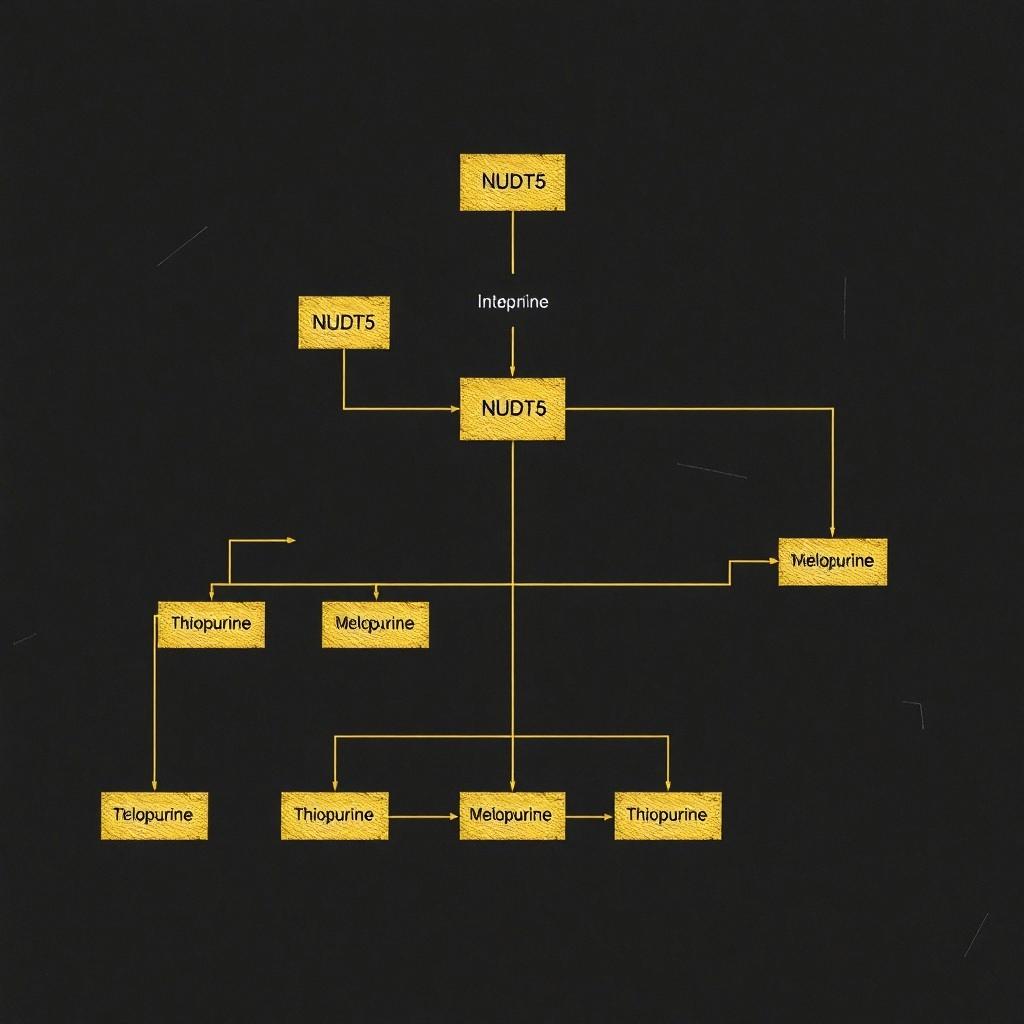
    Design Experiments: CRISPR-based perturbation of NUDT5 in patient-derived leukemia cells with comprehensive metabolomics to map causality in thiopurine response. Science Art

     Science Movie


    Make a narrated HD Science movie for this answer ($32 per minute)


     Discussion


    Stay current without chasing every paper.

    Know what changed, what holds up, and what remains uncertain. Every Friday. No ads.


    My BGPT