Ask questions across claims linked to experiments, exact results, limitations, and sources.Know what the science actually supports before you trust the answer.
Press Enter ↵ to search evidence
Explore by Goal
"The diversity of the phenomena of nature is so great, and the treasures hidden in the heavens so rich, precisely in order that the human mind shall never be lacking in fresh nourishment."
- Johannes Kepler
Quick Answer
Copied
Social media use shows a consistent but small-to-moderate correlational association with worse adolescent mental health: a 2026 systematic review of 50 studies found ~80% reported significant positive associations with depressive symptoms, though causality, anxiety links, and dose-response remain uncertain due to unvalidated self-report measures and reverse-causation pathways . Related evidence suggests effects operate partly through loneliness, sleep disruption, and social context rather than raw screen time.
Long Answer
The Central Evidence
A 2026 systematic review of 50 studies (33 cross-sectional, 17 cohort; adolescents aged 10–19; samples 178–154,981) found that approximately four in five studies reported a statistically significant positive association between higher social media screen time or problematic use and depressive symptoms . The strongest evidence came from cohort studies using within-person techniques (e.g., random-intercept cross-lagged panel models), where increases in an individual's social media use predicted subsequent increases in depressive symptoms after accounting for stable between-person differences.
However, the same review documents important counterevidence: two cross-lagged cohorts found the reverse pathway (depressive symptoms predicting later social media use), and an eight-year cohort found a between-person association but no within-person prospective effect. Anxiety evidence was markedly weaker, with two large trajectory cohorts finding a U-shaped relationship—moderate use associated with lower anxiety than both persistently low and very high use (observed in the ABCD study and a Norwegian registry-linkage cohort) .
Mechanisms and Context
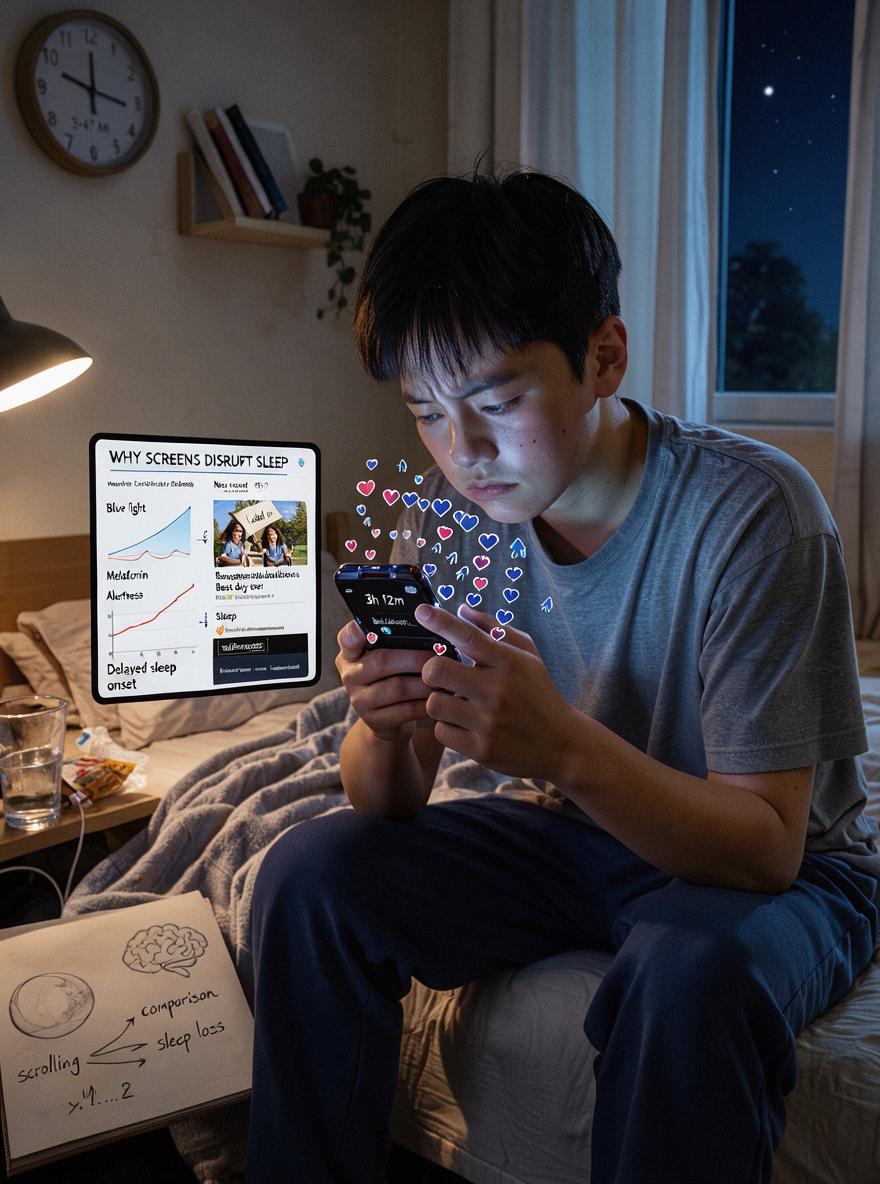
The association is consistently moderated by gender (stronger for female adolescents), sleep disruption (night-time use predicting poorer sleep, which in turn predicts depression and anxiety), cyberbullying, active vs. passive engagement, and family/peer context . A 2022 literature review of nine studies (n=54 to 19,244) similarly links heavier use to depression, anxiety, sleep disruption, and FoMO, with insomnia partially mediating problematic internet use and depression .
Social connection context matters: a large longitudinal Polish study (n=5,099 baseline, 3,275 follow-up) using cross-lagged panel network analysis found emotional loneliness (not social loneliness) was the loneliness dimension most strongly and bidirectionally linked to depressive symptoms, generalized anxiety, social anxiety, and paranoid ideation . Whether online interactions substitute for or displace emotionally meaningful connection remains unresolved in these data.
Confidence and Uncertainty
Confidence: moderate. The association between heavier/problematic social media use and depressive symptoms in adolescents is well-replicated, but key blindspots limit causal claims: (1) exposure was measured with unvalidated single-item self-reports in most studies (unclear in 26/33 cross-sectional and 14/17 cohort studies); (2) 15/17 cohort studies did not establish baseline symptom-free status, so reverse causation cannot be excluded; (3) no pooled effect sizes exist because heterogeneity precluded meta-analysis; (4) evidence is concentrated in high-income Western countries. The relationship is likely reciprocal/transactional rather than unidirectional. What would change this conclusion: high-quality cohorts establishing baseline symptom-free status and using validated exposure measures showing no within-person association would substantially weaken the causal interpretation.
We'll email you the results when your analysis is finished.
Hypothesis Graveyard
Simple linear dose-response ('more screen time = more harm'): contradicted by two large trajectory cohorts finding U-shaped anxiety relationships where moderate use outperforms both extremes.
'Social media is uniformly toxic for teens': contradicted by consistent moderator evidence (gender, use type, family context) and substantial null/reversed-pathway findings across the 50-study review.

 Explore by Goal
 Quick Answer
 Long Answer
 Top Data Sources
 Ask a Follow-Up
 Key Insight
 Keep Exploring
 Hypothesis Graveyard
 Potential Experiments
 Discussion
