Go beyond summaries to locate specific, verifiable claims and sources within research.Know what falsifiable science actually supports before you trust the answer.
Press Enter ↵ to search paper
Explore by Goal
"The most exciting phrase to hear in science, the one that heralds new discoveries, is not 'Eureka!' but 'That's funny...'"
- Isaac Asimov
Quick Explanation
Copied
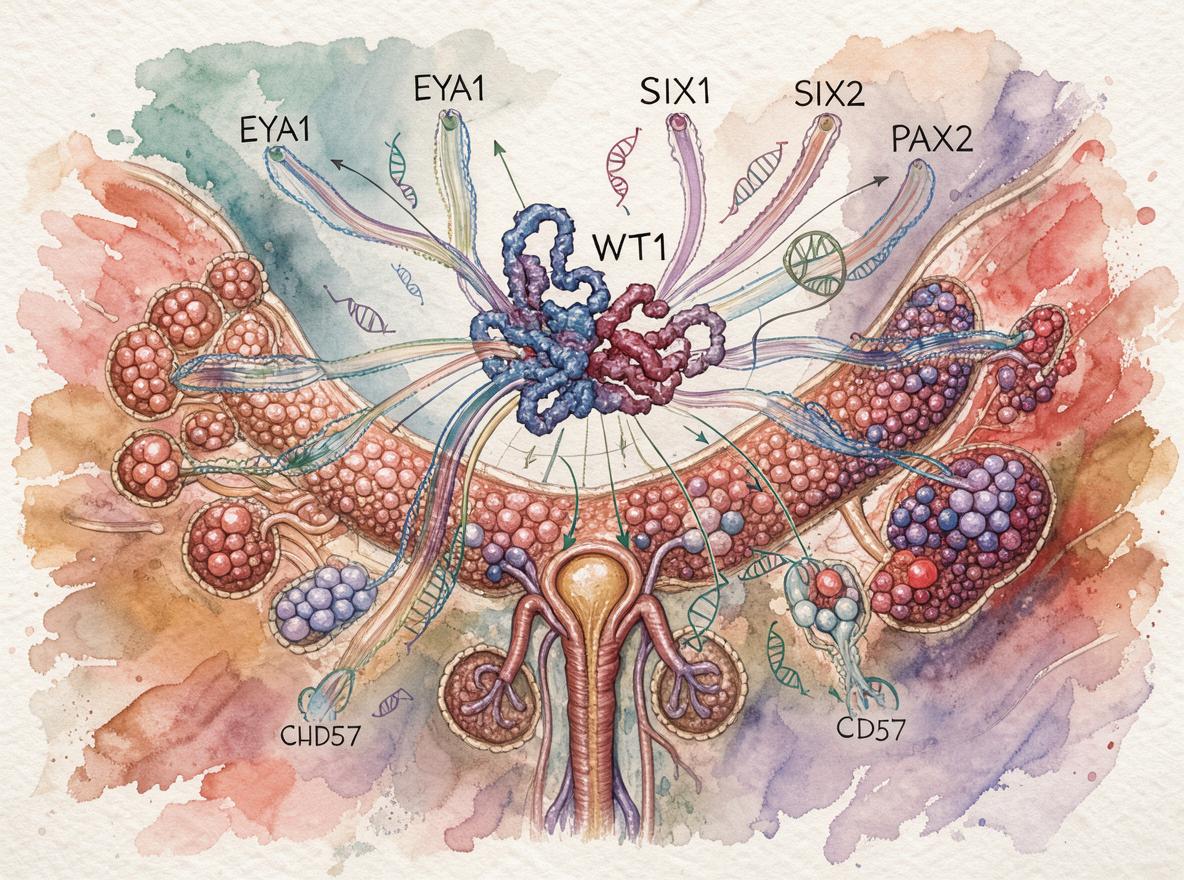
This 2007 microarray study (GSE6700) compared urogenital ridges of Wt1+/+ vs Wt1-/- E11.0 mouse embryos (n=5 pooled per genotype, 4 female/1 male) across three platforms (microarray, qRT-PCR, in situ hybridization), finding ~80% concordance between microarray and qPCR and confirming WT1 predominantly activates rather than represses transcription. The key novelty is identifying Muc16 as the first known WT1-dependent gene in the coelomic epithelium and showing Gata4 is an indirect WT1 target, activated by SF1 (itself a WT1 target) rather than by WT1 directly.
Long Explanation
Evidence Supporting the Central Claim
Of 19,801 murine mRNAs on the CodeLink UniSet Mouse 20k array, 12,043 were expressed in urogenital ridges. Among the 142 genes with >3-fold differential expression, 100 showed higher expression in Wt1+/+ and only 42 in Wt1-/-, supporting WT1 acting predominantly as a transcriptional activator at this developmental stage
Validation by qRT-PCR across 41 genes showed ~80% concordance in directional tendency; for ~20%, the two methods disagreed. Notably, SF1 was a false negative on the microarray despite known Wt1-dependent expression from prior work
Mechanistic Finding: Gata4 is an Indirect WT1 Target
Luciferase reporter assays showed WT1(-KTS), WT1(+KTS), and LHX9 all failed to activate a 5-kb Gata4 promoter construct, while SF1 activated it in a concentration-dependent manner. Additionally, siRNA knockdown of Wt1 in M15 cells reduced Amhr2 (a direct WT1 target) at 48h but did not reduce Gata4 expression, supporting indirect regulation via WT1→SF1→Gata4
Limitations & Blind Spots
Tissue contamination bias: 'WT1 repressed genes' (Zic1, Dbx1, Gdf8, Dmrt2) could not be confirmed by in situ hybridization; authors attributed this to possible contamination with neighboring somites/neural tube in knockout dissections, given the reduced size of Wt1-/- gonads
Pooled embryos confound sex: 4 female + 1 male embryos were pooled per genotype, obscuring sex-specific expression that the authors themselves note as a key downstream feature.
Small n per genotype (n=5) and single timepoint (~E11.0) limit statistical power and developmental scope.
Microarray underestimation: SF1 and Gata4 changes were missed on array but visible by qPCR, suggesting platform sensitivity bias.
Minimal overlap with prior WT1 microarray studies (leukemia, testis, osteosarcoma), consistent with tissue/stage specificity but also highlighting reproducibility uncertainty across contexts
Confidence
Moderate confidence: triple-method validation (array, qPCR, in situ) is rigorous for its era, but sex-mixing in pools, single timepoint, and unverified repressed-gene set temper the central conclusion. The paper pre-dates ChIP-seq and RNA-seq, so the direct vs indirect target distinction remains incomplete by modern standards.
Author Reviews
Feedback:
Updated: November 26, 2026
BGPT Paper Review
Study Novelty
70%
First identification of Muc16 as a WT1-dependent coelomic epithelium gene and first demonstration that Gata4 is an indirect WT1 target via SF1; built on prior Wt1 knockout and Amhr2 work, so incremental rather than groundbreaking.
Scientific Quality
80%
Triple-method validation (microarray, qRT-PCR, in situ) is rigorous for 2007. Key limitations: only 5 pooled embryos per genotype mixing sexes, single timepoint, and failure to confirm any 'WT1 repressed genes' spatially, suggesting possible dissection contamination bias.
Study Generality
60%
Findings are restricted to mouse E11.0 urogenital ridge; prior WT1 target studies in other tissues show minimal overlap, limiting cross-tissue generalization but providing a foundation for broader sex-determination pathway work.
Study Usefulness
70%
Provides a validated target-gene catalog (GSE6700 public data) and clarifies WT1→SF1→Gata4 regulatory hierarchy, useful for understanding sex determination, gonadal dysgenesis, and Denys-Drash/Frasier syndrome phenotypes.
Study Reproducibility
70%
Microarray data deposited in GEO (GSE6700); primer sequences and protocols fully published; luciferase and siRNA methods described with adequate detail for replication in cell lines.
Explanatory Depth
60%
Establishes an indirect regulatory chain (WT1→SF1→Gata4) with promoter reporter and siRNA evidence, but cannot distinguish direct vs indirect for most targets without ChIP; mechanism for coelomic epithelium Muc16 regulation not tested at chromatin level.
Reanalyzing GSE6700 microarray data from this paper to recompute WT1 activated/repressed gene sets, quantify microarray-qPCR concordance across the 41 validated genes, and identify sex-biased WT1 targets.
Get emailed when your analysis is done!
We'll email you the results when your analysis is finished.
Hypothesis Graveyard
WT1 as primarily a transcriptional repressor: rejected by the 100:42 activated:repressed gene ratio and by prior work showing more activated than repressed targets.
Direct WT1 binding to Gata4 promoter: falsified by promoter reporter assays showing no activation by either WT1 isoform and by siRNA kinetics showing delayed Gata4 loss.

 Explore by Goal
 Quick Explanation
 Long Explanation
 Top Data Sources
 Ask a Follow-Up
 Key Insight
 Keep Exploring
 Analysis
 Hypothesis Graveyard
 Potential Experiments
 Discussion
