Check a paper's claims against linked experiments, exact results, stated scope, and limitations.Know what falsifiable science actually supports before you trust the answer.
Press Enter ↵ to search evidence
Explore by Goal
"The important thing in science is not so much to obtain new facts as to discover new ways of thinking about them."
- William Lawrence Bragg
Long Explanation
Copied
What the Paper Reports
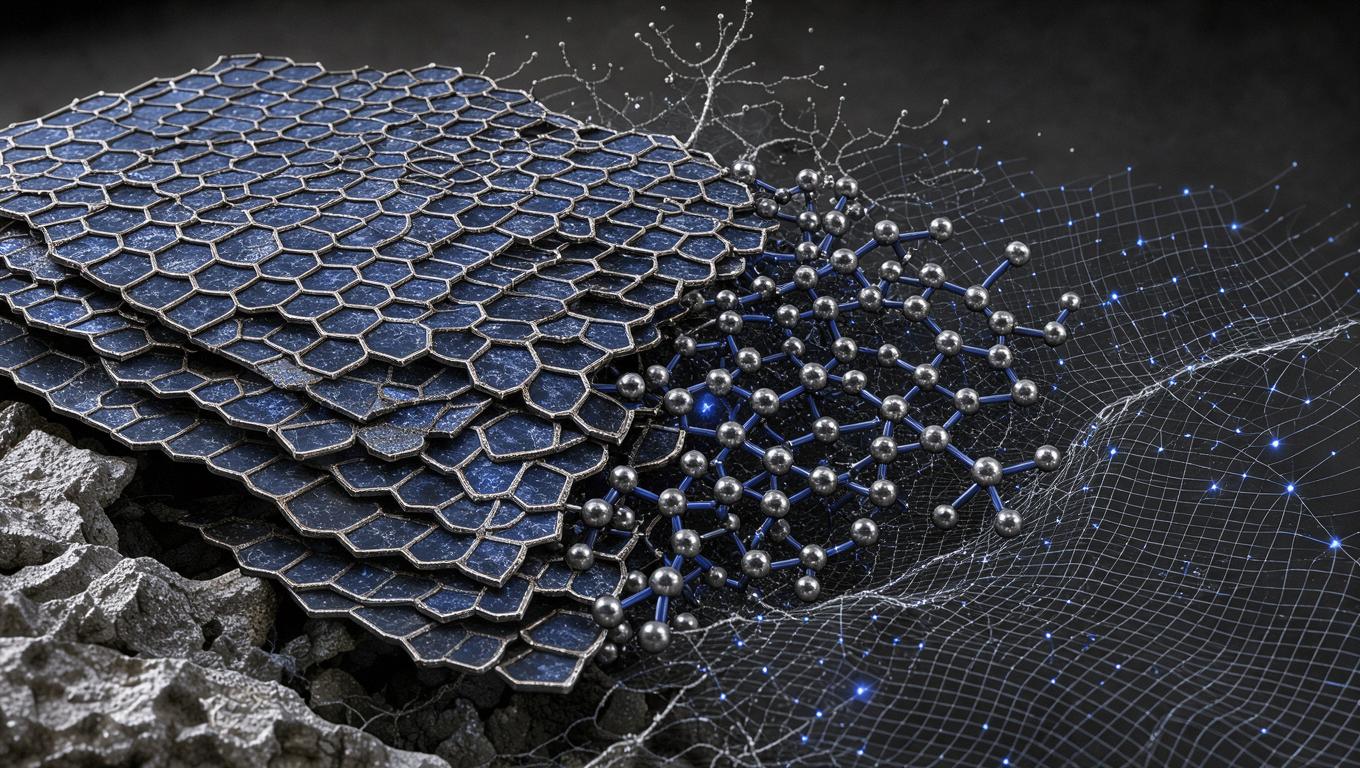
This is a narrative review (Materials, 16 July 2025) synthesizing multiscale simulation methods for wear-resistant nanocoatings: DFT, molecular dynamics with EAM potentials, Monte Carlo, finite element methods, and coupling schemes (quasicontinuum, CADD, bridging domain). The authors report ~30% wear-resistance improvements from ML-accelerated case studies and propose a closed-loop simulation–experiment design protocol . No new data were created; the data availability statement explicitly states no datasets were generated .
Critical Appraisal
Strengths: Comprehensive method coverage with honest self-critique — the review explicitly flags ghost forces in QC, wave reflections in BDM, overfitting risk in ML surrogates, and the loss of physical interpretability in black-box models .
Blindspots: (1) The headline ~30% wear-resistance claim appears in the abstract without a named study, system, or uncertainty; provenance is unverifiable from the text. (2) All cited case studies are drawn from prior publications — the review adds no new validation of its own framework. (3) Reproducibility is weak (5/10): no software versions, parameter sets, or workflows are specified. (4) Potential funder bias: the work is self-funded by Inner Mongolia Power (Group) Co., Ltd., whose electric-power equipment is a direct application domain, though the conflict-of-interest statement declares contributions were independent of the employer . (5) What would falsify the central framework claim — that cross-scale coupling predicts real wear rates — is never tested: no quantitative agreement between simulation and experiment is demonstrated for any coating system in this review itself.
Verdict: A competent, well-organized pedagogical review (novelty 7, quality 9, generality 8, usefulness 8) but with limited primary evidentiary weight; its claims should be treated as a research roadmap, not validated results.
Author Reviews
Feedback:
Updated: November 21, 2026
BGPT Paper Review
Study Novelty
70%
A competent synthesis but largely re-treads established multiscale methods (QC, CADD, BDM, RVE homogenization) and ML surrogates already reviewed elsewhere; the proposed closed-loop protocol is incremental rather than paradigm-shifting.
Scientific Quality
90%
Well-structured, technically literate review with honest self-critique of each method's artifacts and ML limitations. Deductions: the ~30% wear-resistance claim lacks traceable provenance, no new data or validation is generated, and the review relies entirely on secondhand case studies.
Study Generality
80%
Methods span electronic to continuum scales and apply broadly to metallic nanocoatings in tribology, aerospace, and energy; specific enough on methodology to be useful beyond the wear-coatings niche.
Study Usefulness
80%
Serves as a practical entry point for researchers choosing simulation methods and coupling strategies, with an actionable (though unvalidated) closed-loop design protocol proposal.
Study Reproducibility
50%
As a review with no new data, no software versions, parameter sets, or workflows are reported; the framework claims cannot be independently reproduced from the paper alone.
Explanatory Depth
80%
Mechanistic explanations of ghost forces, dislocation transfer in CADD, Cauchy-Born homogenization, and ML physics-informed constraints are given with equations and quantitative errors (e.g., <10% hardness prediction error in Chen et al.).
We'll email you the results when your analysis is finished.
Hypothesis Graveyard
Single-scale simulation (pure MD or pure FEM) sufficiency hypothesis — falsified by the review's documented artifacts: ghost forces in QC, wave reflections in BDM, and FEM's inability to capture dislocation nucleation mean no single scale reproduces observed wear mechanisms.
Purely empirical coating-optimization hypothesis — increasingly obsolete as ML surrogates reduce design iteration cost by orders of magnitude, though it retains value where simulation data is scarce.

 Explore by Goal
 Long Explanation

 Top Data Sources
 Ask a Follow-Up
 Key Insight
 Keep Exploring
 Hypothesis Graveyard
 Potential Experiments
 Discussion
