Check whether claims match experiments, exact reported results, and stated limitations.Know what the science actually supports before you trust the answer.
Press Enter ↵ to review paper
Explore by Goal
"Science is the great antidote to the poison of enthusiasm and superstition."
- Adam Smith
Quick Explanation
Copied
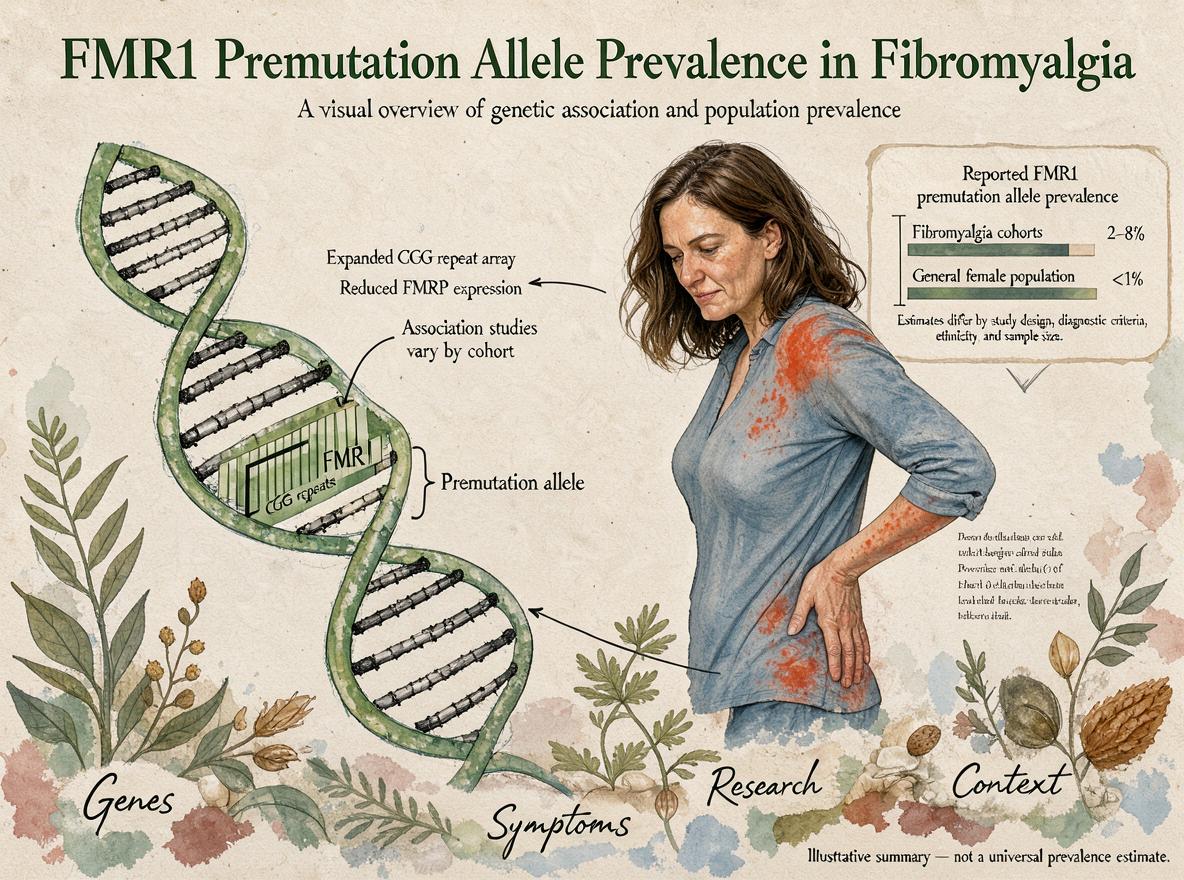
This 2012 Gene paper screened 700 unrelated women with fibromyalgia for FMR1 CGG premutation alleles and found 3 carriers (0.4%), statistically indistinguishable from the general female carrier rate of 1/250–1/400 (P = 0.539 and 0.716), concluding that routine FMR1 screening in fibromyalgia is not justified . This null finding stands despite an earlier report that fibromyalgia was markedly over-represented (43.8%) among female premutation carriers with FXTAS .
Long Explanation
Evidence and Design
The study genotyped 700 unrelated women with fibromyalgia for FMR1 CGG repeat expansions and identified 3 premutation carriers (0.4%), rates consistent with the general female population (1/250–1/400; P = 0.539 and P = 0.716). All 3 carriers showed prominent neurological features — muscular symptoms, neurocognitive alterations, and neurovegetative impairment — but were otherwise clinically indistinguishable from typical fibromyalgia patients. The authors conclude that FMR1 screening should not be incorporated into routine rheumatologic workup, while suggesting stratification of fibromyalgia presentations by carrier status .
This null result directly contextualizes the earlier observation that fibromyalgia was reported in 43.8% of female premutation carriers with FXTAS versus 8.3% of non-FXTAS carriers and 9.4% of controls (P = 0.0097) — an association likely inflated by self-referral of symptomatic women to fragile X clinics. The 2012 screening therefore tests the reverse direction (carrier frequency among unselected fibromyalgia patients) and finds no enrichment.
Critical caveats: the fibromyalgia cohort lacked an age- and ethnicity-matched control cohort genotyped in parallel; P-values are computed against literature-based population rates rather than an internal control. Three carriers is too few to characterize phenotype differences, and the reported neurological symptoms in carriers could reflect ascertainment (detailed neurologic exam applied only to carriers). The population-rate estimates themselves carry uncertainty, though the observed 0.4% sits comfortably within the plausible 0.25–0.40% range, so the null conclusion is reasonable. Confidence: moderate — well-powered for a modest enrichment (would have detected ~3-fold excess), but phenotype subtyping is underpowered.
Feedback:
Updated: October 27, 2026
BGPT Paper Review
Study Novelty
40%
Directly tests a hypothesis already raised by the 2008 expanded-phenotype study; the reverse-direction screening is a modest but timely extension, not a conceptual breakthrough.
Scientific Quality
60%
Adequate sample size (n=700) and straightforward molecular methods, but no internal control cohort, only 3 carriers, and phenotype comparisons are anecdotal; P-values rely on external population estimates.
Study Generality
40%
Findings are specific to fibromyalgia and the FMR1 locus; the negative screening result has limited broader mechanistic value.
Study Usefulness
50%
Practically useful for clinicians: discourages routine FMR1 testing in fibromyalgia while flagging neurological symptoms as a possible stratum for selective testing.
Study Reproducibility
70%
PCR-based CGG repeat genotyping is standard and reproducible; recruitment criteria and cohort sourcing are described at a level permitting replication.
Explanatory Depth
30%
Purely associative screening with no mechanistic investigation of why carriers, if any, might present differently; the neurological-phenotype observation is descriptive.
We'll email you the results when your analysis is finished.
Hypothesis Graveyard
Fibromyalgia is strongly over-represented in FMR1 premutation carriers, implying carrier enrichment in fibromyalgia patients — weakened by the 2012 screening finding of carrier frequency (0.4%) indistinguishable from population rates; the 2008 association is better explained by self-referral ascertainment bias of symptomatic carriers.

 Explore by Goal
 Quick Explanation
 Long Explanation
 Top Data Sources
 Ask a Follow-Up
 Key Insight
 Keep Exploring
 Hypothesis Graveyard
 Potential Experiments
 Discussion
