Check a paper's claims against linked experiments, exact results, stated scope, and limitations.Know what falsifiable science actually supports before you trust the answer.
Press Enter ↵ to search evidence
Explore by Goal
"The cosmos is within us. We are made of star-stuff. We are a way for the universe to know itself."
- Carl Sagan
Quick Explanation
Copied
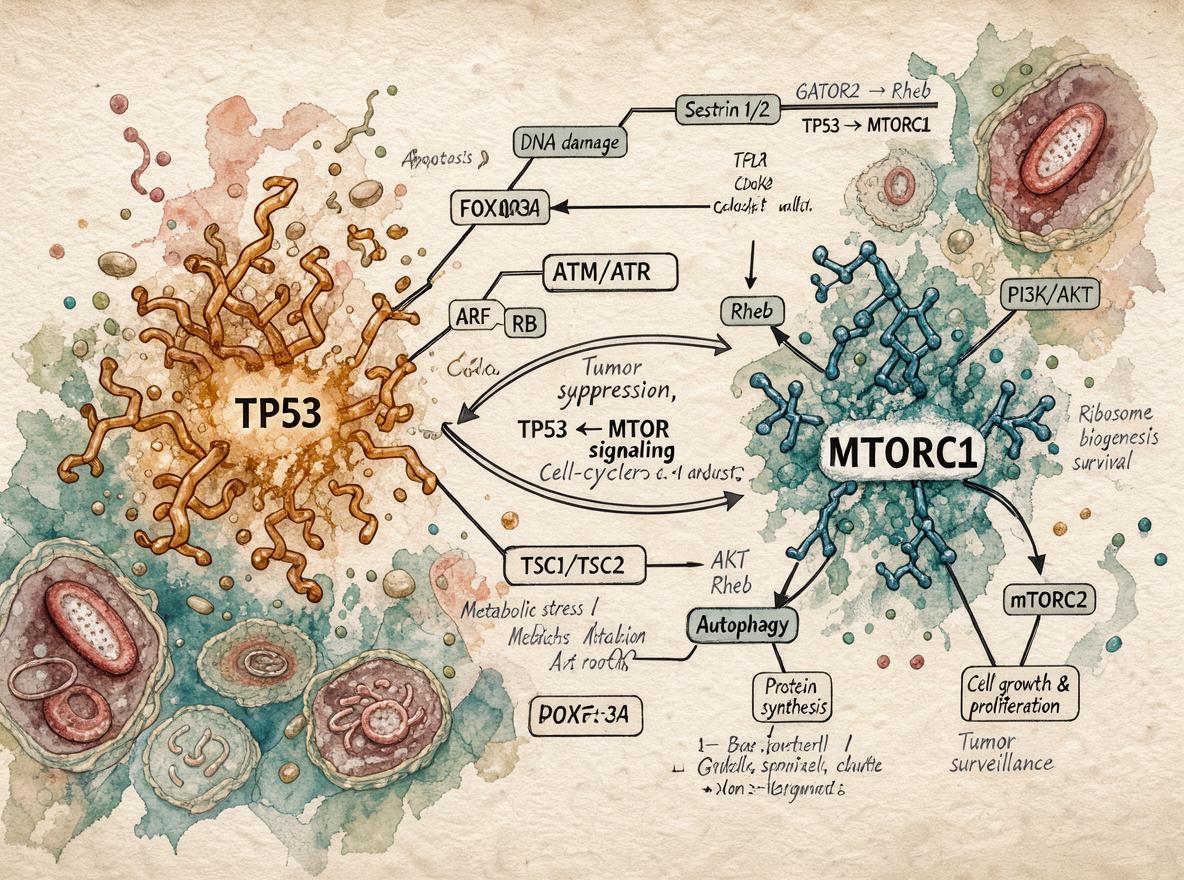
This 2010 Aging editorial by Galluzzi, Kepp and Kroemer synthesizes evidence that TP53 activity level and MTOR signaling status jointly determine whether CDKN1A-driven cell cycle arrest becomes irreversible senescence, reversible quiescence, or cell death . It is a concise, well-reasoned commentary, not primary data, and its central mechanistic claim (an unidentified TP53 target that suppresses MTOR) remains explicitly speculative.
Long Explanation
What the paper reports
This is a short editorial (received 09/16/10, accepted and published 09/18/10) discussing two primary studies: Demidenko et al. showed that transactivation-proficient TP53 converts CDKN1A-induced irreversible senescence into reversible quiescence via MTOR inhibition, mirroring rapamycin's senescence-suppressing, anti-aging effects . Leontieva et al. then showed, in WI-38 human lung fibroblasts, that low-dose doxorubicin (modest TP53/CDKN1A induction, MTOR active) drives irreversible senescence, whereas high-dose doxorubicin or nutlin-3a (TP53 superinduction plus MTOR inhibition) drives reversible quiescence despite normal CDKN1A; combined high doxorubicin plus nutlin-3a causes TP53 hyperaccumulation, complete MTOR suppression, poor CDKN1A transactivation, and cell death .
Interpretive model and its speculative core
The authors propose a promoter-affinity model: CDKN1A, with high TP53 affinity, is induced at both low and high TP53 levels, while an unidentified senescence-suppressing, MTOR-inhibiting TP53 target (sestrin 2 is flagged as a candidate but not confirmed) requires higher TP53 concentrations. This explains the observed switch but is explicitly presented as hypothesis, not demonstrated mechanism .
Critical assessment
Strengths: Timely synthesis; correctly reframes the field by decoupling cell-cycle arrest from senescence; identifies a clear falsifiable unknown (the MTOR-suppressing TP53 target). Weaknesses: (i) It is commentary only — no new data, no quantitative re-analysis; (ii) the model rests on one immortalized fibroblast line (WI-38) and pharmacologic perturbations (doxorubicin, nutlin-3a), so generalization to other cell types, oncogene-driven senescence, or in vivo aging is untested; (iii) the promoter-affinity explanation is one of several possible dose-threshold mechanisms (e.g., kinetics, feedback loops) and the authors do not weigh alternatives; (iv) the editorial context (Impact Aging, self-citing adjacent work by the same group) warrants awareness of potential citation/framing bias. Confidence in the reported experimental outcomes is moderate (secondary summary); confidence in the mechanistic model is low by the authors' own admission.
What would change the conclusion
Identification of the elusive TP53 target and demonstration that it alone reproduces MTOR inhibition and senescence suppression would confirm the model; conversely, showing that MTOR status is irrelevant to the senescence/quiescence switch in TP53-proficient cells would refute it. Follow-up literature (e.g., later sestrin and gaddipustin work) partially supports MTOR-linked senescence suppression, but the editorial itself supplies no such evidence.
Feedback:
Updated: November 24, 2026
BGPT Paper Review
Study Novelty
70%
For 2010, reframing TP53's role from senescence inducer to conditional senescence suppressor via MTOR was a genuinely counterintuitive conceptual advance, though it builds directly on two primary papers it comments on.
Scientific Quality
60%
A well-written expert editorial, but not peer-reviewed primary data; the central mechanism is acknowledged as speculative, and evidence is drawn from a single cell line and pharmacologic perturbations.
Study Generality
70%
TP53-MTOR crosstalk is a broadly conserved axis relevant to cancer, aging, and therapy response, but the editorial's evidence base is narrow (WI-38 fibroblasts).
Study Usefulness
60%
Useful for framing testable hypotheses and for researchers linking p53 pharmacology (nutlin-3a) to senescence/rapamycin biology; limited direct practical utility.
Study Reproducibility
30%
As an editorial it contains no methods or data; reproducibility applies only to the underlying primary studies it summarizes, which are not detailed here.
Explanatory Depth
50%
Proposes a coherent promoter-affinity threshold model, but leaves the key MTOR-suppressing TP53 target unidentified and does not evaluate alternative mechanisms.
Building a dose-response analysis of doxorubicin/nutlin-3a conditions versus MTOR activity and cell fate in WI-38 fibroblasts, using data from the summarized Leontieva experiments to visualize the senescence-quiescence decision boundary.
Get emailed when your analysis is done!
We'll email you the results when your analysis is finished.
Hypothesis Graveyard
CDKN1A level alone determines senescence vs quiescence — falsified by Leontieva et al., since CDKN1A transactivation is similar at low and high doses while outcomes differ.
TP53 always suppresses senescence — falsified by Demidenko et al., because only transactivation-proficient, unmodified TP53 suppresses senescence; transactivation-deficient TP53 does not.

 Explore by Goal
 Quick Explanation
 Long Explanation
 Top Data Sources
 Ask a Follow-Up
 Key Insight
 Keep Exploring
 Analysis
 Hypothesis Graveyard
 Potential Experiments
 Discussion
