Check whether claims match experiments, exact reported results, and stated limitations.Know what the science actually supports before you trust the answer.
Press Enter ↵ to review paper
Explore by Goal
"We cannot solve our problems with the same thinking we used when we created them."
- Albert Einstein
Quick Explanation
Copied
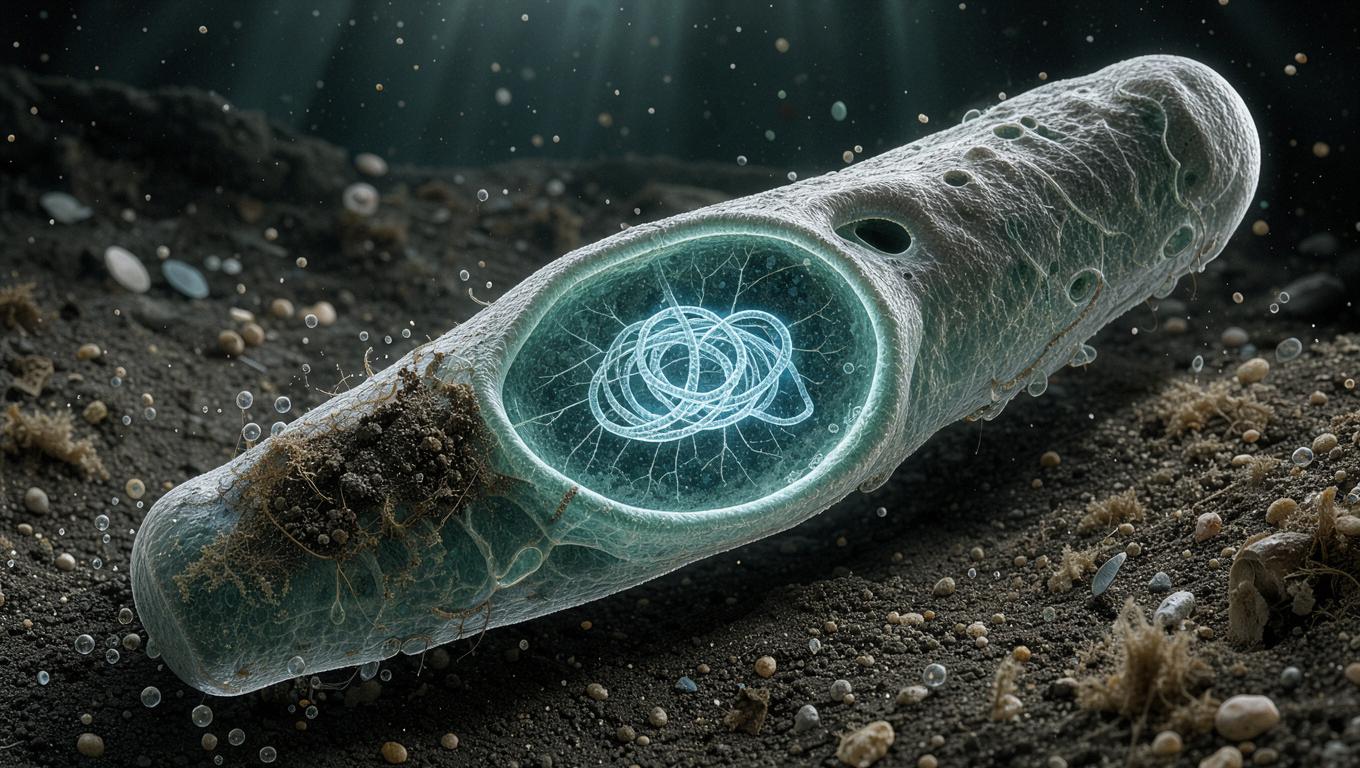
This CARD-FISH study provides the first microscopy of Hodarchaeales-affiliated cells—Asgard archaea proposed as the closest prokaryotic relatives of eukaryotes—revealing unusually large (~3.0 ± 0.9 µm long, up to 5.2 µm) cells with a rounded pole expansion and confined central DNA, a phenotype distinct from typical benthic prokaryotes . However, n = 40 cells from one site, no cultivation, and no ultrastructural (EM/cryo-ET) confirmation leave the "eukaryote-like compartmentalization" interpretation speculative.
Long Explanation
What the study actually showed
Using two newly designed probes (HOD193, HOD286) targeting Hodarchaeales 16S rRNA OTUs (0.1% relative abundance) from Aarhus Bay sediments, the authors visualized cells by dual-probe CARD-FISH with super-resolution confocal microscopy. Cells were elongated with a rounded polar expansion, averaging 3,028 ± 864 nm long (range 1,506–5,209 nm), with pole and body widths of 1,094 ± 194 nm and 843 ± 171 nm (n = 40 across four experiments). DAPI signal was confined to the expansion center, spatially separated from ribosome-derived FISH signal without a conspicuous gap. Specificity was controlled with nonsense probes and EUK1195, and no non-target matches existed in SILVA v132 .
Why the size matters—and why it does not settle eukaryogenesis
The cells are conspicuous by archaeal standards: the closest reported Asgard visualizations (Loki- and Heimdallarchaeota in the same bay) were ~1.3–1.4 µm coccoid cells . Genes encoding MreB and ARP2/3 homologs in some Hodarchaeales genomes offer a plausible mechanistic link to the shape, and the authors explicitly frame phagocytosis as conceivable—not demonstrated. Critically, the deeper phylogenetic context is contested: a 2025 expanded-genome study found the Hodarchaeales-sister-to-eukaryotes topology not supported after data refinement, placing eukaryotes outside Heimdallarchaeia instead . MAG-based Asgard phylogenies also carry documented chimerism risk . The paper's own key MAG (CSMAG_1182) is low quality (54% completeness), so the exact identity of the imaged cells within Hodarchaeales remains unresolved—acknowledged by the authors.
What would change this conclusion: cultivation of Hodarchaeales, cryo-ET or electron microscopy confirming membrane-bounded compartmentalization (the DAPI–FISH separation lacks a visible gap and membrane staining failed in the earlier Aarhus Bay study ), and probe validation against additional, better-resolved Hodarchaeales genomes.
Feedback:
Updated: October 27, 2026
BGPT Paper Review
Study Novelty
80%
First-ever microscopic visualization of Hodarchaeales cells, the proposed closest archaeal relatives of eukaryotes; no prior morphological data existed for this order.
Scientific Quality
80%
Rigorous dual-probe CARD-FISH with strong specificity controls (nonsense probes, EUK1195), but small n (40 cells, one site), no cultivation, no ultrastructural confirmation, and dependence on a low-quality reference MAG (54% completeness) limit interpretive strength.
Study Generality
60%
Focused on one sediment site and one Asgard order; generalization to Asgard-wide eukaryogenesis models is indirect and depends on contested phylogenetic placement.
Study Usefulness
80%
Provides the first phenotype anchors for the closest archaeal relatives of eukaryotes, directly informing eukaryogenesis models and motivating cultivation/EM follow-up.
Study Reproducibility
70%
Probes, sequences (GenBank PP903622/PP903623), and methods are published; but rarity of target cells (0.1%) and lack of culture make independent replication nontrivial.
Explanatory Depth
70%
Links morphology to genomic potential (MreB, ARP2/3) and DNA organization, but stops short of mechanistic demonstration; compartmentalization remains inferred from FISH/DAPI signal geometry.
We'll email you the results when your analysis is finished.
Hypothesis Graveyard
Hodarchaeales are definitively the eukaryote sister lineage: undermined by the 2025 expanded-genome study that no longer supports the Hodarchaeales-sister topology after controlling for Njordarchaeales chimerism.
Large Asgard cells imply true intracellular compartments: no membrane was visualized, and DAPI–FISH signals lacked a conspicuous gap; only electron tomography could establish this.

 Explore by Goal
 Quick Explanation
 Long Explanation
 Top Data Sources
 Ask a Follow-Up
 Key Insight
 Keep Exploring
 Hypothesis Graveyard
 Potential Experiments
 Discussion
