Check whether claims match experiments, exact reported results, and stated limitations.Know what the science actually supports before you trust the answer.
Press Enter ↵ to review paper
Explore by Goal
"I would rather have questions that can't be answered than answers that can't be questioned."
- Richard Feynman
Quick Explanation
Copied
This 2014 Nature Reviews Clinical Oncology review by Ning, Wong, Ferraldeschi, Attard and De Bono is an authoritative, well-sourced synthesis of AR-targeting evolution from Huggins' 1941 castration work through abiraterone and enzalutamide, accurately citing pivotal phase III survival benefits (e.g., abiraterone COU-AA-301 OS 15.8 vs 11.2 months, HR 0.74), while candidly flagging resistance, cross-resistance and biomarker gaps . Its main blindspots are sponsor-linked authorship and reliance on positive-trial narratives.
Long Explanation
Scientific Content and Accuracy
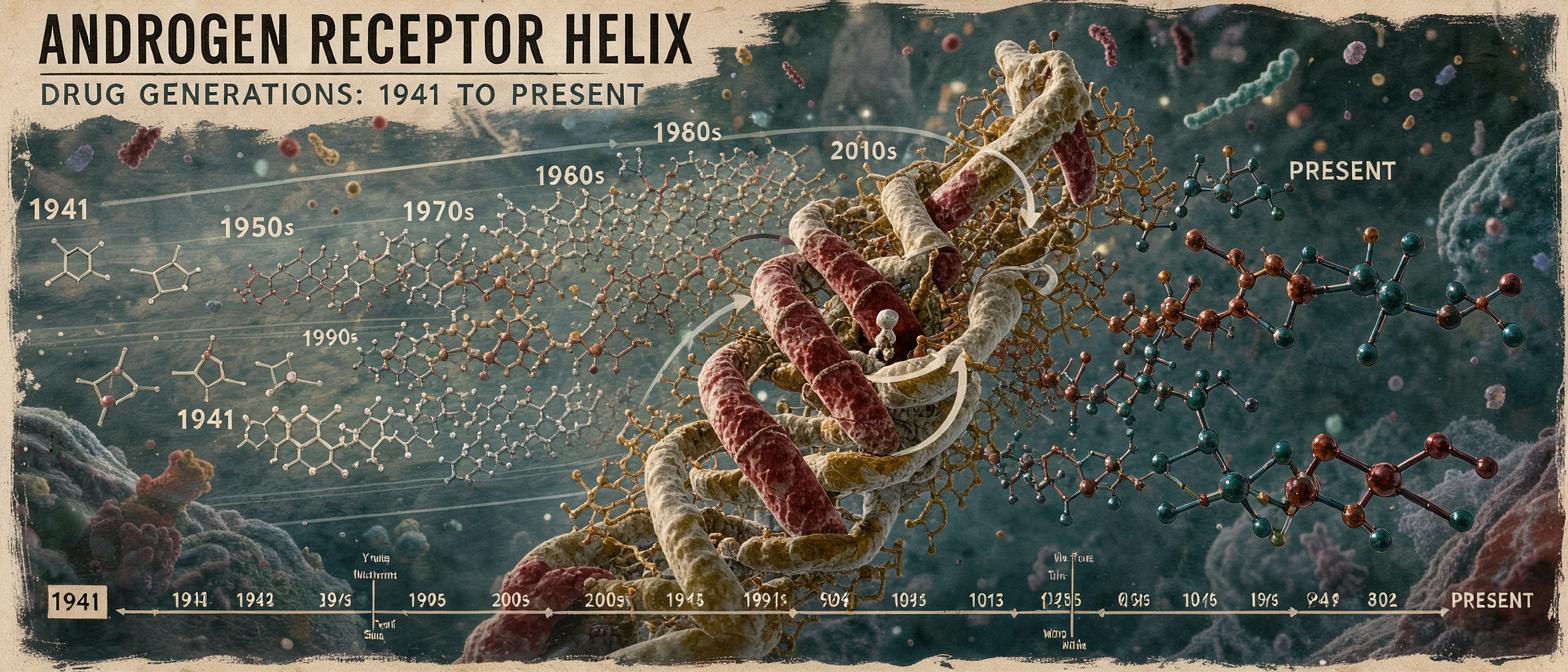
The review traces AR-targeted therapy chronologically: Huggins' 1941 castration principle (Nobel 1966), Schally's LHRH analogues (Nobel 1977), first-generation antiandrogens (flutamide 1989), and next-generation agents. Its quantitative core is faithful to primary sources: abiraterone post-docetaxel OS 15.8 vs 11.2 months (HR 0.74, 95% CI 0.64–0.86), pre-chemotherapy rPFS 16.5 vs 8.3 months (HR 0.53), and enzalutamide post-docetaxel OS 18.4 vs 13.6 months (HR 0.63) .
The mechanistic sections — intratumoral androgen persistence, AR amplification/overexpression (~one-third of CRPC), LBD mutations converting first-generation antiandrogens into agonists in up to 30% of resistant patients, and constitutively active AR splice variants bypassing LBD inhibitors — align with subsequent literature on AR alterations driving CRPC resistance .
Critical Appraisal
Strengths: historically complete (173 references), mechanistically grounded, honest about open questions — notably that continued AR-axis dependence after abiraterone/enzalutamide was still unproven, and that no molecular subtype then predicted response. The glucocorticoid-receptor bypass via prednisone co-administration is a subtle, forward-looking insight later validated experimentally .
Weaknesses/blindspots: (1) Corresponding author De Bono disclosed commercial interest in abiraterone acetate, a structural conflict for a review championing CYP17 inhibition ; (2) reliance on press-release data for PREVAIL rather than peer-reviewed results; (3) inclusion of multiple ASCO abstracts of agents later abandoned (ASP9521: 0% PSA response; orteronel: failed OS endpoint) without overt negative-result framing — the review does report these failures, mitigating omission bias; (4) narrative reviews inherently risk citation bias toward positive trials ; (5) speculative claim that AR splice variants explain taxane cross-resistance is explicitly labeled as authors' belief, not evidence.
Verification and Falsifiability
What would change the conclusions: randomized evidence that AR-axis intensification fails in CRPC (contradicted by COU-AA-301/AFFIRM), demonstration that AR-independent mechanisms dominate post-ARSI progression (partially supported by later work showing AR-independent transformation under intensive AR blockade ), or validation of predictive biomarkers the review said were lacking. Confidence: high on factual trial data (strong evidence); moderate on forward-looking predictions.
Feedback:
Updated: October 27, 2026
BGPT Paper Review
Study Novelty
70%
Synthesizes then-recent paradigm-shifting approvals (abiraterone 2011/2013, enzalutamide 2012) and early recognition of splice variants, GR bypass, and NTD-targeting; not a primary discovery, but a timely, forward-looking consolidation at the field's inflection point.
Scientific Quality
80%
Comprehensive (173 refs), mechanistically accurate, and unusually candid about unproven hypotheses and failed agents (orteronel, ASP9521, AZD3514 tolerability). Deductions for undisclosed-magnitude industry funding tied to abiraterone, use of press releases (PREVAIL), and non-systematic narrative methodology.
Study Generality
70%
Focused on prostate cancer/AR axis, but the resistance-evolution framework (targeted-therapy pressure selecting bypass mechanisms) generalizes across oncology.
Study Usefulness
90%
Directly informed clinical sequencing questions, biomarker development priorities, and drug-development direction (NTD inhibitors, AR degraders); its predictions were largely borne out.
Study Reproducibility
50%
As a narrative review, reproducibility is inherently limited; search criteria are stated (PubMed 2000–March 2014, ASCO abstracts 2010–2013) but no systematic PRISMA methodology, quality scoring, or data tables beyond summarized trials.
Explanatory Depth
70%
Deep mechanistic treatment of AR biology (HSP dissociation, DBD/LBD/NTD domains, backdoor androgen synthesis, PI3K/AR reciprocal feedback), though some causal claims (taxane cross-resistance via splice variants) remain speculative.
We'll email you the results when your analysis is finished.
Hypothesis Graveyard
'CRPC is androgen-independent' — the dominant 1990s framing; falsified by tissue androgen measurements showing intratumoral T/DHT near non-castrate levels and by abiraterone/enzalutamide survival benefits.
'First-generation antiandrogen failure means AR blockade is exhausted' — falsified by demonstration that AR amplification/promiscuous LBD mutations, not target irrelevance, drove bicalutamide/flutamide resistance.

 Explore by Goal
 Quick Explanation
 Long Explanation
 Top Data Sources
 Ask a Follow-Up
 Key Insight
 Keep Exploring
 Hypothesis Graveyard
 Potential Experiments
 Discussion
