Check a paper's claims against linked experiments, exact results, stated scope, and limitations.Know what falsifiable science actually supports before you trust the answer.
Press Enter ↵ to search evidence
Explore by Goal
"The most important scientific revolutions all include, as their only common feature, the dethronement of human arrogance from one pedestal after another of previous convictions about our centrality in the cosmos."
- Stephen Jay Gould
Quick Explanation
Copied
This industry-funded (MSD), WFPHA-authored policy review of WHO WUENIC data for 27 EU states (2010–2021) documents widespread declines in paediatric vaccine coverage, including DTP3 coverage below the 95% threshold in 13 of 27 countries by 2019 and a steep Romanian measles-2 drop from 93% to 76% — useful as a descriptive synthesis, but weakened by MSD funding, author affiliations in communications consulting, duplicated text passages, and non-systematic methods.
Long Explanation
What the paper reports
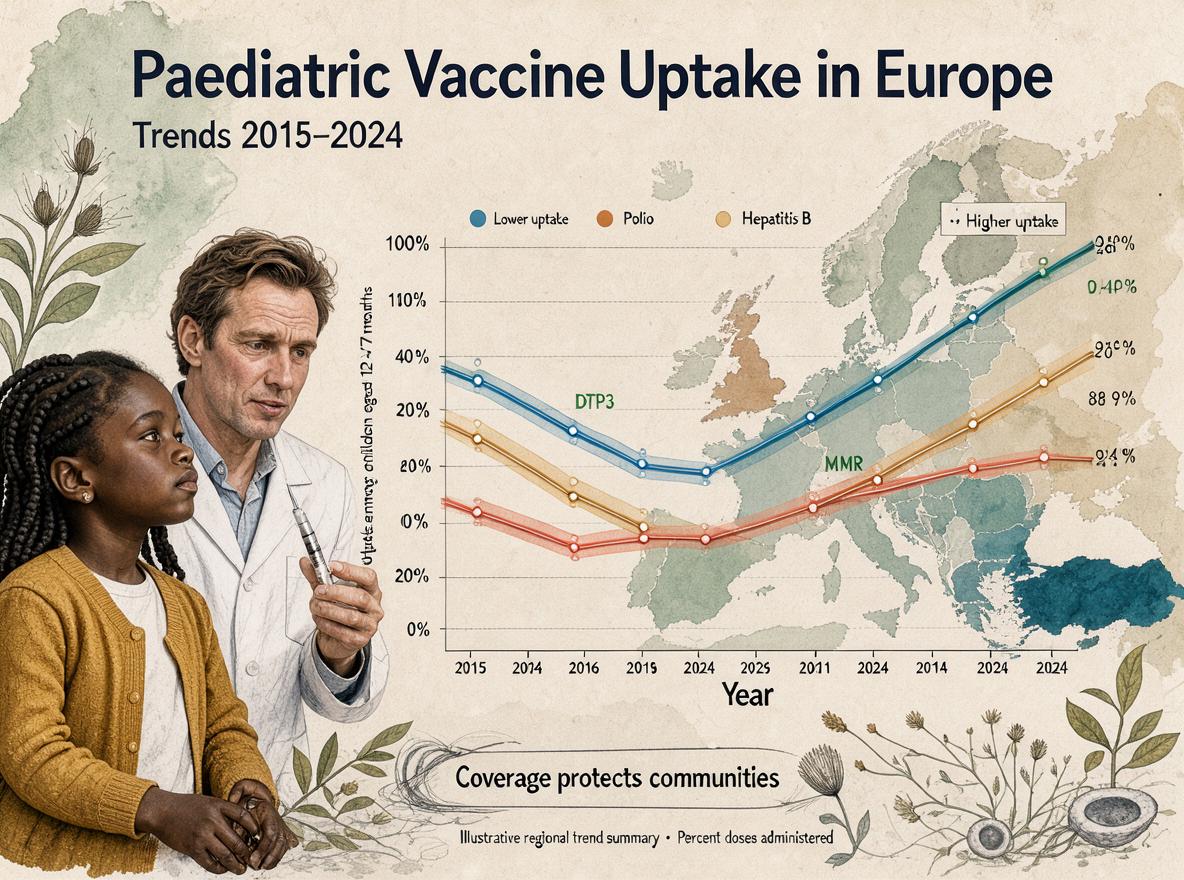
The review analysed WHO/UNICEF WUENIC vaccination coverage for all 27 EU Member States (2010–2021) across seven indicators (DTP1, DTP3, Hib3, HepB3, measles dose 1 and 2, polio3), contextualised with a non-systematic literature review of Austria, Bulgaria, Germany, Italy, and Romania . Key quantitative findings: 13 of 27 countries fell below the 95% DTP3 target in 2019 vs 10 in 2010; Estonia DTP1 declined 96%→92%; Romania HepB3 fell 98%→87%; Romania measles-2nd-dose dropped 93%→76%; by 2021 only 12 countries met the 95% polio target, five fewer than in 2010 .
Note: the bar pairing compares 2010 baseline values against later-year troughs reported in the text; the paper's own Figures 1–7 contain the full country–year series.
Critical assessment
Conflicts and framing. The study was funded by an unrestricted MSD (Merck/MSD vaccine manufacturer) grant, and the first author is employed by Brunswick Group, a communications consultancy . While the declared separation of funder influence is standard, an unrestricted pharma grant to a communications-affiliated advocacy output warrants skepticism toward framing of "recovery" narratives and policy recommendations derived from the WFPHA Taskforce's own policy statement .
Methodological limitations. The literature analysis is a targeted (non-systematic) review with no PRISMA protocol, no formal bias assessment, and no statistical testing — claimed associations between policies (mandates, digital reminders, hexavalent vaccines, access changes) and coverage changes are observational, single-country anecdotes vulnerable to confounding and post hoc reasoning. Text duplication in the supplied manuscript (repeated Results and Hib3 sections) suggests editorial sloppiness. Data gaps (Slovenia HepB3 2020; Finland/Luxembourg/Cyprus measles-2 missing years) and mixed data sources (WUENIC vs national registries with different denominators, e.g., Ireland school-year data) limit comparability .
What the paper does acknowledge vs. misses. It flags delayed 2021 data collection and heterogeneous pandemic containment measures. It does not formally test whether policy interventions caused coverage changes, quantify effect sizes, or address WUENIC estimation-model uncertainty (WUENIC values are modelled estimates, not raw administrative counts) — a blind spot for any time-series interpretation.
Verdict and falsifiability
The descriptive epidemiology is likely accurate (traceable to public WUENIC data) and the policy levers proposed (access, information, procurement reliability, crisis plans) are consistent with broader literature on immunisation programme resilience. Confidence in the coverage trends: moderate-to-strong. Confidence in causal policy attributions: weak. The findings would be falsified if independent administrative registries showed no decline in the flagged countries/years, or if the flagged policy–coverage associations failed to replicate in controlled multi-country analyses.
Feedback:
Updated: November 22, 2026
BGPT Paper Review
Study Novelty
50%
Describes already-known post-2019 coverage declines documented by WHO/UNICEF and prior reviews; adds marginal value through EU-wide 2021 update and country-level synthesis, but introduces no new data or methods.
Scientific Quality
40%
Non-systematic review with no statistical testing, anecdotal causal claims, duplicated text in the manuscript, mixed data sources, and an MSD unrestricted grant plus a communications-consultancy first author; descriptive data are traceable but the analytical rigor is low.
Study Generality
50%
Applies to EU paediatric immunisation policy specifically; findings on access/information levers are broadly consistent but not generalizable beyond high-income vaccination systems.
Study Usefulness
50%
Useful as a concise descriptive snapshot and policy checklist for EU immunisation stakeholders, but limited for evidence-based decision-making given weak causal inference.
Study Reproducibility
60%
Underlying WUENIC data are publicly available and analysis years/scope are stated, but exact analysis code, inclusion criteria for literature, and handling of mixed sources are not specified.
Explanatory Depth
30%
Offers surface-level narrative associations between policies and coverage without mechanistic, quantitative, or confounding-controlled explanation.
We'll email you the results when your analysis is finished.
Hypothesis Graveyard
Mandatory-vaccination laws are the primary driver of high EU coverage — the paper itself shows mandates coexist with both success (France, Italy) and persistent low coverage (Bulgaria, Romania), so this strongman explanation fails on within-paper evidence.
COVID-19 service disruption alone explains the decline — declines predate 2020 (2019 vs 2010 comparisons show broad deterioration), so the pandemic is an amplifier, not the root cause.

 Explore by Goal
 Quick Explanation
 Long Explanation
 Top Data Sources
 Ask a Follow-Up
 Key Insight
 Keep Exploring
 Hypothesis Graveyard
 Potential Experiments
 Discussion
