Check a paper's claims against linked experiments, exact results, stated scope, and limitations.Know what falsifiable science actually supports before you trust the answer.
Press Enter ↵ to search evidence
Explore by Goal
"Science is the acceptance of what works and the rejection of what does not. That needs more courage than we might think."
- Jacob Bronowski
Quick Answer
Copied
Lambies et al. identify the atypical PKC isoforms (PKCζ, PKCι) and Par polarity proteins (Par3, Par6, Par-1a) as required regulators of glutamine-stress-induced macropinocytosis in KRAS-mutant PDAC, via EGFR-primed aPKC activation and aPKC-dependent Par3 relocation to dynein-positive microtubules; knockdown suppresses macropinocytosis and xenograft growth, with aPKC upregulation/activation seen in human PDAC samples
Long Answer
What the paper establishes (reported evidence)
A kinome-wide siRNA screen in glutamine-starved AsPC-1 cells (FITC-dextran uptake, high-content imaging, 679 kinases, hits >67% reduction, two screening rounds) identified PKCζ and PKCι as required for stress-induced macropinocytosis. Independent siRNAs confirmed the effect in AsPC-1 and HPAF-II cells, and the aPKC inhibitor ACPD phenocopied knockdown. Par polarity proteins (Par-1a, Par3, Par6) also scored as hits, with knockdown suppressing uptake to a similar extent (e.g., siPARD6B#1 P=0.0004; siPAR1a#2 P=0.0192) .
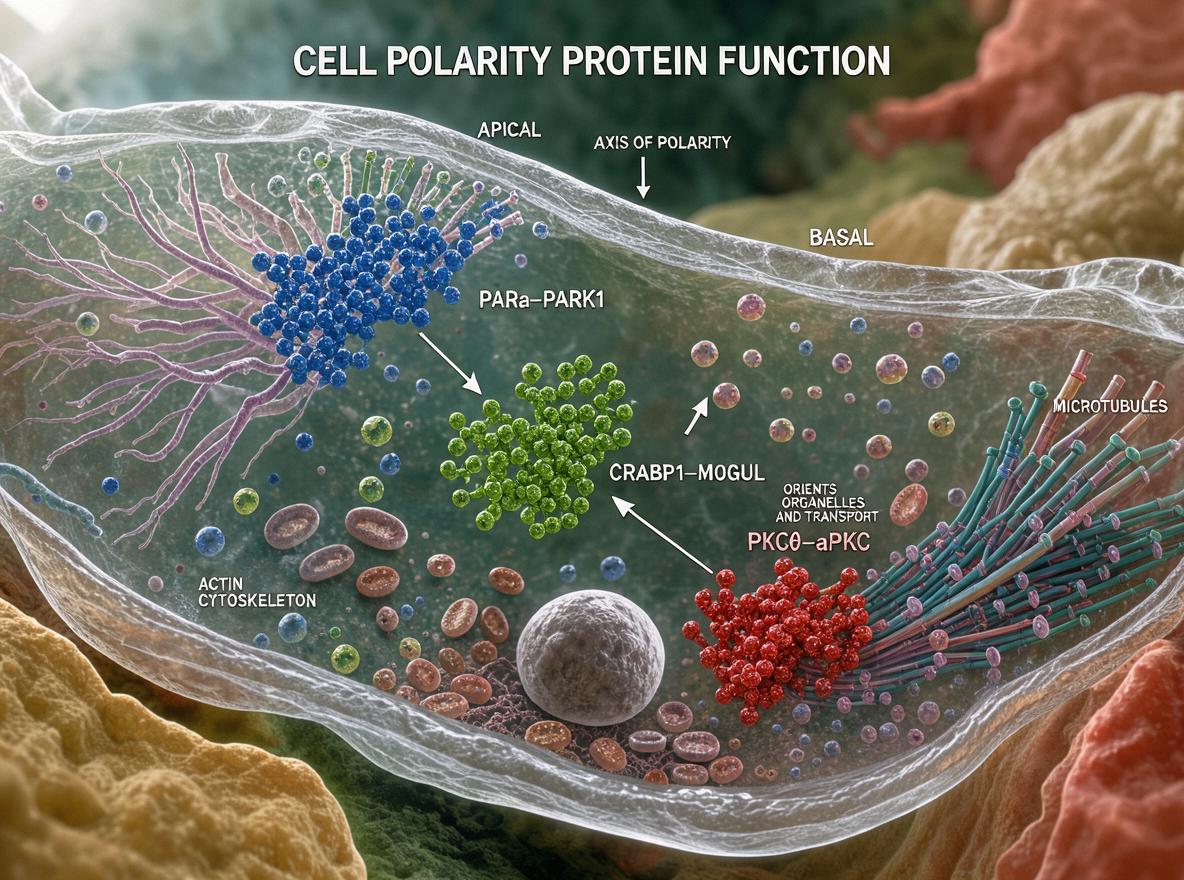
Mechanistically, glutamine deprivation—but not the glutamine antagonist DON—raised p-aPKC/aPKC ratios (T560/T555), and this phosphorylation was EGFR-dependent (erlotinib-sensitive); aPKCs sat upstream of Pak1 but did not alter EGFR activation itself. DON instead increased aPKC transcription via the transcription factor CREM, supported by ChIP/CUT&RUN enrichment of CREM at the PRKCZ promoter. Par3 redistributed to microtubule-associated puncta under glutamine deprivation in an aPKC-dependent manner, colocalizing with dynein; colchicine, paclitaxel, and the dynein inhibitor ciliobrevin D all blocked uptake, implicating microtubule-motor mechanics in nascent macropinosome formation .
In vivo, doxycycline-inducible shRNAs against PRKCZ or PRKCI (n=8 tumors/condition) significantly reduced AsPC-1 xenograft growth (both P<0.0001 vs shCTRL), reduced phospho-Histone H3 without changing cleaved caspase-3, and lowered the ex vivo macropinocytic index in non-peripheral tumor regions (both P<0.0001). pPKCζ T560 was enriched in nutrient-depleted non-peripheral regions where macropinosome-positive cells were found .
Rescue logic and clinical correlation
The strongest causal evidence is the Pak1 rescue: overexpressing Pak1-WT or Pak1-T423E restored macropinocytosis and albumin-dependent proliferation in PKCζ-depleted cells (e.g., P=0.0096 and 0.0451 for macropinocytosis rescue), arguing the fitness defect is specifically macropinocytosis-linked. PRKCI/PAR1a upregulation was seen in multiple GSE datasets, and high PRKCI, PRKCZ, PARD3, or PARD6B correlated with worse overall survival (Log-rank tests) in the TCGA mixed-adenocarcinoma dataset .
Critical assessment: limitations, blindspots, and counterpoints
Model scope. Mechanistic work rests on two PDAC lines (AsPC-1, HPAF-II) plus heterotopic xenografts in athymic mice; stromal contributions and orthotopic/metastatic contexts are absent. The authors themselves flag cell-line heterogeneity as a limitation .
Contextual CREM inconsistency. CREM knockdown blocked DON-induced uptake in both lines but glutamine-starvation-induced uptake only in HPAF-II, not AsPC-1—an acknowledged heterogeneity the mechanistic model does not fully explain.
Causality at Par3/dynein is correlative. Par3 relocation and Par3-dynein colocalization are described (N=2 imaging experiments), but direct disruption of the Par3-dynein interaction was not tested, so the 'tension for scission' model is interpretation rather than demonstrated mechanism.
Conflict of interest. The corresponding author holds a patent on macropinocytosis-associated diagnostics/therapeutics (US-11209420-B2), a financial incentive that warrants independent replication of therapeutic framings.
Survival analyses used a scan-based cut-off (minimal group size 8), an approach prone to optimized dichotomization; effects sizes and multivariable adjustment are not reported.
Known unknowns. Whether aPKC directly phosphorylates Par-1a T211, isoform-specific roles, and how other PKC subgroups behave remain open, as the authors state.
Falsifiability: the central claim would be weakened if aPKC catalytic-dead rescue (rather than Pak1 bypass) failed to restore uptake, or if macropinocytosis persisted in aPKC/Par3 double-depleted cells. None of the available records provide such contrary evidence.
Feedback:
Updated: November 24, 2026
BGPT Paper Review
Study Novelty
80%
Repurposing of the Par/aPKC polarity network—and microtubule-dynein mechanics—for nascent macropinosome formation under nutrient stress is a new function; prior macropinocytosis regulation (EGFR-Pak) was known but the polarity axis and CREM link are novel.
Scientific Quality
80%
Multi-tier validation (orthogonal siRNAs, pharmacology, rescue with Pak1, in vivo xenografts, human TMA) is strong; weakened by limited cell lines, N=2 imaging experiments for Par3-dynein colocalization, scan-based survival cutoffs, and an inventor-patent conflict of interest.
Study Generality
70%
The finding reframes polarity proteins as nutrient-stress effectors, relevant beyond PDAC to other KRAS-mutant and Ras-driven cancers, though most data are PDAC-specific.
Study Usefulness
80%
Identifies concrete therapeutic/prognostic targets (aPKCs, CREM) for nutrient-stressed tumors and provides a validated imaging assay for macropinocytosis regulators.
Study Reproducibility
80%
Detailed methods, reagent IDs (siRNA/shRNA sequences, antibodies, Addgene plasmids), GEO deposit GSE276007, and source data files support replication; dose/timing specifics are provided.
Explanatory Depth
70%
Mechanism is traced from stress source to EGFR/CREM → aPKC → Par3/microtubule-dynein → uptake → fitness, but key links (direct Par-1a phosphorylation, Par3-dynein functional coupling) remain correlational.

 Explore by Goal
 Quick Answer
 Long Answer
 Top Data Sources
 Ask a Follow-Up
 Key Insight
 Keep Exploring
 Analysis
 Hypothesis Graveyard
 Potential Experiments
 Discussion
