Check a paper's claims against linked experiments, exact results, stated scope, and limitations.Know what falsifiable science actually supports before you trust the answer.
Press Enter ↵ to search evidence
Explore by Goal
"The greatest enemy of knowledge is not ignorance, it is the illusion of knowledge."
- Stephen Hawking
Quick Explanation
Copied
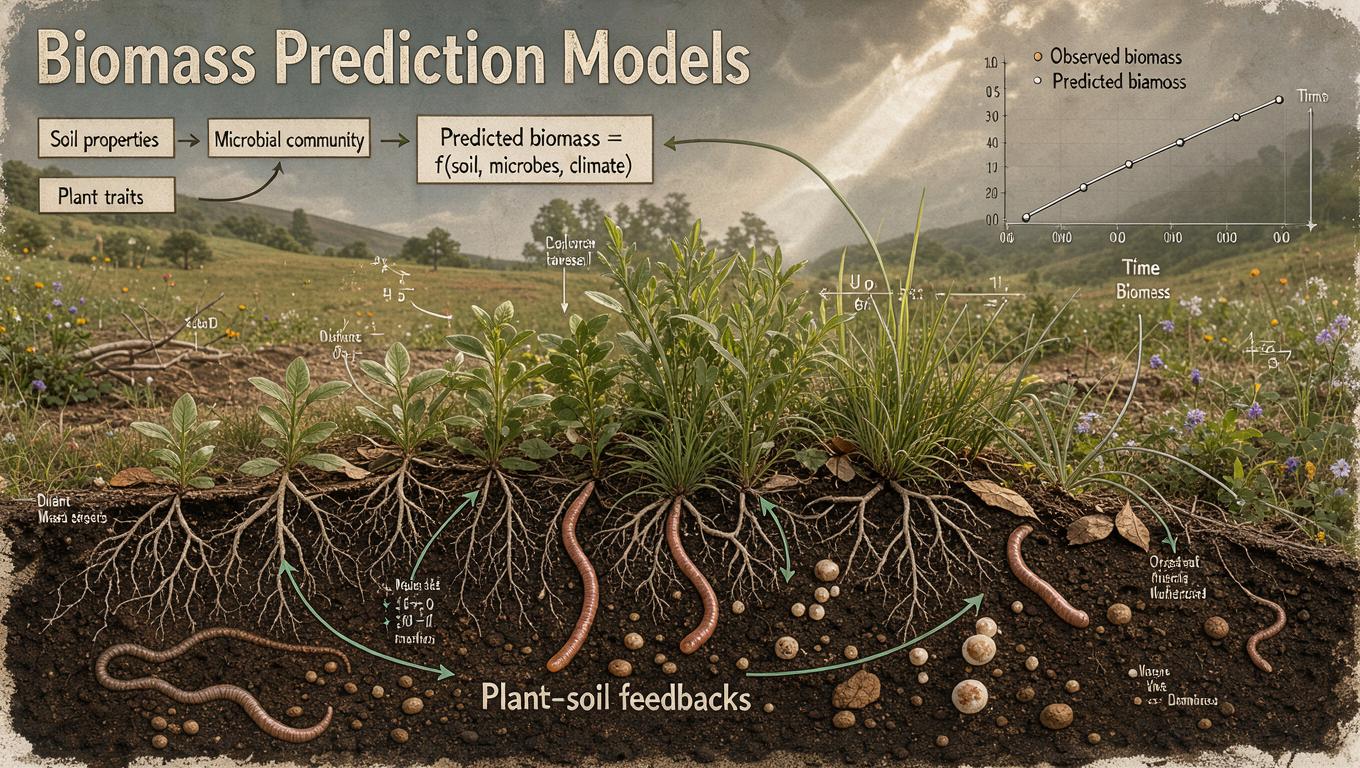
In this factorial greenhouse test of 12 species and 162 communities, plant–soil feedback (PSF) data improved biomass predictions in every model tested, adding ~10% explained variance overall (2–32% by model), but the effect was modest relative to intrinsic growth-rate differences, and most PSFs were positive—unlike the predominantly negative PSFs reported in field literature—so community-level relevance remains uncertain .
Long Explanation
What the paper tested
Kulmatiski and colleagues ran a rare factorial PSF experiment: 12 Texas prairie species were each grown on soils cultivated by every other species (2,220 pots), then the resulting PSF values were used to parameterize five plant-growth models (Additive, Exponential, and three Logistic variants). Predictions were validated against biomass measured in 162 communities (2-, 4-, 8-, and 12-species mixtures) grown in a separate greenhouse experiment .
PSF-informed models beat Null models for all five model types. Overall, PSFs explained ~10% more total variance. The effect was largest for the simple Additive model (32% more variance, 67% of Null-unexplained variance) and smaller (2–8% more variance; 11–16% of unexplained variance) for the time-discrete models. PSFs, associated with a 28% biomass difference across soil types, were enough to flip competitive outcomes in 33 of 132 species pairs—more than double the 14/132 detected when a conventional non-factorial 'self vs. other' test was applied to the same data .
Key mechanistic insights
The authors articulate three underappreciated constraints that the community-level framing exposes: (1) Null models parameterized on monoculture biomass already embed 'self' PSF effects, so PSF gains are conservative; (2) PSFs must rival intrinsic growth-rate differences to alter rank abundance—PSF magnitude alone is meaningless without this comparison; (3) PSFs must vary among species to change relative abundances. A further subtle point: PSFs matter more for small/rare species because dominant species dominate the soil 'state' of the community, and a small PSF on a large plant can outweigh a large PSF on a small one .
Critical appraisal — what the authors admit, and what remains
The paper is unusually honest about its limits: greenhouse growth did not correlate with field abundance from prior Texas experiments (R²=0.05, P=0.47), and most PSFs here were positive, whereas meta-analytic literature reports mostly negative PSFs—so quantitative transfer to field settings is unsupported. Carrying-capacity-limited models compressed PSF effects, and the best-performing model (Logistic Pot-Level-K) showed the smallest PSF benefit, an inversion the authors justify only by ensemble reasoning. BGPT inference: the factorial design is the genuine methodological advance (detecting soil-type-specific PSFs that averaged 'other' designs obscure), but the field-validity gap is the critical unresolved blindspot—falsehood would be established if factorial PSF data failed to improve community predictions in field mesocosms or under nutrient/water stress regimes.
Feedback:
Updated: November 21, 2026
BGPT Paper Review
Study Novelty
70%
First factorial PSF experiment with >5 species and direct model-prediction validation against 162 communities; most prior PSF work used non-factorial monoculture designs plus theory. Incremental rather than paradigm-shifting.
Scientific Quality
80%
Large, well-replicated factorial design (2,220 pots; 132 PSF values), multi-model ensemble, transparent reporting of null-hypothesis framing and explicit significance-vs-R² caveats. Weaknesses: greenhouse-only, positive PSFs atypical of literature, no field correlation, Exponential model required post-hoc time-step adjustment.
Study Generality
60%
Framework (Null vs PSF model comparison, competitive-threshold index) generalizes to any system, but empirical results are restricted to 12 Texas prairie species in greenhouse sand-peat medium.
Study Usefulness
70%
Provides a concrete, reusable protocol for testing PSF community relevance and shows monoculture PSF experiments likely overestimate community effects; directly informs restoration and community-prediction modeling.
Study Reproducibility
70%
Detailed methods (pot sizes, inoculum, timing, model equations, time-step derivations) enable replication; no public data/code repository stated, and some appendix tables carry the key results.
Explanatory Depth
70%
Moves beyond 'PSFs matter' to quantify when PSFs can and cannot alter competitive outcomes (magnitude vs intrinsic growth-rate differences, species variability, size-dependence); mechanistic soil-microbe detail (e.g., microbial biomass proxy, µ=5) remains assumed rather than measured.
We'll email you the results when your analysis is finished.
Hypothesis Graveyard
'PSFs are primary drivers of community assembly' — weakened here: PSFs changed competitive outcomes in only 25% of pairs and explained ≤10% extra variance vs intrinsic growth-rate differences.
'Non-factorial self-vs-other experiments capture community PSF effects' — falsified: they detected less than half (14/132) the competitively relevant PSF pairs found by the factorial design.

 Explore by Goal
 Quick Explanation
 Long Explanation
 Top Data Sources
 Ask a Follow-Up
 Key Insight
 Keep Exploring
 Hypothesis Graveyard
 Potential Experiments
 Discussion
