Ask questions across claims linked to experiments, exact results, limitations, and sources.Know what the science actually supports before you trust the answer.
Press Enter ↵ to search evidence
Explore by Goal
"Study hard what interests you the most in the most undisciplined, irreverent and original manner possible."
- Richard Feynman
Quick Explanation
Copied
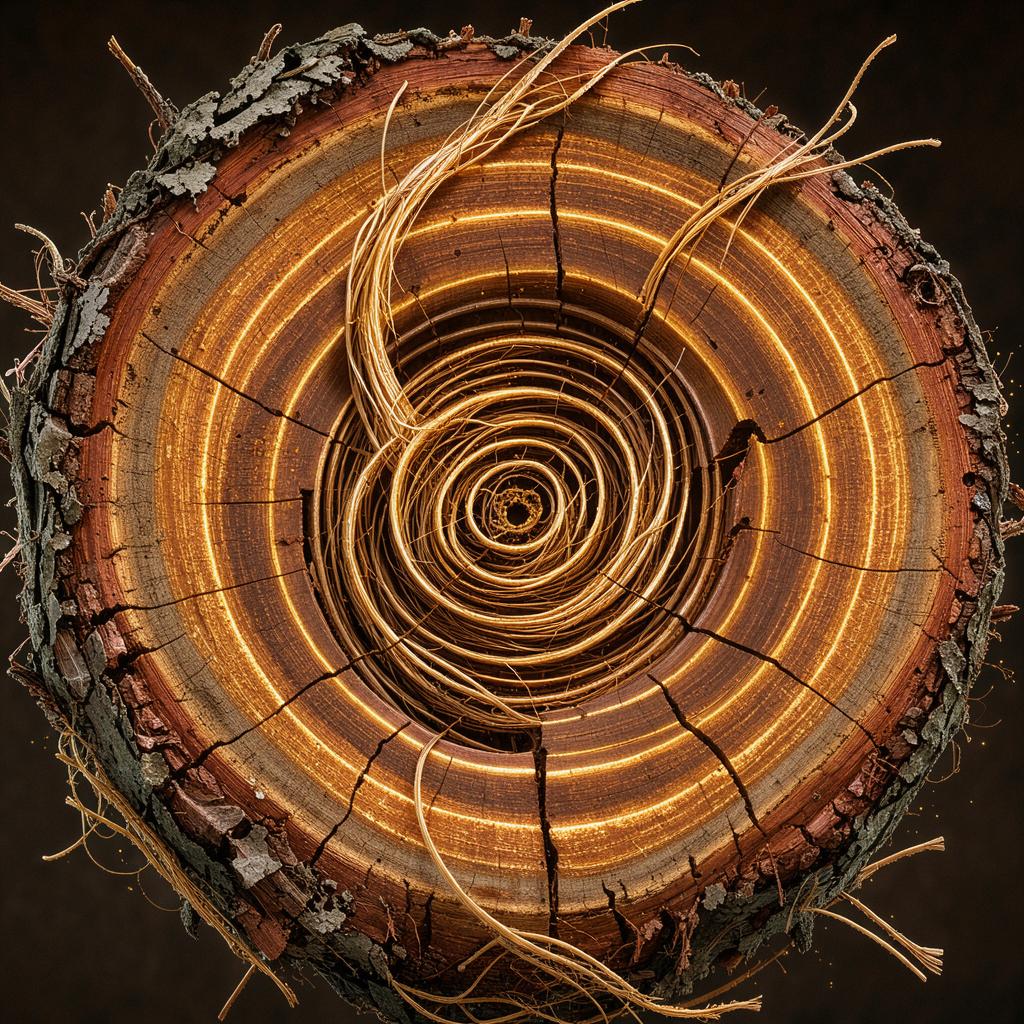
Wood is the secondary xylem of trees: a cellulose–lignin composite whose properties (density, microfibril angle, stiffness) vary with species, cambial age, and environment. Juvenile wood generally has shorter fibers, larger microfibril angles, lower density, and inferior mechanics than mature wood .
Long Explanation
What Wood Is, Structurally
Wood is secondary xylem: a hierarchical natural composite of cellulose microfibrils wound around hollow cells, embedded in lignin and hemicellulose. Its two most predictive micro-structural parameters are basic density and microfibril angle (MFA) — the angle cellulose fibrils make with the cell axis. In nine-year Eucalyptus in Sumatra, MFA ranged only 9.2–11.0° across three species, yet together with basic density (0.41–0.46 g/cm³) it predicted stiffness (MOE) and strength (MOR) better than either parameter alone .
Note: reported E. urophylla MOE/MOR values in the source table contain formatting ambiguities; E. grandis and E. pellita values shown are unambiguous .
Wood Changes With Age: Juvenile vs Mature
The same tree makes two different woods. Near the pith, juvenile wood has shorter fibers, larger MFA, and lower density and strength; properties then stabilize toward the cambium. In Japanese yellow-poplar (Liriodendron tulipifera), all ten measured properties changed logarithmically near the pith and stabilized after cambial age ~9 years (~14 cm diameter) — notably later than peak growth increment (CAI at 4.9 yr; MAI at 7.4 yr), implying a growth–quality tradeoff . A 10-species Chinese study (70 trees) generalized the juvenile/mature pattern across conifers and hardwoods .
Measuring and Breeding Wood Quality
Because destructively testing timber is slow, near-infrared spectroscopy calibrations now predict properties from increment cores: across 3,323 cores from 14 pine species in 5 countries, R² was 0.77 (air-dry density), 0.82 (MFA), and 0.901 (stiffness) . Genomic selection adds prediction across generations: in ~6,000 phenotyped, ~2,500 genotyped Norway spruce, pedigree-based (ABLUP) and marker-based (GBLUP) models showed comparable predictive ability for wood properties .
Environment vs Genetics — and Blind Spots
For Victorian Douglas fir (~55 yr, 24 trees), green-timber density (372–432 kg/m³) and strength differed significantly by locality, but after air-drying locality effects vanished; strength grouped as S6/SD6, weaker than mature North American timber . Growth form also matters: foxtailing Caribbean pines in Fiji were taller and straighter with only minor wood-density differences vs normals .
Confidence and caveats: Key uncertainties include (1) single-site designs — the Eucalyptus and Liriodendron studies cannot separate genotype from environment; (2) small samples (nine Liriodendron trees, 24 Douglas fir); (3) possible provenance effects misattributed to site in the Douglas fir study; (4) unverified legacy extractions. Findings would be revised if multi-site trials showed consistent negative growth–quality correlations or if NIR/genomic calibrations failed on independent validation sets. What is missing: molecular mechanisms linking MFA variation to cell-wall biosynthesis, and long-term data on property stability.
Running GWAS-style association of Norway spruce genotypes with SilviScan-derived wood property phenotypes, testing GBLUP vs ABLUP predictive accuracy across two progeny trials.
Get emailed when your analysis is done!
We'll email you the results when your analysis is finished.
Hypothesis Graveyard
Foxtailing in Caribbean pine was assumed to degrade timber value; the Fiji study falsified this — foxtails had similar wood density and better form, so the 'foxtail = bad wood' premise fails.
Fast growth was assumed to reduce wood quality universally; the Eucalyptus study found no negative growth–property relationships, refuting the strict tradeoff model.

 Explore by Goal
 Quick Explanation
 Long Explanation
 Top Data Sources
 Ask a Follow-Up
 Key Insight
 Keep Exploring
 Analysis
 Hypothesis Graveyard
 Potential Experiments
 Discussion
