Check each claim against its experiments, reported results, scope, and stated limitations.Know what the science actually supports before you trust the answer.
Press Enter ↵ to start review
Explore by Goal
"The diversity of the phenomena of nature is so great, and the treasures hidden in the heavens so rich, precisely in order that the human mind shall never be lacking in fresh nourishment."
- Johannes Kepler
Long Explanation
Copied
Serendipitous Discovery: Two Common Enzymes Form Ordered Filaments
This Observation paper reports the first cryo-EM structures of filaments formed by alkaline phosphatase (ALP) from P. aeruginosa and proteinase K (ProtK), both discovered unintentionally in unrelated samples. The ALP filament is scaffold-dependent, anchored by unassigned electropositive-contacting densities (likely eDNA or acidic polysaccharides), while the ProtK nanotube appears concentration-driven with minimal two-hydrogen-bond interfaces .
Structural Comparison
Feature
ALP Filament
ProtK Nanotube
Resolution
~3.7 Å (overall), ~3.3 Å (local)
3.2 Å
Symmetry
1-start helix; 3-start peripheral scaffold
D1; 8 antiparallel protofilaments
Rise (Å)
28.4
8.36
Twist (°)
83.2
−83.72
Dimensions
Not precisely stated
~17 nm outer; ~90 Å inner diameter
Scaffold
Unassigned central + peripheral densities
None identified
Key contacts
~1,150 Ų buried; KKK-41, R219, R248
2 H-bonds per interface × 3 types
Active sites
Exposed; spaced ~62 Å
Solvent accessible; fold unchanged (RMSD 0.8 Å)
PDB / EMDB
36PY / EMD-77749
28EP / EMD-81689
Critical Assessment
Strengths: Atomic-resolution structures from crude samples; honest self-critique (authors acknowledge ProtK nanotube may be an artifact of concentration and monitored stock solution, finding no tubes there). Data deposited for independent verification. Automated model building (ModelAngelo) demonstrates a generalizable discovery workflow .
Limitations and blindspots: The chemical identity of the ALP scaffold densities is unresolved—eDNA, RNA, exopolysaccharides, teichoic acid, and polyphosphate are all listed as candidates without discriminating evidence. No physiological relevance is demonstrated for ProtK nanotubes in the native fungus Tritirachium album. No concentration-dependence curves or catalytic activity comparisons (polymeric vs. monomeric) are presented. Sample sizes, particle counts, and map validation metrics (FSC, Q-scores) are not reported in the main text. The authors' interpretation that ALP polymerization is "evolved" rests solely on absence of homologous KKK/R219/R248 residues in E. coli ALP (74% identity)—a suggestive but not conclusive evolutionary argument.
What would change the conclusions: A higher-resolution map showing different protofilament count or symmetry would weaken the ProtK structural claim. Identification of the scaffold density as a specific molecule (or demonstration that ALP polymerizes without any scaffold) would test the scaffold-dependence model. Concentration-dependent assembly/disassembly curves for ProtK would distinguish artifact from biology.
Proteinase K Crystal Structure (3PRK Reference)
The paper shows the ProtK nanotube monomer superposes on this crystal structure with 0.8 Å RMSD, confirming no packing-induced rearrangement.
Author Reviews
Feedback:
Updated: September 16, 2026
BGPT Paper Review
Study Novelty
70%
First report of filament formation by two widely-used enzymes (ALP and ProtK) discovered serendipitously. The finding that cryo-EM can identify atomic structures of uncharacterized assemblies without purification adds methodological novelty. However, the conceptual framework (enzyme filamentation as regulation) is well-established.
Scientific Quality
60%
High-resolution structures with deposited coordinates are a strength. Honest self-critique about ProtK artifact possibility. However, missing map validation metrics, no functional characterization, no concentration-dependence data, and unassigned scaffold densities limit completeness. As an Observation paper it meets its scope but does not test hypotheses.
Study Generality
40%
Findings are specific to two enzymes in particular contexts. The broader point—that cryo-EM can discover uncharacterized oligomeric states in crude samples—is generalizable but not deeply explored.
Study Usefulness
50%
Useful for the enzyme polymerization community and as a methodological demonstration. Limited immediate practical utility given unresolved scaffold identity and unclear physiological relevance. Structural data may inform future studies of biocatalytic nanomaterials.
Study Reproducibility
50%
Structures deposited (PDB/EMDB), methods described in supplemental material, commercial ProtK source identified. However, exact conditions triggering filament formation are incompletely characterized, and particle counts/processing details are not fully reported in the main text.
Explanatory Depth
60%
Structural mechanisms are well described (contact interfaces, electrostatics, symmetry). However, the chemical identity of the ALP scaffold and the physiological/biophysical driving forces for ProtK assembly remain unknown, limiting mechanistic depth.
We'll email you the results when your analysis is finished.
Hypothesis Graveyard
ALP filaments are intracellular storage bodies analogous to cytoophidia: unlikely because ALP is periplasmic/extracellular and the filaments were found in sheared extracellular samples of P. aeruginosa, not in cytoplasm.
ProtK nanotubes are physiological amyloid-like structures: unlikely given the minimal 2-H-bond interfaces, absence of any known oligomerization in native fungus, and failure to detect tubes in stock solution.

 Explore by Goal
 Long Explanation

 Top Data Sources
 Ask a Follow-Up
 Key Insight
 Keep Exploring
 Hypothesis Graveyard
 Potential Experiments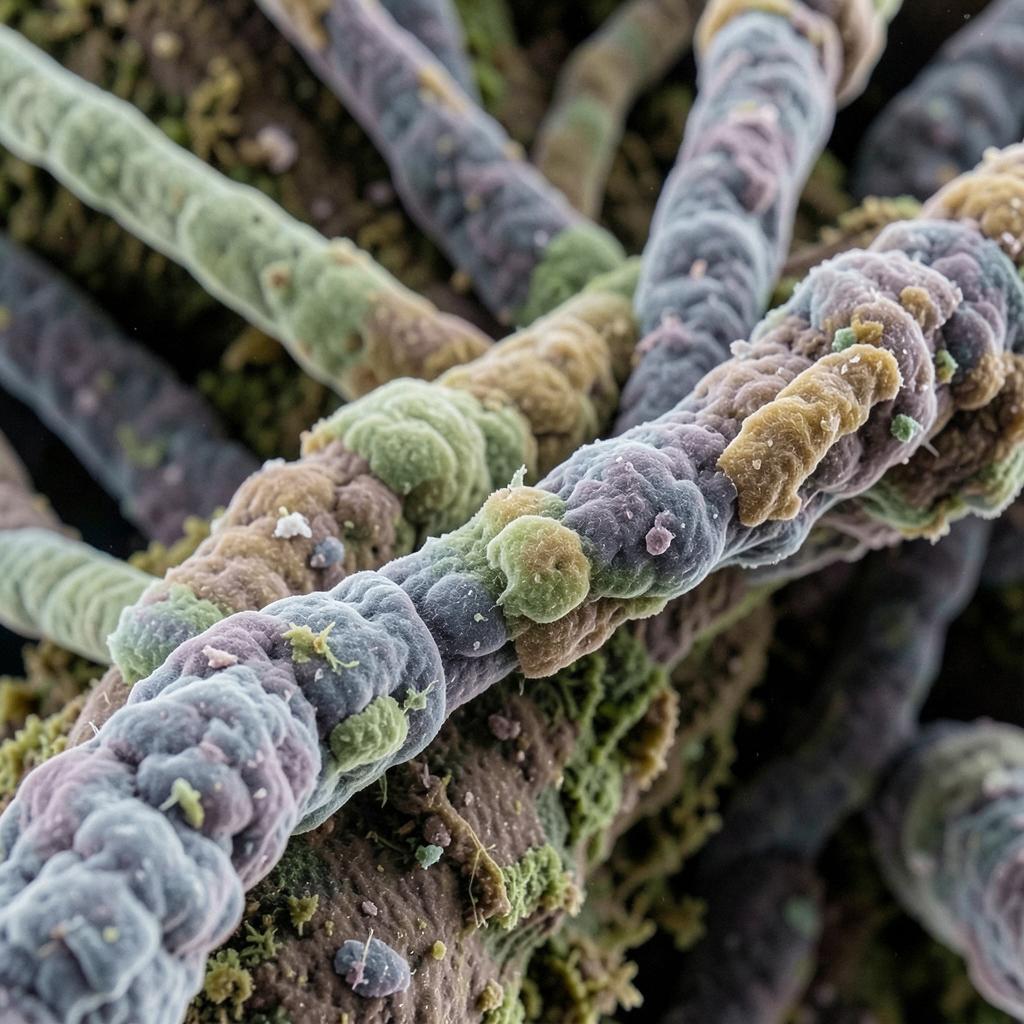
 Discussion