Examine the evidence base and provenance of specific claims made by authors or groups.Know what the science actually supports before you trust the answer.
Press Enter ↵ to review
Explore by Goal
"The aim of science is not to open the door to infinite wisdom, but to set a limit to infinite error."
- Bertolt Brecht
Quick Explanation
Copied
Andrew Rowntree (ORCID 0000-0003-3220-0720) is an early-career applied mathematician-turned-computational biologist at the University of Manchester, with 10 works, 66 citations, and an h-index of 3, whose strongest contributions are first-author mathematical modelling of HES1-cell-cycle coupling and middle-author contributions to high-impact oscillatory gene dynamics papers in PNAS (2021, 2026) and Developmental Cell (2025). His trajectory shows growing influence (27 citations in 2025, 21 in 2026) but his independent senior record is not yet established.
Long Explanation
Career Arc and Citation Metrics
Andrew Rowntree's OpenAlex profile shows 10 works, 66 total citations, and an h-index of 3, with no listed primary institution — consistent with a postdoctoral-stage researcher . His output rises steadily: one work in 2014 (a University of Chester mathematical dissertation on mutualism modelling), an applied-numerics paper on discrete mutualism models in 2019, then a shift to systems/cancer biology from 2021 onward .
Citations by year show clear momentum: 1 (2019), 3 (2021), 3 (2022), 3 (2023), 8 (2024), 27 (2025), and 21 already in 2026 — roughly 73% of career citations arriving in the last two years, a pattern typical of a researcher whose best work is recently published.
Key Scientific Contributions
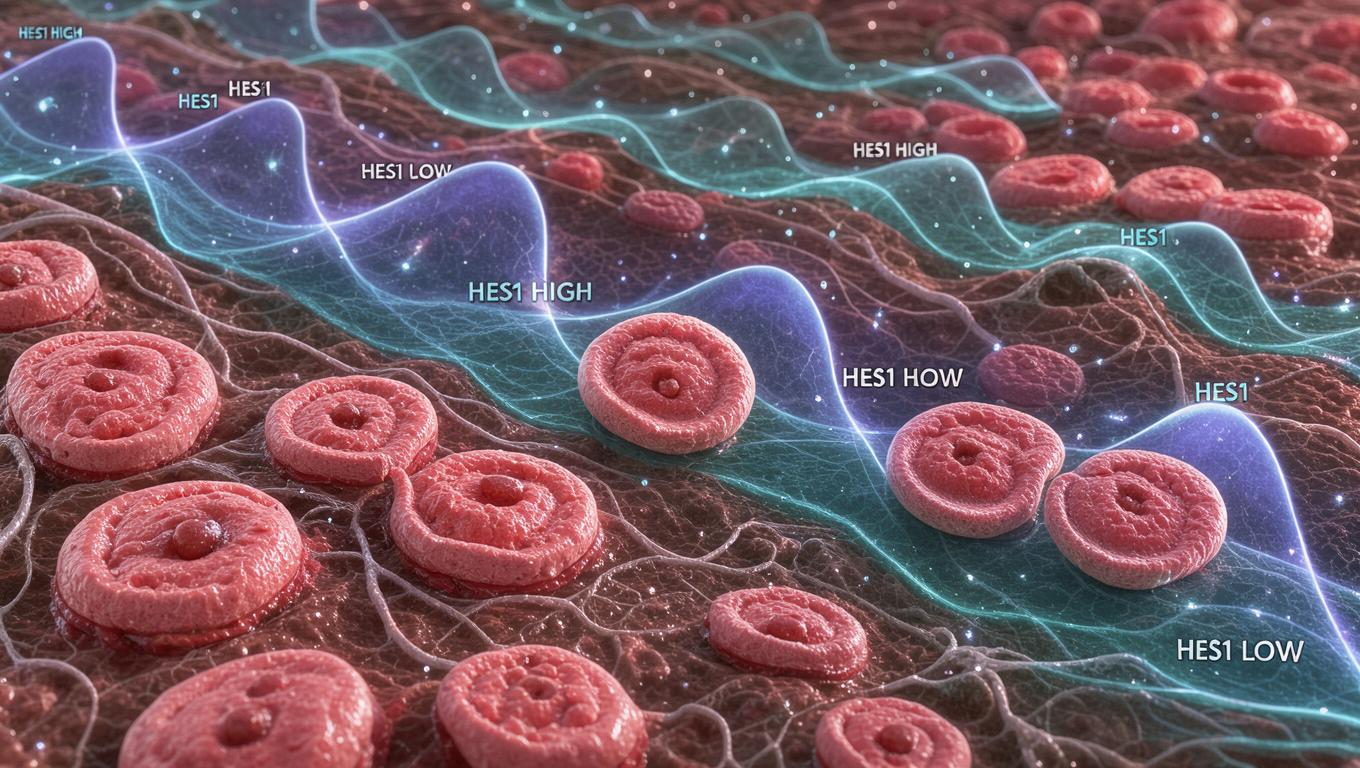
His most-cited work, a middle-author PNAS paper (25 citations), combined endogenous Hes1 fluorescent labelling with dynamical analysis to show that phase registration of Hes1 oscillations with mitoses underlies cell-cycle length heterogeneity in ER+ breast cancer cells . He then led (first-author) the mathematical counterpart, showing bilateral feedback in an oscillator model is required to explain Hes1–cell-cycle coupling dynamics . This experimental-theory pairing across 2021–2022 demonstrates genuine interdisciplinarity: he can both build dynamical models and sit inside a wet-lab collaboration.
His 2025 first-authored-lineage work culminated in a 2026 PNAS paper showing HES1 oscillations are required for cell-cycle re-entry in ER+ breast cancer cells — a causal claim with direct relevance to dormant disseminated tumour cell reactivation and recurrence . He is also a middle author on a Developmental Cell paper decoding NEUROGENIN3 oscillatory timing in human pancreatic endocrine differentiation (16 citations) , and contributed to glioblastoma work identifying oscillatory SOX2 expression in quiescent glioblastoma stem cells , plus a methods preprint engineering tunable oscillatory protein expression using Tet-ON and dTAG degron systems .
Blindspots and Uncertainties
Known: strong collaborative embedding in the Papalopulu group at Manchester, an interdisciplinary maths-to-biology skill set, and two PNAS-tier papers within a 5-year window. Inferred: the low h-index (3) against 66 total citations indicates a few well-cited papers rather than a broad independent footprint. Uncertain/unknown: no primary institution is listed in OpenAlex; funding, grants, invited talks, and sole-corresponding-author roles are not visible in the supplied metadata, so independence cannot be assessed. All co-first/co-middle positions mean his personal contribution magnitude in high-impact papers cannot be separated from team effects from these data alone. Confidence in the bibliometric picture is high; confidence in inferring scientific depth beyond published work is moderate.
Feedback:
Updated: November 01, 2026
BGPT Author Review
Scientific Quality
50%
Early-career researcher with a credible interdisciplinary trajectory: a 2014 maths dissertation, a 2019 applied-numerics paper, then rapid ascent into high-impact systems oncology (PNAS 2021 and 2026, Developmental Cell 2025). H-index of 3 and 66 citations signal potential, not established authority. No evidence of independent funding or group leadership; nearly all high-impact work is collaborative under Papalopulu. Solid but unproven at senior level.
Communication Quality
60%
Papers appear in top-tier venues with clear mechanistic framing (phase registration, oscillation decoding), suggesting effective cross-disciplinary communication between mathematics and experimental biology. However, communication quality cannot be fully judged from abstracts alone, and heavy MDPI Mathematics output suggests audience-limited writing in at least one venue.
Author Novelty
70%
The Hes1-oscillation/cell-cycle phase-register concept and the requirement of HES1 oscillations for cell-cycle re-entry in dormant cancer cells are non-obvious, mechanism-level claims in an underexplored niche (oscillatory transcription factors controlling quiescence in cancer). The degron/Tet-ON oscillation engineering preprint extends this toward synthetic control. Not paradigm-shifting, but a distinctive and coherent research line.
Scientific Rigor
60%
High reference counts (48-103), causal claims backed by endogenous knock-in reporters, and paired experimental-theoretical validation suggest careful work. However, reliance on cell-line models for cancer claims, middle-author obscurity in flagship papers, and one first-author paper in a lower-rigour MDPI venue temper the assessment. Preprint-to-PNAS consistency is a positive reproducibility signal.
Benchmarking Andrew Rowntree's citation trajectory, venue impact, and co-authorship network against matched systems-biology postdocs using OpenAlex and Semantic Scholar APIs to quantify independence signals.
Get emailed when your analysis is done!
We'll email you the results when your analysis is finished.
Hypothesis Graveyard
Hes1 expression level (steady-state abundance) determines cell-cycle heterogeneity — superseded by the phase-register finding, since oscillation phase relative to mitosis, not mean level, explains the heterogeneity.
HES1 acts solely as a passive Notch readout in ER+ breast cancer — falsified by the 2026 PNAS requirement result showing HES1 oscillations are causally necessary for re-entry.

 Explore by Goal
 Quick Explanation
 Long Explanation
 Ask a Follow-Up
 Key Insight
 Keep Exploring
 Analysis
 Hypothesis Graveyard
 Potential Experiments
 Discussion
