Check each claim against its linked experiments, results, and falsification criteria.Know what the science actually supports before you trust the answer.
Press Enter ↵ to check claims
Explore by Goal
"The most incomprehensible thing about the world is that it is comprehensible."
- Albert Einstein
Quick Explanation
Copied
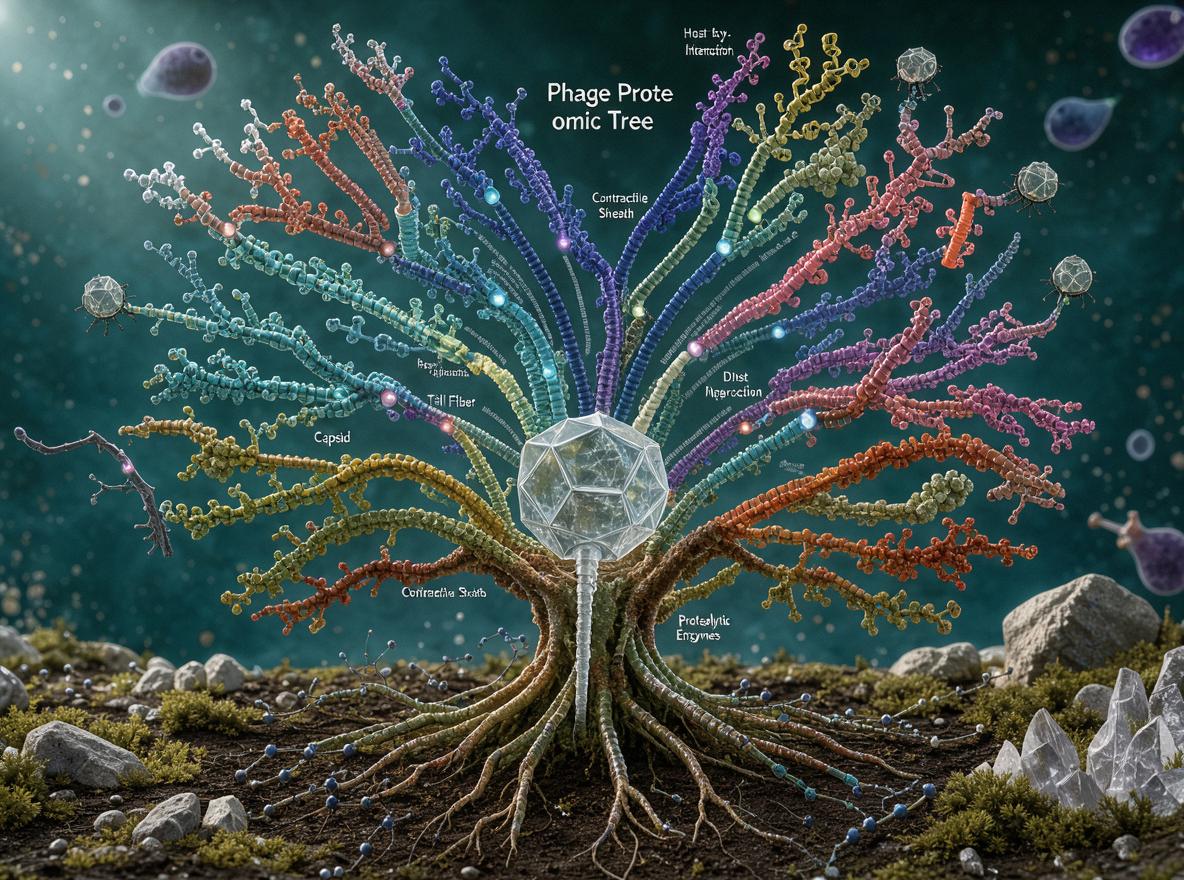
Rohwer & Edwards (2002) showed that no single protein is conserved across all 105 fully sequenced phage genomes and built the first whole-proteome distance tree, with a missing-gene penalty of 10 satisfying all 17 literature-derived taxonomic criteria and resolving the P22/ICTV misclassification . It founded modern phage proteomic taxonomy, now scaled by ESM-2-embedding tools such as HieVi to ~24,000 genomes .
Long Explanation
The Core Discovery: Phage Have No Universal Marker
All-vs-all BLASTP of the 3,981 predicted proteins from 105 complete phage genomes yielded 21,153 significant hits (E < 0.1), yet no single protein occurred in all 105 genomes. The most-hit protein, the transglycosylase YomI, reached only 45 of 105 genomes, and >60% of its matches covered less than half the protein . This negative result is the paper's foundation: phage cannot have a 16S rRNA equivalent, so any taxonomy must be proteome-wide.
The Method: Distance + Penalty, Validated Against Literature
The authors built trees from length-corrected PROTDIST (Dayhoff-PAM) scores plus a penalty for each unshared ORF. A penalty of 10 satisfied all 17 literature-derived criteria (including correct P22-lambda grouping, resolving the ICTV's morphology-driven P22-T7 pairing); a penalty of 5 missed the Mycoplasma P1 criterion, and 100 forced unrelated genomes together . The empirical tuning is honest but weakly principled — the optimal penalty could shift with genome sampling, a concern echoed by the 2004 commentary 'We Agree To Disagree', which argued a universal scheme was premature given mosaicism and estimated sampling of <0.0002% of the global phage metagenome .
Note: Signature-gene counts above sum subgroups (e.g., siphophage = 0+53+15+9+0); microphage and podophage sums combine their two subgroups. Lambda-like siphophages and inophages had zero signature genes, showing the marker approach fails exactly where lateral gene transfer is most rampant .
Legacy and Blind Spots
The tree anticipated today's ICTV genomic taxonomy. Modern successors vindicate the concept while fixing its weaknesses: VirClust clusters 1,951 dsDNA genomes hierarchically with calibrated genus/family thresholds ; HieVi uses ESM-2 protein-language-model embeddings over 24,362 genomes and recovers ICTV taxa (AMI > 0.8 for Straboviridae and Herelleviridae) ; and Vclust scales alignment-based tANI dereplication to 15.7 million IMG/VR contigs . Remaining caveats: only cultured phage genomes were used; ~15% of genomes were singletons with no testable prediction; evolutionary-history claims rest on consistency with prior small-phage phylogenies rather than an independent validation; and the mosaic, laterally-transferred siphophage problem persists in every successor framework.
What would change this verdict: a major phage lineage lacking the tree's predicted groupings (e.g., through reticulate-only evolution), or failure of the signature genes to detect uncultured relatives in metagenomes — the latter was never experimentally demonstrated in the paper.
Feedback:
Updated: November 01, 2026
BGPT Paper Review
Study Novelty
80%
First sequence-based taxonomy for phage at a time when ICTV classification required electron microscopy and culturing; the negative result (no universal protein) and whole-proteome compatibility approach were genuinely new for the field.
Scientific Quality
70%
Sound computational workflow with honest sensitivity analysis of penalty values and literature-derived validation criteria; but validation is circular (criteria drawn from known small-phage phylogenies), penalty 10 is empirically tuned rather than derived, and ~15% singletons are untestable.
Study Generality
60%
Framework generalizes to any genome set without universal markers, but implementation was tuned to 105 genomes and focused specifically on bacteriophage taxonomy; prophages were explicitly excluded.
Study Usefulness
70%
Directly enabled the shift from morphology-based to genome-based phage taxonomy; signature genes proposed for uncultured biodiversity monitoring; the conceptual scaffold persists in VirClust, vConTACT, and HieVi despite methodological supersession.
Study Reproducibility
70%
Methods are detailed (BLASTP E cutoffs, CLUSTALW parameters, PROTDIST, FITCH with jumble/global rearrangement) and PERL code was posted online at salmonella.utmem.edu, though that URL is now defunct and raw distance matrices were not archived.
We'll email you the results when your analysis is finished.
Hypothesis Graveyard
A single universal phage marker (e.g., terminase or portal protein) could serve as phage's 16S rRNA: falsified by this paper's all-vs-all BLASTP showing no protein in all 105 genomes.
The proteomic tree directly reflects vertical evolutionary history for all phage groups: undermined by the authors' own admission that lateral transfer makes tree-based history inference hazardous for siphophages.

 Explore by Goal
 Quick Explanation
 Long Explanation
 Top Data Sources
 Ask a Follow-Up
 Key Insight
 Keep Exploring
 Hypothesis Graveyard
 Potential Experiments
 Discussion
