Analyze how experimental results and claims are presented, scoped, and limited in a paper.Know what the science actually supports before you trust the answer.
Press Enter ↵ to analyze
Explore by Goal
"The scientific man does not aim at an immediate result. He does not expect that his advanced ideas will be readily taken up. His work is like that of the planter - for the future. His duty is to lay the foundation for those who are to come, and point the way."
- Nikola Tesla
Quick Explanation
Copied
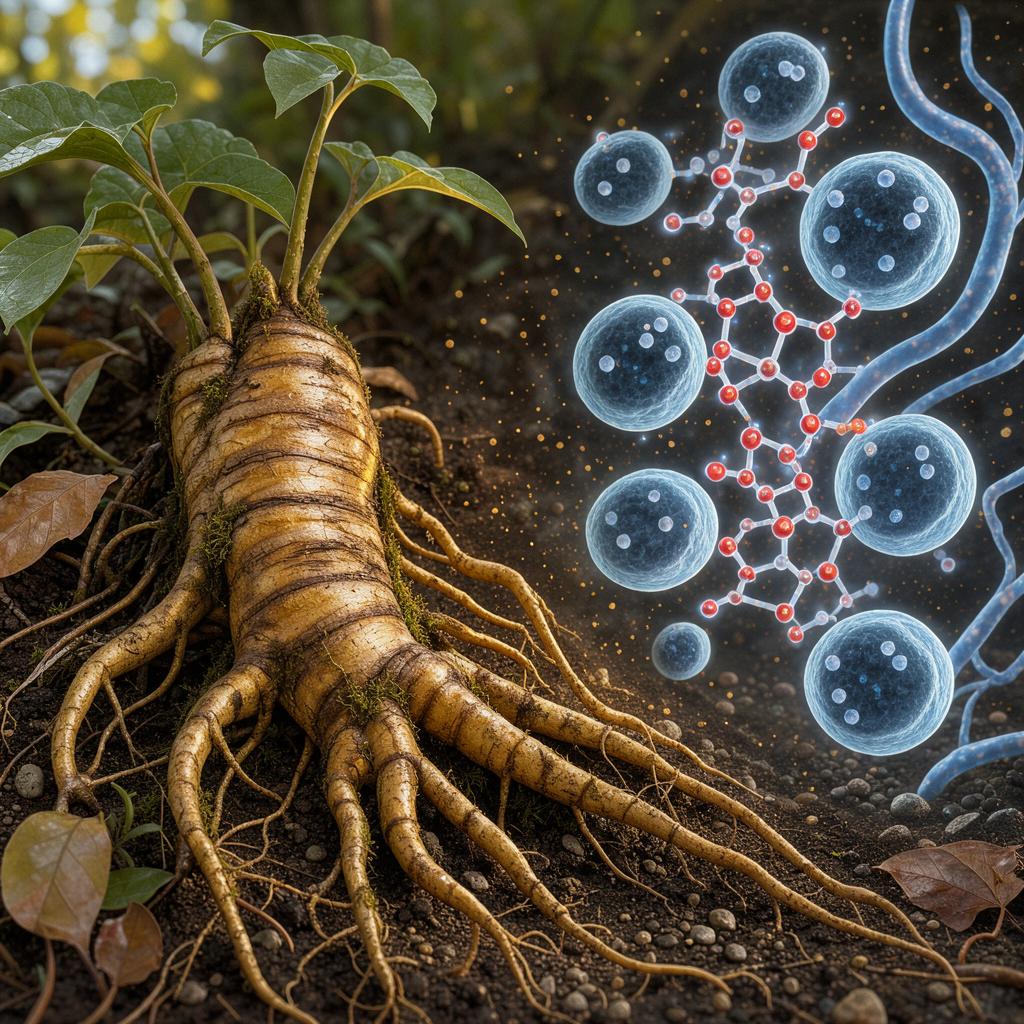
This 2009 review synthesizes preclinical and some clinical evidence that hypoglycemic herbs (ginseng, bitter melon, Coptis chinensis, and multi-herb formulas) act mainly by increasing insulin secretion, enhancing glucose uptake, inhibiting intestinal glucose absorption, and suppressing hepatic glucose production, but it relies heavily on animal and in vitro data with limited randomized clinical support [1].
Long Explanation
Core Mechanistic Claim of the Review
The review (Hui et al., 2009) organizes hypoglycemic herb activity into four mechanistic classes: increased insulin secretion, enhanced glucose uptake by adipose and muscle tissue, inhibited intestinal glucose absorption, and inhibited hepatic glucose output [1]. It correctly frames diabetes physiology, noting type 2 accounts for roughly 90–95% of cases and that β-cell loss is driven by cytokines, lipotoxicity, and glucotoxicity [1].
Reported Evidence (Author Interpretations)
Key quantitative claims are preclinical: Korean red ginseng (0.1–1.0 g/ml) stimulated insulin release from isolated rat islets at 3.3 mM glucose; heat-processed American ginseng (100 mg/kg for 20 days) lowered glucose and HbA1c in STZ-diabetic rats and reduced renal AGE products; Panax ginseng berry extract (150 mg/kg) achieved euglycemia by day 12 in db/db mice [1]. Radix Ginseng Alba acts via intestinal absorption blockade and hepatic glucose-6-phosphatase inhibition; Radix Ginseng Palva via PPAR-γ upregulation [1].
Critical Appraisal
The review is honest that few herbs have been validated in systematic clinical trials, and it acknowledges three confounders: multi-component plant chemistry, part-of-plant and extraction variability, and possible synergy in multi-herb formulae [1]. BGPT infers the main weakness: most cited data are rodent or in vitro, with small samples and no human randomized trial effect sizes reported. Herb-drug interaction risk (e.g., hypoglycemia when combined with sulfonylureas) is discussed only indirectly. A related supplied study of 102 diabetic hemodialysis patients found oral hypoglycemic agents were not riskier than insulin and meglitinides carried lower hypoglycemia risk than mixed insulin (36.4% vs 70.0%, P=0.016), a reminder that therapy-specific hypoglycemia risk quantification was missing from the review [2]. Confidence in the mechanistic framework is moderate; confidence in clinical transferability is low pending randomized trials.
Feedback:
Updated: October 29, 2026
BGPT Paper Review
Study Novelty
60%
An early consolidated mapping of herb-to-mechanism for diabetes, but most cited mechanisms (insulin secretion, GLUT4, PPAR-γ) were already established pharmacology.
Scientific Quality
60%
Scholarly and mechanistically organized, but relies on non-randomized, mostly rodent/in vitro evidence; no meta-analytic effect sizes, no systematic search methodology stated.
Study Generality
70%
Covers a broad class of herbs and four general mechanisms applicable across many botanical compounds, increasing mechanistic understanding.
Study Usefulness
60%
Useful as a mechanistic reference for researchers and clinicians counseling patients, though clinical decision-making utility is limited by weak human evidence.
Study Reproducibility
50%
It is a narrative review without stated search criteria; underlying cited experiments vary in methodological transparency.
Explanatory Depth
70%
Provides reasonably deep molecular pathways (KATP channels, insulin signaling cascade, PPAR-γ, G-6-phosphatase) though depth varies by herb.
We'll email you the results when your analysis is finished.
Hypothesis Graveyard
'Single active compound explains each herb's effect' — largely falsified by fractionation studies where isolated sesquiterpenoids were inactive while polysaccharide fractions retained hypoglycemic activity, indicating multi-component action.
'Herbs are safer than drugs because they are natural' — unsupported; some herb decoctions contain hepatotoxic pyrrolizidine alkaloids, and hypoglycemia risk is real in combination with conventional agents.

 Explore by Goal
 Quick Explanation
 Long Explanation
 Top Data Sources
 Ask a Follow-Up
 Key Insight
 Keep Exploring
 Hypothesis Graveyard
 Potential Experiments
 Discussion
