Go beyond summaries to locate specific, verifiable claims and sources within research.Know what falsifiable science actually supports before you trust the answer.
Press Enter ↵ to search paper
Explore by Goal
"The important thing is not to stop questioning. Curiosity has its own reason for existing."
- Albert Einstein
Quick Explanation
Copied
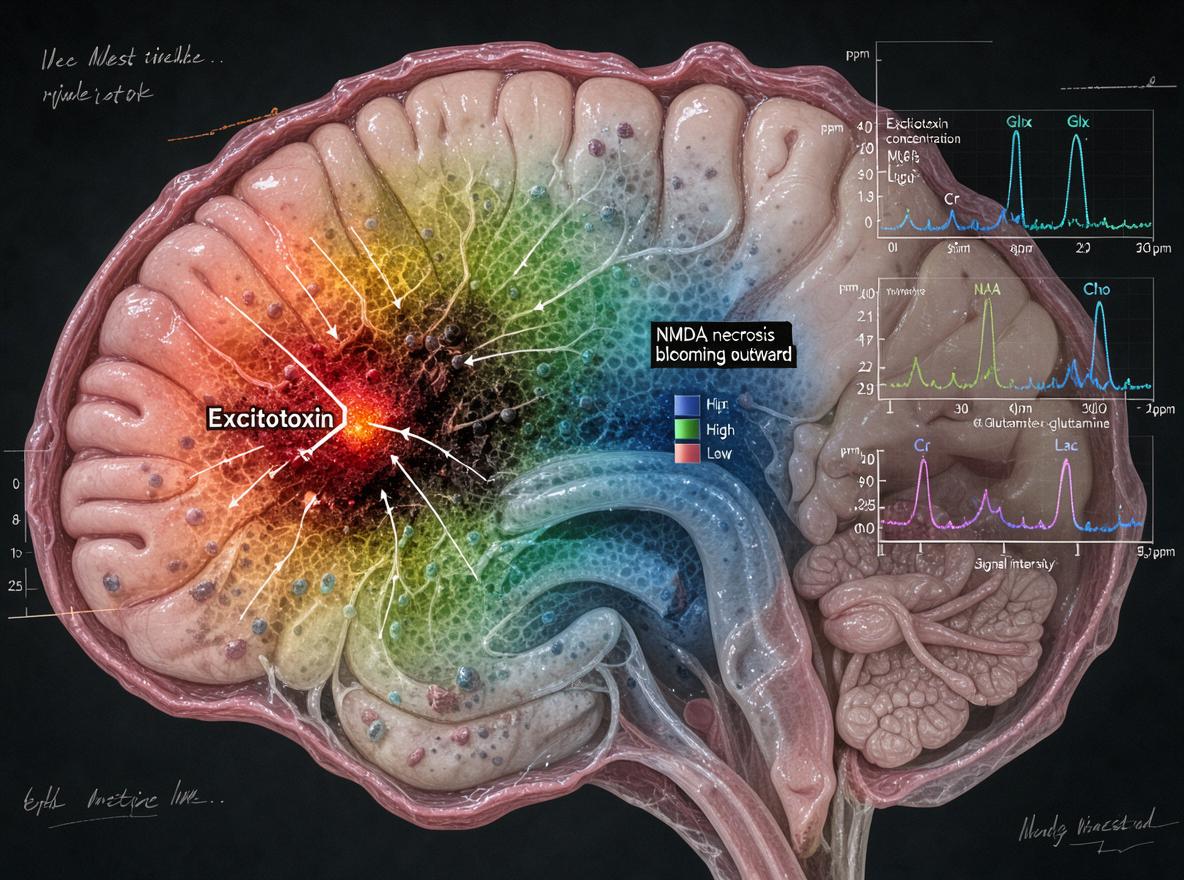
This 1991 neonatal rat study shows intracerebral NMDA and quisqualate, but not glutamate itself, reproduce hypoxic-ischemic-like damage patterns, while excitotoxin-induced metabolic changes (modest lactate rise, preserved PCr) differ markedly from hypoxia-ischemia .
Young et al. injected 7-day-old Sprague-Dawley rats intracerebrally with LD50 doses of glutamate (3.5 pmol), quisqualate (100 nmol), or NMDA (10 nmol) — a 350-fold dose spread used to equalize mortality — and compared outcomes to hypoxia-ischemia (carotid ligation + 3.5 h, 8% O₂). NMDA produced the most severe injury (near-total cortical, hippocampal, and white-matter necrosis mimicking the middle cerebral artery territory of hypoxia-ischemia), QA was intermediate with selective hippocampal pyramidal necrosis, and glutamate caused only mild local damage .
The decisive biochemical dissociation: lactate doubled with all three excitotoxins but rose ~7-fold with hypoxia; glucose fell with hypoxia but rose with GLU; phosphocreatine declined only during hypoxia (0.05 < P < 0.1) . This argues energy failure is not required for excitotoxic injury — supporting the authors' hypothesis that energy collapse is an epiphenomenon, not a cause.
Mechanistic Interpretation and Unexplained Findings
The fivefold glycine rise, inversely correlated with damage severity, is flagged by the authors as unexplained. They attribute GLU's relative neonatal safety to rapid high-affinity uptake (noting GLU binding sites are low postnatally while NMDA receptors enrich during development). Cross-species work reinforces this: neonatal macaques given MSG showed 17–90× plasma glutamate/aspartate elevations with no hypothalamic necrosis , and a toxicology review concluded marked plasma elevations plus high osmotic load are needed for neonatal mouse lesions, with strong species differences limiting mouse-to-primate extrapolation — a funding conflict (Gerber, Searle) that warrants skepticism.
Critical Limitations
Whole-brain extracts mask regional metabolism; cytosolic dilution may miss focal energy collapse.
No explicit blinding reported for 0–3 neuropathology scoring; small n (metabolic groups 4–6; NMDA pathology n=8).
Single timepoint (3 h) and single species/age; no long-term functional outcomes.
Equimortality dosing conflates toxin potency with diffusion/uptake differences the authors acknowledge cannot be fully separated.
Overall conclusion confidence: moderate — internally consistent within the model, but generalization to human neonatal hypoxic-ischemic encephalopathy requires caution given species-dependent excitotoxin sensitivity. Falsification would require showing equimortal GLU/QA/NMDA produce identical metabolic signatures to hypoxia-ischemia.
Feedback:
Updated: November 27, 2026
BGPT Paper Review
Study Novelty
60%
For 1991, applying proton MRS to dissect excitotoxic vs hypoxic metabolic signatures in neonatal brain was valuable but built on established excitotoxicity and kainate literature; the core dissociation was partially anticipated by prior slice and in vivo work.
Scientific Quality
70%
Controls (Tris vehicle, equimortality dosing, no anesthesia) are thoughtful and statistics use Bonferroni correction, but no explicit blinding, small n per group, whole-brain extraction dilution, and single timepoint weaken inference; NEJM-grade rigor not matched.
Study Generality
60%
Findings generalize within rodent neonatal excitotoxicity and inform hypoxia-ischemia mechanisms, but single species, age, and timepoint limit breadth; cross-species evidence shows excitotoxin sensitivity varies substantially.
Study Usefulness
70%
The metabolic dissociation (excitotoxic injury without energy failure) directly informs neuroprotection strategies targeting NMDA receptors rather than energy metabolism, and motivated the authors' MK-801 microdialysis program.
Study Reproducibility
60%
Methods (stereotaxic coordinates, doses, timing, MRS protocol) are detailed enough to reproduce, but no raw data or code availability, and inter-animal diffusion variability is acknowledged as uncontrolled.
Explanatory Depth
70%
Mechanistic reasoning links metabolite changes to transamination, glutamine synthetase uptake, and receptor ontogeny, though the glycine finding remains unexplained and mechanisms are inferred, not directly tested.
We'll email you the results when your analysis is finished.
Hypothesis Graveyard
Glutamate itself is the principal neonatal hypoxic-ischemic toxin via direct injection-equivalent action — falsified here because equimortal GLU produced minimal injury and metabolic signatures distinct from hypoxia, while NMDA-mimetic patterns dominated.

 Explore by Goal
 Quick Explanation
 Long Explanation
 Top Data Sources
 Ask a Follow-Up
 Key Insight
 Keep Exploring
 Hypothesis Graveyard
 Potential Experiments
 Discussion
