Ask questions across claims linked to experiments, exact results, limitations, and sources.Know what falsifiable science actually supports before you trust the answer.
Press Enter ↵ to search evidence
Explore by Goal
"The most important scientific revolutions all include, as their only common feature, the dethronement of human arrogance from one pedestal after another of previous convictions about our centrality in the cosmos."
- Stephen Jay Gould
Quick Analysis Plan
Copied
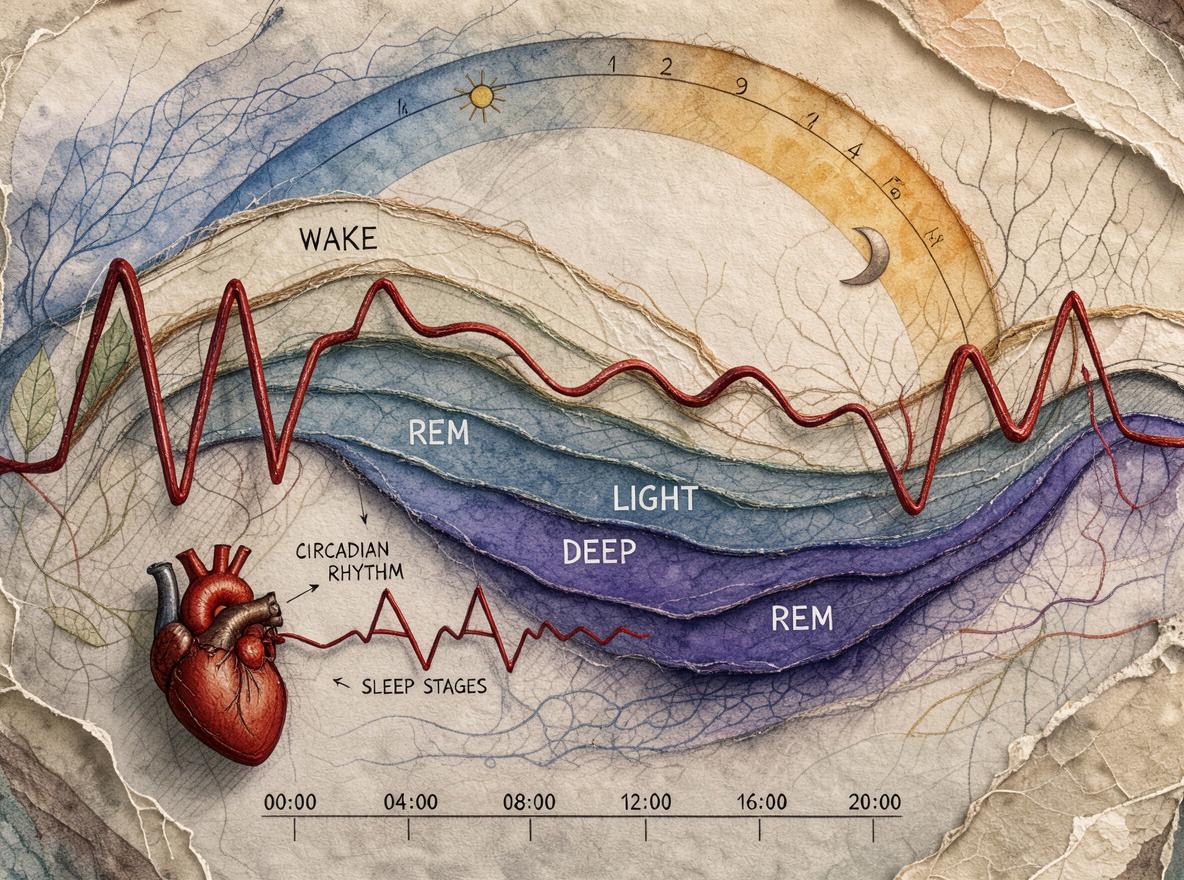
The supplied evidence does not support the claimed review: none of the records address circadian HR/HRV across sleep stages, forced desynchrony, or time-isolation protocols. Only indirect relevance exists — one systematic review notes circadian timing strongly affects short-term HRV reference values . Several records are about rhinoviruses (HRV-C), an acronym mismatch, not heart rate variability.
Long Analysis Plan
Evidence Mismatch: The Records Do Not Support the Claimed Topic
Verdict: the premise must be rejected. Of the seven claim-level records supplied, zero examine circadian heart rate or HRV across sleep stages, and none involve forced desynchrony or time-isolation protocols — the two gold-standard designs for dissociating circadian from sleep-homeostatic influences. The topic title appears to have conflated two unrelated meanings of the acronym "HRV": four records concern human rhinovirus species C (respiratory virology) , while three concern heart rate variability methodology — none of which report sleep-stage or circadian-phase data.
The closest indirect evidence is the systematic review of HRV reference values, which explicitly identifies circadian timing as a strong modifier of short-term HRV but provides no sleep-stage quantification and no controlled circadian protocols — high heterogeneity across 57 studies (1989–2022) prevented meta-analysis entirely . This directly foreshadows the design problem with time-isolation studies generally: without controlling circadian phase, HRV "reference values" are uninterpretable — but the review itself supplies no effect sizes for the circadian component.
The only quantitative HR/HRV data actually present in the records come from a single healthy adult under Stroop-type cognitive load (above) — an n=1 ad hoc illustrative example, not sleep-stage or circadian evidence .
What the Records DO Establish: Measurement Confounds That Would Undermine the Review
Methodological records show that any circadian HRV review ignoring preprocessing would be fragile. Under simulated missing data, physiology-informed DVC preprocessing preserved stress-classification F1 at ~0.60 even with 35% missing beats, while linear/pchip/spline interpolation fell below 0.50 F1 at only 10% missing data . Artifact-correction methods likewise differ materially: a proposed peak-correction algorithm achieved ~2% mean error vs ~16% for median filtering, validated on 23 of 59 cyclists (NEEDED race) plus open PhysioNet data, with the primary dataset private — limiting replication . RNN-based gap filling outperformed cubic-spline interpolation and deletion across gap sizes (1-10 missing beats) in 15 race + 11 lab participants, yet could not accurately reconstruct individual RR intervals .
Critical Blind Spots
Publication/selection bias in reference-value literature: the systematic review flags possible bias toward studies reporting normal values, and underrepresentation of sleep, ethnicity, and lifestyle confounders — precisely the variables a circadian review would need .
Small-n and dataset specificity: artifact-correction validation rests on 11–23 subjects per dataset; subject-dependent model performance means pooled effect estimates across sleep stages would carry large, unquantified heterogeneity.
Missing evidence to answer the actual question: no forced-desynchrony data, no sleep-stage (N1/N2/N3/REM) HR or HRV values, no circadian phase-amplitude estimates, no time-isolation cohorts. What would change this verdict: claim-level records quantifying HR/HRV by sleep stage under FD vs constant routine, with circadian phase fitted (e.g., core-body-temperature minimum alignment) and sample sizes.
Confidence in this verdict: high (9/10) — the topic is a genuine open question, but it cannot be evaluated from the records supplied.
We'll email you the results when your analysis is finished.
Hypothesis Graveyard
'HRV-C records are relevant to the circadian review' — falsified: HRV-C here denotes human rhinovirus species C, a respiratory virus characterized from pediatric nasopharyngeal aspirates, with zero cardiovascular content.
'The single-subject cognitive-load HRV example provides baseline circadian HR values' — rejected: n=1 ad hoc illustrative data with no circadian or sleep-stage control carries no evidential weight for the claimed comparison.

 Explore by Goal
 Quick Analysis Plan
 Long Analysis Plan
 Top Data Sources
 Ask a Follow-Up
 Key Insight
 Keep Exploring
 Hypothesis Graveyard
 Potential Experiments
 Discussion
