Go beyond summaries to locate specific, verifiable claims and sources within research.Know what falsifiable science actually supports before you trust the answer.
Press Enter ↵ to search paper
Explore by Goal
"The first principle is that you must not fool yourself — and you are the easiest person to fool."
- Richard Feynman
Quick Explanation
Copied
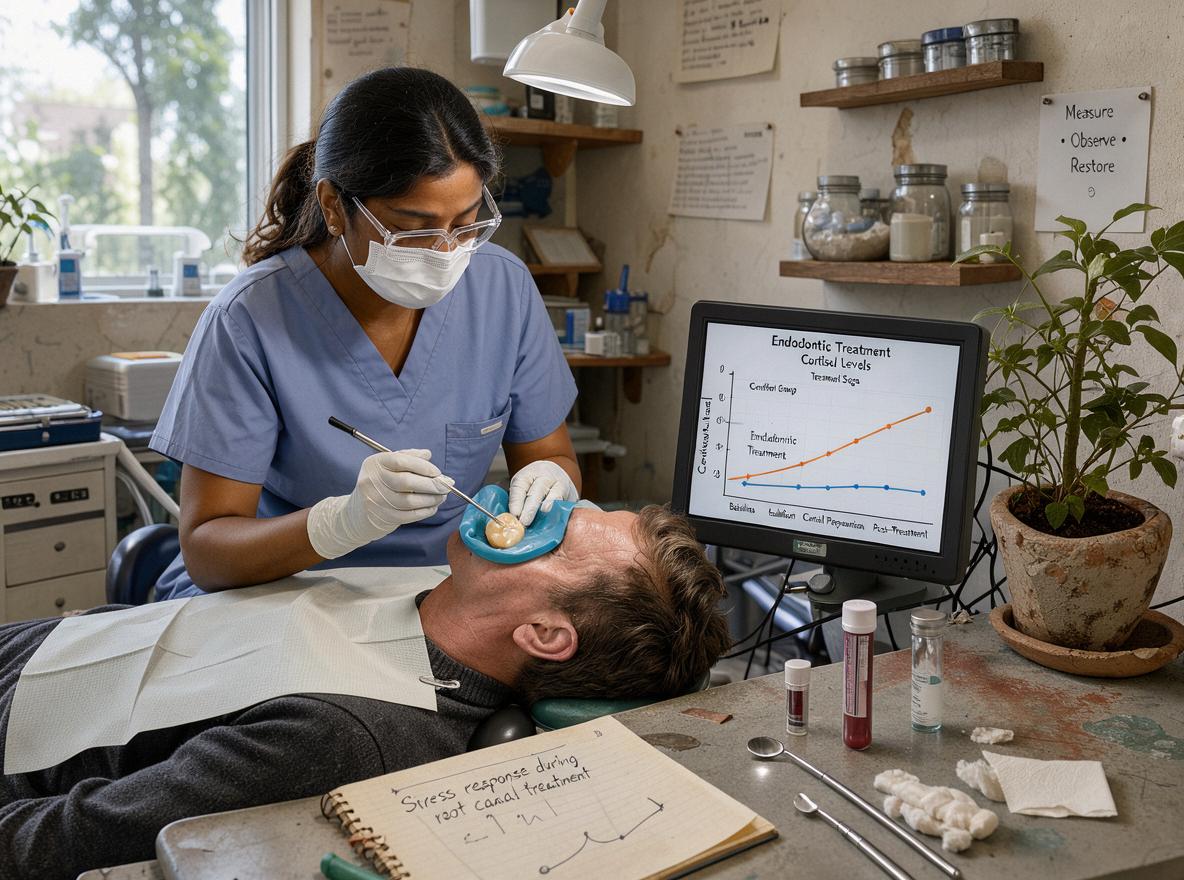
This within-subject study of 44 adults found subjective dental anxiety (CDAS) fell after both procedures, but salivary cortisol fell only after restorative treatment, with no consistent psychometric–hormonal correlation — a clean dissociation between felt and physiological stress, though the lack of a control group, single site, and small sample limit causal strength.
Long Explanation
What the evidence actually shows
In 44 adults (18 male, 26 female) with asymptomatic upper premolars, the same tooth received endodontic treatment (ET) and, one week later, restorative treatment (RT) by a single operator — a within-subject design that elegantly controls for trait anxiety and individual HPA-axis reactivity . The central, genuinely interesting result is a dissociation: CDAS scores decreased significantly after both ET (p = 0.004) and RT (p < 0.001), whereas cortisol decreased significantly only across RT phases (pre-RT to post-RT, p < 0.001; post-ET to post-RT, p = 0.006) — and changes in CDAS did not correlate with changes in cortisol .
The median cortisol trajectory (2.09 → 2.33 ng/mL across ET vs 2.65 → 1.63 ng/mL across RT) is compatible with two non-exclusive readings: anticipation/relief dynamics rather than procedure-type effects, or diurnal drift, since sampling spanned 08:00–12:30 . Notably, cortisol rose nominally after ET (2.09→2.33) while self-reported anxiety fell — the opposite of a simple "stress hormone tracks fear" narrative. This dissociation is consistent with broader evidence that subjective and endocrine stress measures decouple: pharmacological hydrocortisone altered mood without parallel anxiety changes , and the cortisol awakening response buffers daily distress independently of anticipation .
Critical appraisal
Strengths: within-subject design, gold-standard LC-MS/MS assay (superior specificity to immunoassays ), morning sampling, single operator, Bonferroni correction, and honest negative correlation finding (reduces HARKing risk). Weaknesses: no control group or no-treatment visit; fixed ET-before-RT order confounds procedure type with sequence/time; 4.5-hour morning window permits diurnal cortisol decline (the falling post-RT value could partly be circadian); repeated CDAS invites demand/repetition effects; single site, young-skewed, gender-unbalanced sample (26 F / 18 M) limits generalizability . Notably, the authors did acknowledge most of these, which strengthens reporting integrity.
What would change the conclusion: a randomized cross-over trial with counterbalanced procedure order, tightly matched sampling times, and a sham/no-treatment arm. If ET and RT cortisol trajectories then converge, the current ET-vs-RT difference is mostly an order/time artifact; if strong CDAS–cortisol correlations emerge once diurnal confounding is removed, the "dissociation" claim collapses. Confidence in the dissociation finding itself is moderate — the null correlation could reflect low power (n=44) as easily as true decoupling. Individual-level data are available only on request, hampering independent reanalysis.
Explore deeper:
Feedback:
Updated: November 25, 2026
BGPT Paper Review
Study Novelty
60%
Within-subject CDAS–cortisol dissociation across two procedures on the same tooth is a tidy refinement, but dental-anxiety cortisol studies and psychophysiological decoupling are established themes; the paired-procedure design is the main fresh element.
Scientific Quality
70%
Validated LC-MS/MS assay, Bonferroni correction, single operator, and transparent limitation reporting are strong; however, non-randomized fixed procedure order, no control group, wide diurnal sampling window, and reliance on median-based nonparametric tests without effect sizes constrain inference. Honest reporting of the null correlation reduces positive-result bias.
Study Generality
50%
Study Usefulness
60%
Useful for dental clinicians recognizing that self-report and HPA-axis measures index different constructs, and for methodologists designing stress studies; limited by inability to attribute effects to procedure type versus order or time of day.
Study Reproducibility
60%
Methods (LC-MS/MS parameters, CDAS, timepoints, statistics in SPSS) are specified and a-priori power analysis with G*Power was reported, but raw data are only available on request, preventing full independent verification.
Explanatory Depth
50%
Reports a dissociation but offers no mechanistic account (e.g., anticipation, circadian phase, HPA habituation) for why cortisol fell after RT but not ET; explanatory depth stops at description.
We'll email you the results when your analysis is finished.
Hypothesis Graveyard
'Endodontic treatment is inherently more physiologically stressful than restorative treatment' — the fixed order (ET first, RT a week later) makes this untestable here; the nominally higher post-ET cortisol may reflect anticipation or the first-visit novel-stressor effect rather than procedure type.
'Anxiety questionnaires and cortisol are interchangeable stress biomarkers' — already implausible given the null within-subject correlation here and hydrocortisone pharmacopsychology showing mood effects without anxiety-like increases.

 Explore by Goal
 Quick Explanation
 Long Explanation
 Top Data Sources
 Ask a Follow-Up
 Key Insight
 Keep Exploring
 Hypothesis Graveyard
 Potential Experiments
 Discussion
