Check whether claims match experiments, exact reported results, and stated limitations.Know what the science actually supports before you trust the answer.
Press Enter ↵ to review paper
Explore by Goal
"The diversity of the phenomena of nature is so great, and the treasures hidden in the heavens so rich, precisely in order that the human mind shall never be lacking in fresh nourishment."
- Johannes Kepler
Quick Answer
Copied
This 2009 murine study showed that MyD88-dependent innate signaling was required for nearly all cardinal features of house dust mite (HDM) asthma—eosinophilia, Th2 cytokines, IL-17, neutrophilia, and airway hyperreactivity—while TLR4 deficiency attenuated only the Th2/eosinophilic arm, not Th17/neutrophilic responses, implying distinct innate PRR combinations drive divergent T-helper phenotypes. Strengths include adjuvant-free sensitization to a clinically relevant allergen and clean knockout logic; key limitations are mouse-to-human extrapolation, uncharacterized HDM ligands, and modest sample sizes (4–12 mice/group).
Long Answer
Evidence Map: What the Knockout Data Show
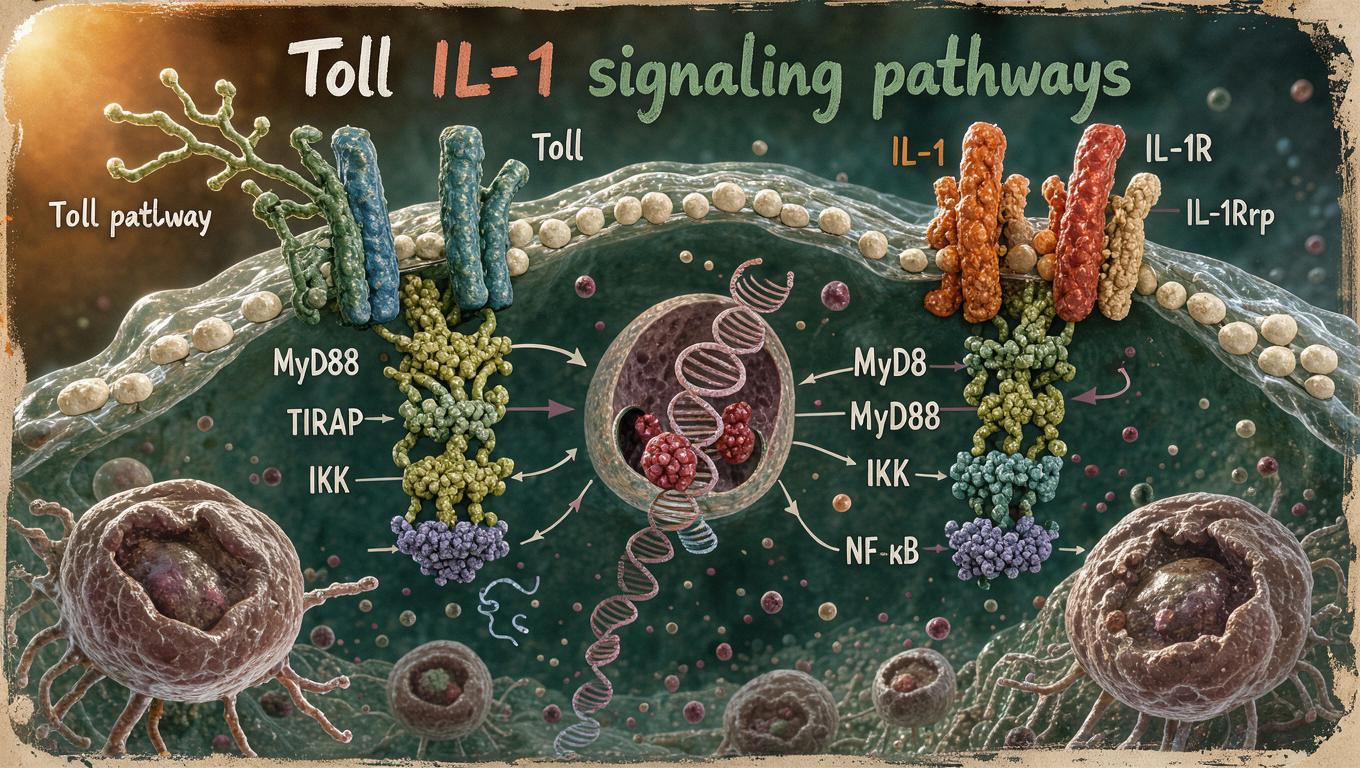
Phipps et al. sensitized BALB/c mice intranasally with HDM extract (Dermatophagoides pteronyssinus) without adjuvants or LPS spiking, then compared wild-type, MyD88–/–, TLR2–/–, and TLR4–/– mice across inflammation, cytokine, and lung-function readouts . In vitro, HDM activated NF-κB in TLR2- and TLR4-transfected HEK cells, but not TLR3/5/9; the TLR2/4 activation persisted with the cysteine protease inhibitor E-64, arguing against protease-generated endogenous danger signals—though serine proteases were not excluded.
Heat encodes the authors' reported direction of change versus wild-type: 0 = significantly attenuated, 1 = not significantly altered. Goblet cell hyperplasia was MyD88-independent, IL-17/neutrophilia were MyD88-dependent but TLR4-independent, and Th2 responses tracked the TLR4–MyD88 axis. Values are semi-quantified from reported significance statements, not exact effect sizes.
Critical Assessment
Strengths: Adjuvant-free airway sensitization to a clinically relevant allergen extends the Eisenbarth OVA/LPS paradigm; the dissociation between TLR4 (Th2) and MyD88-total (Th17/neutrophilic) responses is internally consistent, with residual AHR in TLR4–/– mice plausibly neutrophil-mediated. The OX40L-mDC finding links signaling to a known Th2-polarizing checkpoint. Authors declared no financial conflicts .
Limitations the authors partially addressed but did not fully close: (1) The identity of the TLR ligands within HDM was not determined—mite-derived or from mite-associated microbes (bacteria, fungi, protozoa) remains open; (2) TLR2–/– mice paradoxically showed reduced IFN-γ, left mechanistically unexplained; (3) IL-17 elevation in TLR4–/– mice was reported as "data not shown"; (4) n = 4–12 mice/group with Student t-tests and no correction for multiple comparisons; (5) whole-body knockout confounds epithelial vs DC-intrinsic MyD88 roles; (6) BALB/c background may not generalize—strain effects on Th2 skewing are well documented; (7) IgE was undetectable, limiting humoral conclusions. A sponsor tie (Boehringer Ingelheim fellowship) is declared and unlikely to bias a basic mechanism paper, but is worth noting.
What would falsify the central claim: demonstrating full HDM asthma phenotypes in MyD88–/– mice on other backgrounds, or identifying a MyD88-independent epithelial pathway (e.g., TSLP) sufficient for Th2 sensitization when MyD88 is intact—consistent with the authors' own caveat that OX40L/TSLP causality was not directly tested.
Feedback:
Updated: October 27, 2026
BGPT Paper Review
Study Novelty
70%
First demonstration using a clinically relevant aeroallergen without exogenous adjuvant that MyD88 is near-essential for Th2 asthma, and that Th2 vs Th17 responses diverge at the TLR4 level; built directly on the Eisenbarth OVA/LPS paradigm.
Scientific Quality
80%
Rigorous knockout design, multiple complementary readouts, batch control of HDM, protease controls. Weaknesses: small n, no multiple-comparison correction, several 'data not shown' claims, whole-body KOs, single strain.
Study Generality
70%
Mechanistic findings on innate control of T-helper fate extend beyond HDM to allergen innate immunology broadly, but are murine and allergen-specific; human translation inferred rather than demonstrated.
Study Usefulness
80%
Established HDM as the adjuvant-free asthma model standard and framed neutrophilic/Th17 asthma as a distinct innate-signaling phenotype, guiding later work on epithelial cytokines and endotoxin thresholds.
Study Reproducibility
70%
Detailed methods (doses, strains, backcrossing, reagents, commercial HDM source) support replication; some key results relegated to 'data not shown' reduce verifiability.
Explanatory Depth
70%
Provides a causal chain (HDM → TLR4/MyD88 → mDC maturation/OX40L → Th2 → AHR) but leaves ligand identity and Th17-inducing PRR unresolved, acknowledged by authors.
We'll email you the results when your analysis is finished.
Hypothesis Graveyard
TLR2 activation universally drives Th2 responses: rejected here because TLR2–/– mice developed full allergic inflammation; prior Pam3Cys/OVA studies used artificial routes and adjuvants that inflated TLR2's Th2 role.
Goblet cell hyperplasia is IL-13/T-cell dependent: preserved in MyD88–/– mice despite absent Th2 cytokines, suggesting non-T-cell innate eosinophil/mucus pathways during primary exposure.

 Explore by Goal
 Quick Answer
 Long Answer
 Top Data Sources
 Ask a Follow-Up
 Key Insight
 Keep Exploring
 Hypothesis Graveyard
 Potential Experiments
 Discussion
