Check a paper's claims against linked experiments, exact results, stated scope, and limitations.Know what falsifiable science actually supports before you trust the answer.
Press Enter ↵ to search evidence
Explore by Goal
"The scientist is not a person who gives the right answers, he's one who asks the right questions."
- Claude Lévi-Strauss
Quick Explanation
Copied
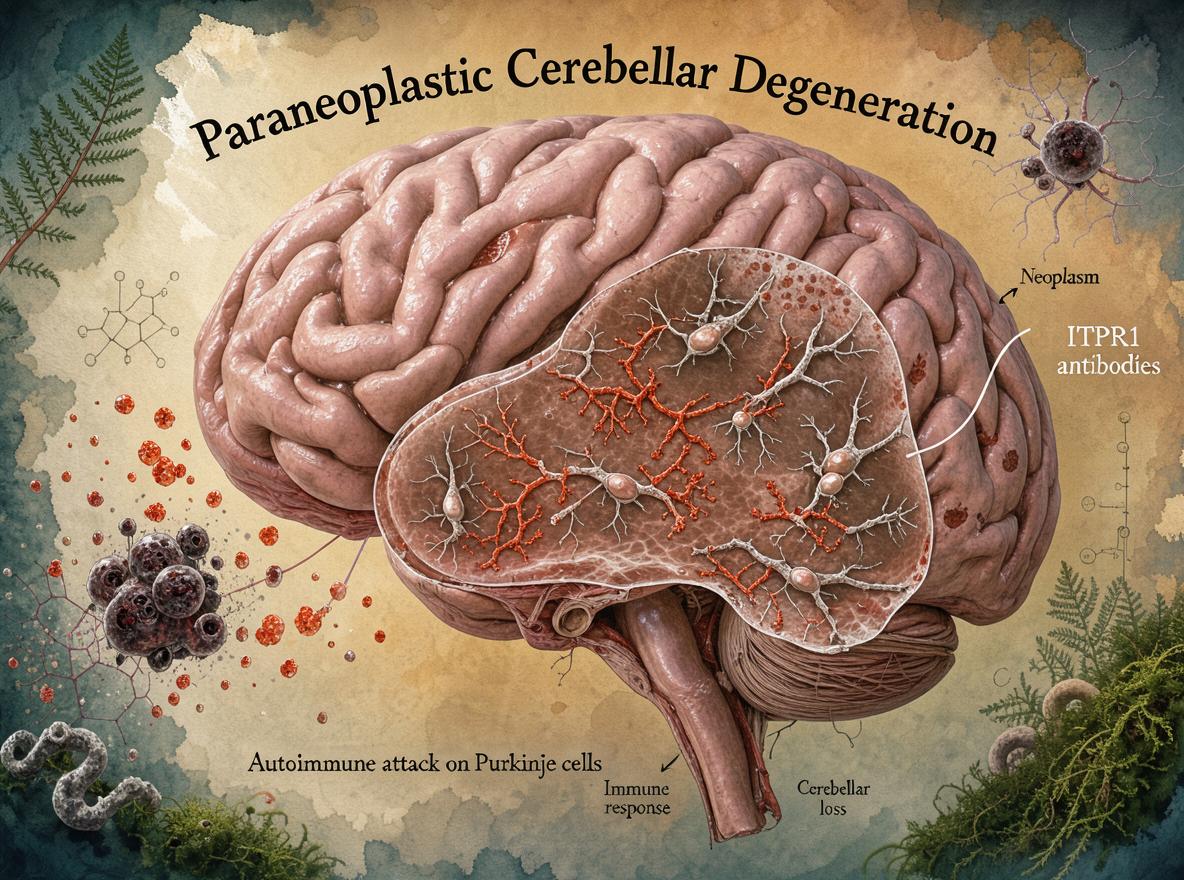
This is a single-patient clinical note describing a 31-year-old woman with anti-ITPR1 cerebellar ataxia who developed ITPR1-expressing breast cancer 11 years later, suggesting but not proving a paraneoplastic relationship. With only 5 published anti-ITPR1 ataxia cases and no tumor association previously reported, the cancer link remains speculative and the claim rests on temporal coincidence plus tumor antigen expression, not causation.
Long Explanation
Case Evidence and Author Interpretation
The paper reports a Martinican woman who at 31 (after 3 years of progressive gait ataxia and dysarthria) had pontocerebellar atrophy with hot cross bun sign on MRI, acellular CSF without oligoclonal bands, and high-titer anti-Purkinje cell antibodies (serum 1/32,000; CSF 1/1,000) later characterized as anti-ITPR1 .
Immunotherapy (methylprednisolone, plasma exchange, IVIg) failed; she stabilized severely disabled. She carried a pathogenic germline BRCA1 mutation, and 11 years after onset, surveillance mammography found a bifocal grade I, ER+/PR+/Her2+ ductal carcinoma with nodal metastases; both tumor and metastatic nodes expressed ITPR1. The authors infer the cerebellar autoimmunity was paraneoplastic, but explicitly acknowledge that with only 4 prior published anti-ITPR1 ataxia cases and no other tumor association, no conclusion about cancer association is possible.
Critical Appraisal
Reported observations: clinical course, titers, imaging, tumor pathology, and BRCA1 status are documented in detail. Author interpretation: the paraneoplastic label is an inference from tumor ITPR1 expression plus temporal sequence; the patient was in tumor remission with unchanged neurology at 6 months, so no causal test occurred. BGPT inference: 11 years is far longer than typical PCD-to-cancer intervals reported in the cited Euronetwork series, and ITPR1 is broadly expressed in normal tissues, so tumor expression alone is weak evidence. Possible confounders include the BRCA1-driven breast cancer risk being independent of the ataxia, and coincidence. The long latency also raises the reverse-causality question: could decades of autoimmunity be unrelated to a genetically predisposed cancer? No post-treatment antibody titer data are given, which would be the natural falsification test. Strengths: rigorous negative tumor screening before cancer, objective immunopathology, and full serial clinical data.
Feedback:
Updated: November 21, 2026
BGPT Paper Review
Study Novelty
70%
First report of tumor association (and specifically ITPR1-expressing breast cancer) in anti-ITPR1 cerebellar ataxia; the antibody itself was described before, so novelty is incremental but real.
Scientific Quality
60%
Careful, transparent case documentation with honest caveats, but a single case with no mechanistic proof of paraneoplastic causation; no prompt injections detected.
Study Generality
40%
Very niche single-case report; generalizable only as a caution about cancer surveillance in intracellular-antigen autoimmunity.
Study Usefulness
50%
Useful clinically for flagging individualized cancer-risk assessment in anti-ITPR1 and related antibody syndromes; limited for advancing mechanisms.
Study Reproducibility
50%
Methods (titers, immunopathology, imaging) are described but single-case, no full antibody characterization protocol or raw data provided.
Explanatory Depth
40%
Describes a plausible antigen-overlap mechanism but does not test it; no functional antibody studies, titer dynamics, or T-cell data.
Compiling a structured case-timeline table of clinical events, antibody titers, and tumor pathology from the anti-ITPR1 report for evidence inspection.
Get emailed when your analysis is done!
We'll email you the results when your analysis is finished.
Hypothesis Graveyard
'ITPR1 tumor expression proves paraneoplastic origin' - rejected because ITPR1 is broadly expressed in many normal tissues and tumors, so expression alone is non-specific; causation needs titer dynamics or T-cell responses.

 Explore by Goal
 Quick Explanation
 Long Explanation
 Top Data Sources
 Ask a Follow-Up
 Key Insight
 Keep Exploring
 Analysis
 Hypothesis Graveyard
 Potential Experiments
 Discussion
