Ask questions across claims linked to experiments, exact results, limitations, and sources.Know what the science actually supports before you trust the answer.
Press Enter ↵ to search evidence
Explore by Goal
"Nothing in life is to be feared, it is only to be understood. Now is the time to understand more, so that we may fear less."
- Marie Curie
Quick Answer
Copied
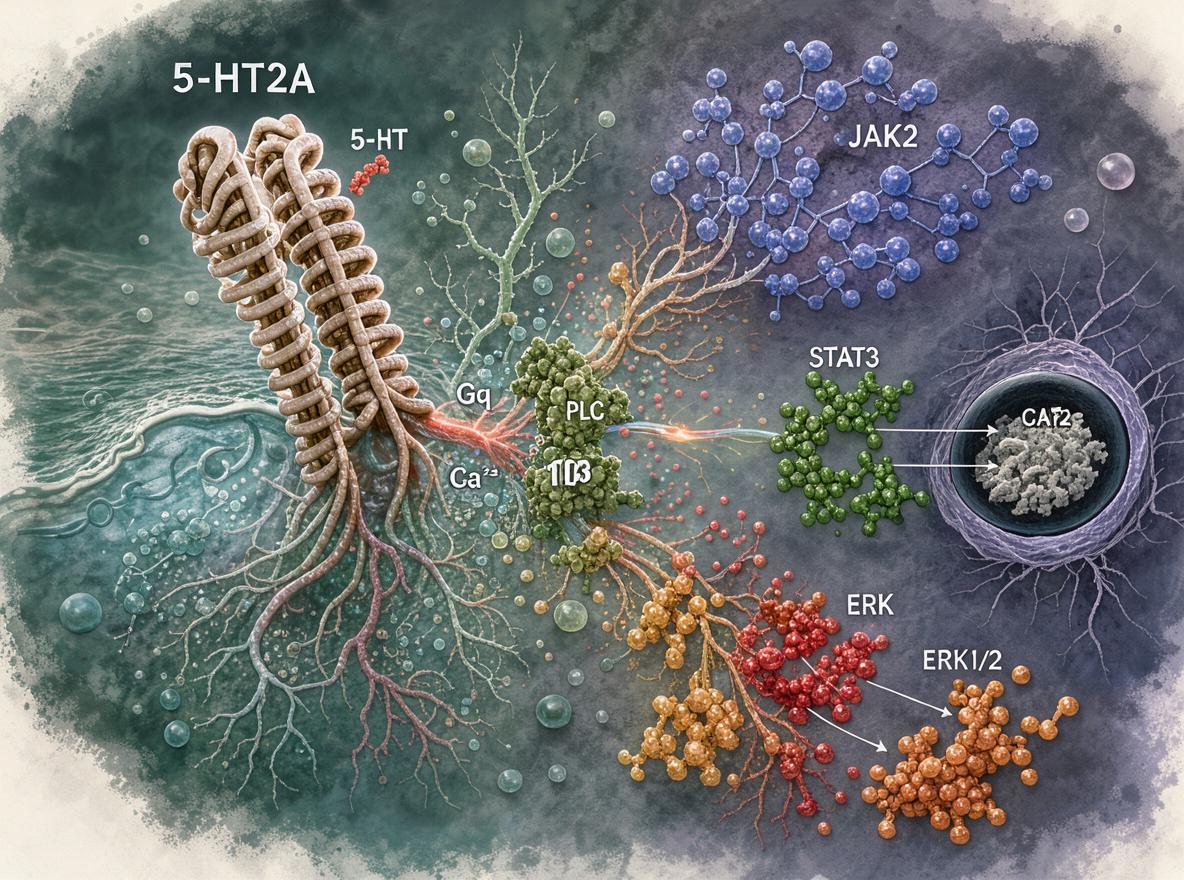
Psychedelics (psilocybin, LSD, DMT) act primarily as agonists at serotonin 5-HT2A receptors, triggering Gq/PLCβ signaling and downstream cascades including JAK2-STAT3 and Ras-ERK1/2 phosphorylation, as demonstrated for the 5-HT2A agonist DOI in cellular models . However, no supplied source directly establishes the full psychedelic neurobiological mechanism.
Long Answer
Core pharmacology: Classic psychedelics are agonists at serotonin receptors, most critically the 5-HT2A subtype. A signaling-dissection study using the selective 5-HT2A agonist DOI showed that receptor activation phosphorylates JAK2, driving both STAT3 Tyr705 phosphorylation and ERK1/2 activation through a PLCβ–PKCβ–Ras axis, with MEK1/2 (U0126, 25 µM) and JAK2 (AG490, 30 µM) inhibition fully blocking downstream effects while PI3K-AKT was activated but not required . This illustrates that 5-HT2A is a pleiotropic G-protein-coupled receptor engaging multiple transduction cascades beyond canonical Gq/PLC.
Broader serotonergic context: Serotonin signaling varies widely by receptor subtype: 5-HT2C receptors tonically inhibit nigrostriatal dopaminergic activity, since 5-HT2C-null mice show elevated substantia nigra dopaminergic firing and striatal dopamine , and 5-HT2A vs 5-HT2C exert opposing control over psychostimulant-induced dopamine output in VTA and nucleus accumbens . Serotonin also stimulates microglial exosome secretion (~4.8-fold IDE release in BV-2 cells at 25 µM 5-HT) .
Epistemic limits: The supplied evidence covers serotonergic receptor signaling broadly but no source directly characterizes psychedelic drugs' subjective or therapeutic neural mechanisms (e.g., cortical glutamate release, neuroplasticity, entropic brain effects). Those central claims are therefore unresolved here; the clinical trials listed (psilocybin in AUD/OCD, LSD dose-ranging, SERT inhibition on LSD response ) address safety and mechanism indirectly.
We'll email you the results when your analysis is finished.
Hypothesis Graveyard
Psychedelics act purely monoamine-transporter-mediated (like SSRIs): refuted by receptor-class specificity; 5-HT2A agonism with distinct downstream cascades (JAK2/PLCβ/Ras) best explains their unique profile.
All psychedelic effects reduce to elevated extracellular serotonin: null-mutation data show 5-HT2C tonically gates dopamine independently, so receptor-subtype configuration, not bulk serotonin level, determines output.

 Explore by Goal
 Quick Answer
 Long Answer
 Top Data Sources
 Ask a Follow-Up
 Key Insight
 Keep Exploring
 Hypothesis Graveyard
 Potential Experiments
 Discussion
