Check your hypothesis against versioned claims, exact reported results, and stated falsification criteria.Know what falsifiable science actually supports before you trust the answer.
Press Enter ↵ to search evidence
Explore by Goal
"Biology is a science of three dimensions. The first is the study of each species across all levels of biological organization, molecule to cell to organism to population to ecosystem. The second dimension is the diversity of all species in the biosphere. The third dimension is the history of each species in turn, comprising both its genetic evolution and the environmental change that drove the evolution."
- E. O. Wilson
BGPT Odds of True
50%
80% Confidence
Part 1 (predictable scaling of duration with distance from Γ0) is theoretically plausible but completely untested — only one initial condition and one distance (≈1.75×10⁻³) exist in the source. Part 2 (observable-dependent selection) is consistent with the observable-relative framework but never demonstrated. Midpoint estimate reflects plausible-but-unverified status.
Hypothesis Novelty
75%
The transient-center framework itself is new (Oct 2026); asking for quantitative duration–distance scaling laws and observable-comparison on Γ0 goes beyond the paper's own open conjectures, so it is a genuinely novel extension rather than a restatement.
Quick Analysis Plan
Copied
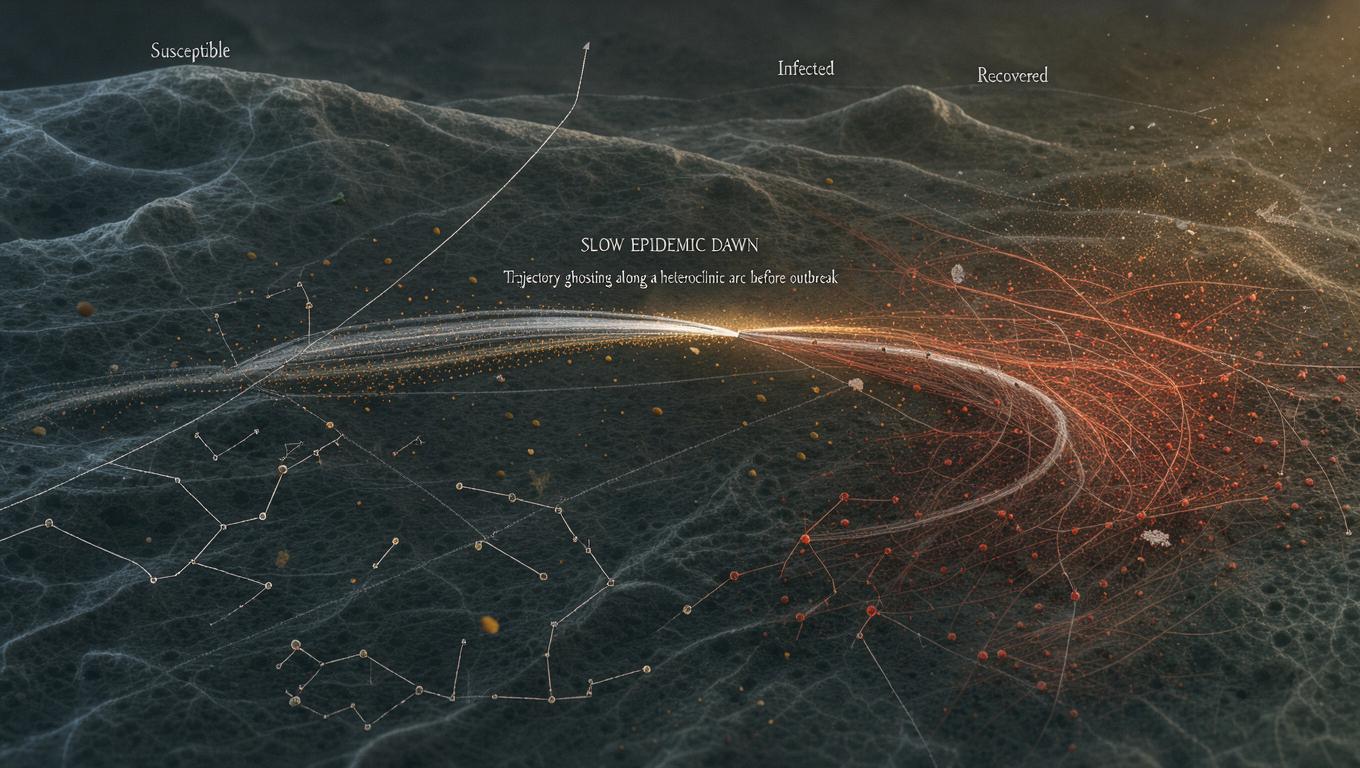
The source paper proves the heteroclinic orbit Γ0 of reachable transient centers exists and shows one trajectory passing within ≈1.75×10⁻³ of it, but it never tests whether inter-epidemic duration scales with initial distance from Γ0, nor compares observables . Both parts remain untested conjectures.
Long Analysis Plan
What the evidence supports — and what it cannot
The paper establishes the structural half of the hypothesis: every point of the disease-free heteroclinic orbit Γ0 is a reachable v-transient center (Theorem 4.6), and all disease-free feasible points are v-transient centers (Theorems 4.2–4.3) . The framework is explicitly observable-relative (escape criteria built on g = Dv, g², or auxiliary scalars), which makes observable-dependent selection of transient centers conceptually coherent — but the paper never defines a duration metric, never varies the observable, and never varies the initial condition.
Missing to test the hypothesis: (1) a duration-vs-distance sweep from a family of initial conditions near Γ0 (only one IC, z0=(35, 0.09555, 67), distance ≈1.75×10⁻³, is shown); (2) a formal scaling law — near-heteroclinic slow passage often scales logarithmically with distance in relaxation oscillators, but this is inferred, not shown; (3) a comparison of observable choices (I vs. N vs. log I) on the same orbit. The converse characterization of all reachable centers in D0 is an acknowledged open conjecture .
We'll email you the results when your analysis is finished.
Hypothesis Graveyard
Duration scales linearly with distance from the disease-free equilibrium E+ rather than from Γ0: rejected as the primary hypothesis because the paper's own construction routes slow passage along Γ0, making orbit-distance the geometrically natural predictor, though it remains untested against equilibrium-distance scaling.
A single 'universal' transient center governs all inter-epidemic delays: undermined by the theory's explicit observable-relativity (g = Dv criteria), which permits multiple centers on the same orbit.
Science Art
Science Movie
Make a narrated HD Science movie for this answer ($64 per minute)

 Explore by Goal

 Hypothesis Novelty
 Quick Analysis Plan
 Long Analysis Plan
 Top Data Sources
 Ask a Follow-Up
 Key Insight
 Keep Exploring
 Hypothesis Graveyard
 Discussion
