Check a paper's claims against linked experiments, exact results, stated scope, and limitations.Know what falsifiable science actually supports before you trust the answer.
Press Enter ↵ to search evidence
Explore by Goal
"The scientific man does not aim at an immediate result. He does not expect that his advanced ideas will be readily taken up. His work is like that of the planter - for the future. His duty is to lay the foundation for those who are to come, and point the way."
- Nikola Tesla
Quick Explanation
Copied
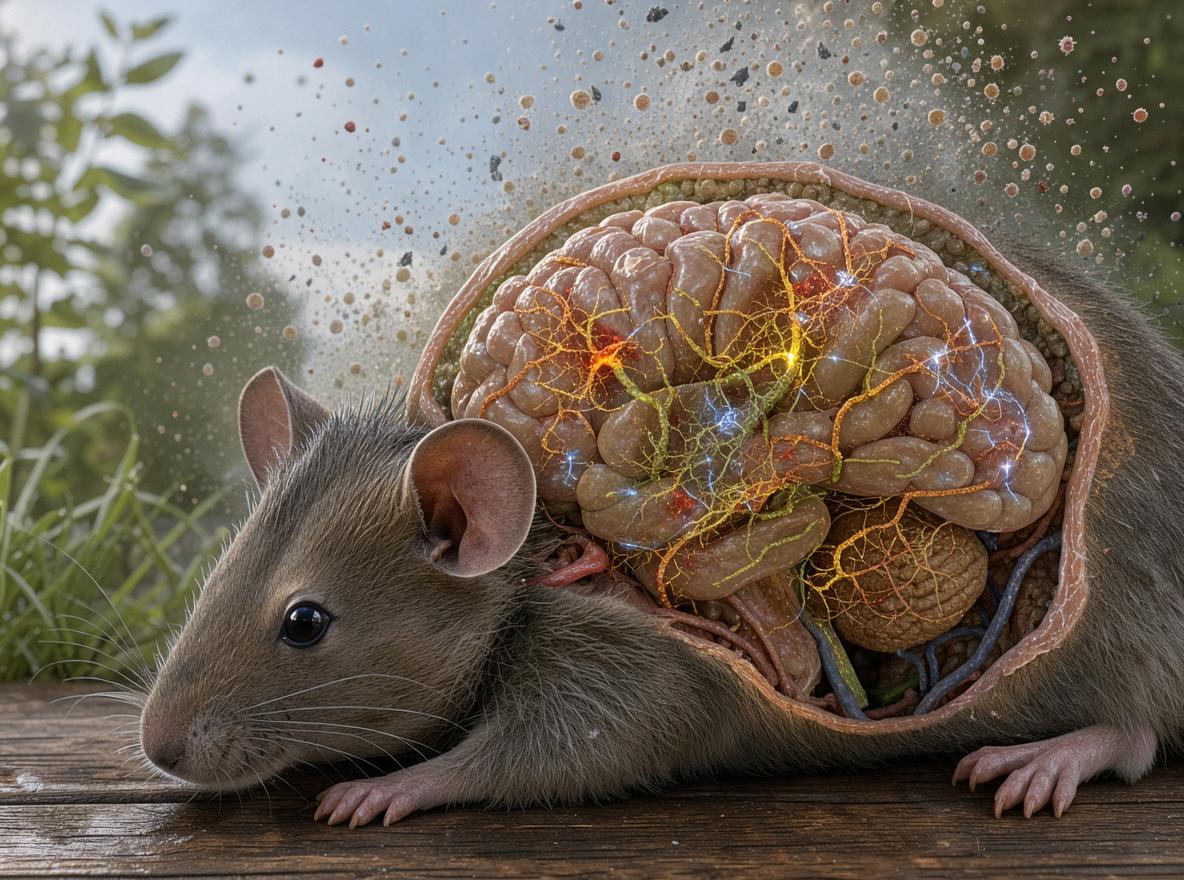
This bioRxiv preprint reports that adult C57BL/6J mice surviving nasal H1N1 influenza A pneumonitis show elevated brain H2O2, protein nitrotyrosination, and total α-synuclein six weeks post-inoculation, with relative tau phosphorylation rising only in Lrrk2 p.G2019S mice, despite no genotype effect on acute survival or lung viral titres .
Long Explanation
What the Study Found (Reported Evidence)
Adult (5–7 week) C57BL/6J mice — wild-type, Lrrk2 p.G2019S (GS/GS), and Lrrk2 p.D1994S (kinase-dead) knock-ins — were nasally inoculated with 2×10³ PFU of mouse-adapted influenza A/Fort Monmouth/1/1947 H1N1 (1 LD50). Neither genotype altered survival, weight loss, or lung viral titres at 3 dpi; female mice had higher mortality, consistent with prior H1N1 work in this strain .
At 6 weeks post-inoculation (6 wpi), with no detectable H1N1 protein in brain by Western blot, infected survivors showed: (1) elevated brain H2O2 (P<0.001 pooled, P<0.05 in WT subgroups); (2) increased protein nitrotyrosination (P<0.001 pooled; significant in male GS mice, trends in females); (3) higher total soluble α-synuclein (P<0.05 pooled only, lost on genotype/sex stratification); and (4) a GS-dependent ~increase in the fold-change of [p-tau(Ser199)]/[t-tau] vs WT (P<0.01, Fig. 4i) .
Outcome (6 wpi)
Pooled significance
Stratified result
Genotype dependence
H2O2 (Amplex Red)
P<0.001
WT significant; GS trend
No
Nitrotyrosination (blot)
P<0.001
Male GS significant; female trends
No (sex-modulated)
Total α-synuclein (ELISA)
P<0.05
Not significant split by genotype/sex
No
[p-tau]/[t-tau] fold change
NS
GS > WT (P<0.01, Fig. 4i)
Yes (p.G2019S)
Critical Appraisal
Strengths: Well-defined model with both hyperkinase and kinase-dead Lrrk2 alleles; both sexes; open Zenodo deposition (Key Resources Table) ; honest reporting of null acute effects and of α-synuclein significance that collapses when stratified.
Weaknesses (acknowledged by authors): single 6-wpi timepoint; young mice; tau phosphorylation is notoriously sensitive to hypothermia, anesthesia, and circadian state — a real confound the authors flag but cannot exclude. Additional BGPT critiques: effect sizes and n per group are not visible in the provided text, so power for stratified analyses is unverifiable; the key tau finding is a derived ratio-of-fold-changes (infected/mock per genotype), which compounds noise and is vulnerable to regression-to-the-mean; mechanism (peripheral cytokine signals vs BBB changes vs systemic ROS) is explicitly untested; soluble α-synuclein elevation does not demonstrate aggregation or seeding. Still a preprint (bioRxiv, July 31, 2025), so not yet peer-reviewed.
Key Uncertainties
Whether effects persist beyond 6 wpi, whether they occur in aged hosts, whether they translate to neurotropic viruses or humans, and the causal pathway from lung to brain all remain unknown — the authors themselves label the peripheral-inflammation-to-brain hypothesis "a theory that remains to be tested." Confidence in the descriptive findings: moderate; confidence in causal/mechanistic interpretation: low pending longitudinal and mechanistic studies.
Author Reviews:
Feedback:
Updated: October 31, 2026
BGPT Paper Review
Study Novelty
70%
Extends known influenza-neurodegeneration links (H5N1 neurotropism, H1N1 gliosis) to non-neurotropic H1N1 in adult survivors with paired Lrrk2 allelic interrogation and tau phosphorylation readout — a partially new combination, not a new paradigm.
Scientific Quality
70%
Careful design with two Lrrk2 alleles, both sexes, honest null results, and open data; but preprint status, undisclosed n/effect sizes, derived ratio endpoint for the headline tau finding, and tau's sensitivity to hypothermia/anesthesia lower confidence.
Study Generality
60%
Findings are mouse-strain-, virus strain-, and age-specific; conceptual relevance to infection-triggered neurodegeneration is broad but direct generalization is limited.
Study Usefulness
70%
Provides a testable framework for post-acute infection effects on PD-linked brain markers and gene-environment interplay; useful for modelers and biomarker researchers, not yet actionable clinically.
Study Reproducibility
70%
Detailed protocols, Key Resources Table, and full Zenodo deposition support reproduction; undisclosed group sizes in the provided text are a minor gap.
Explanatory Depth
60%
Descriptive elevations are well documented, but the mechanism (peripheral inflammatory signals vs BBB vs systemic ROS) is explicitly untested, and α-synuclein transcriptional vs post-translational origin is unresolved.
We'll email you the results when your analysis is finished.
Hypothesis Graveyard
Direct viral neuroinvasion explains the brain changes — rejected by the authors' own anti-H1N1 Western blot showing no brain viral protein at 6 wpi.
Lrrk2 genotype alters acute infection control generally — falsified here for H1N1 (survival, weight, titres unchanged), contrasting with Salmonella/reovirus results, indicating pathogen-specific Lrrk2 immunology.

 Explore by Goal
 Quick Explanation
 Long Explanation
 Top Data Sources
 Ask a Follow-Up
 Key Insight
 Keep Exploring
 Hypothesis Graveyard
 Potential Experiments
 Discussion
