Check each claim against its experiments, reported results, scope, and stated limitations.Know what the science actually supports before you trust the answer.
Press Enter ↵ to start review
Explore by Goal
"Look deep into nature, and then you will understand everything better."
- Albert Einstein
Quick Explanation
Copied
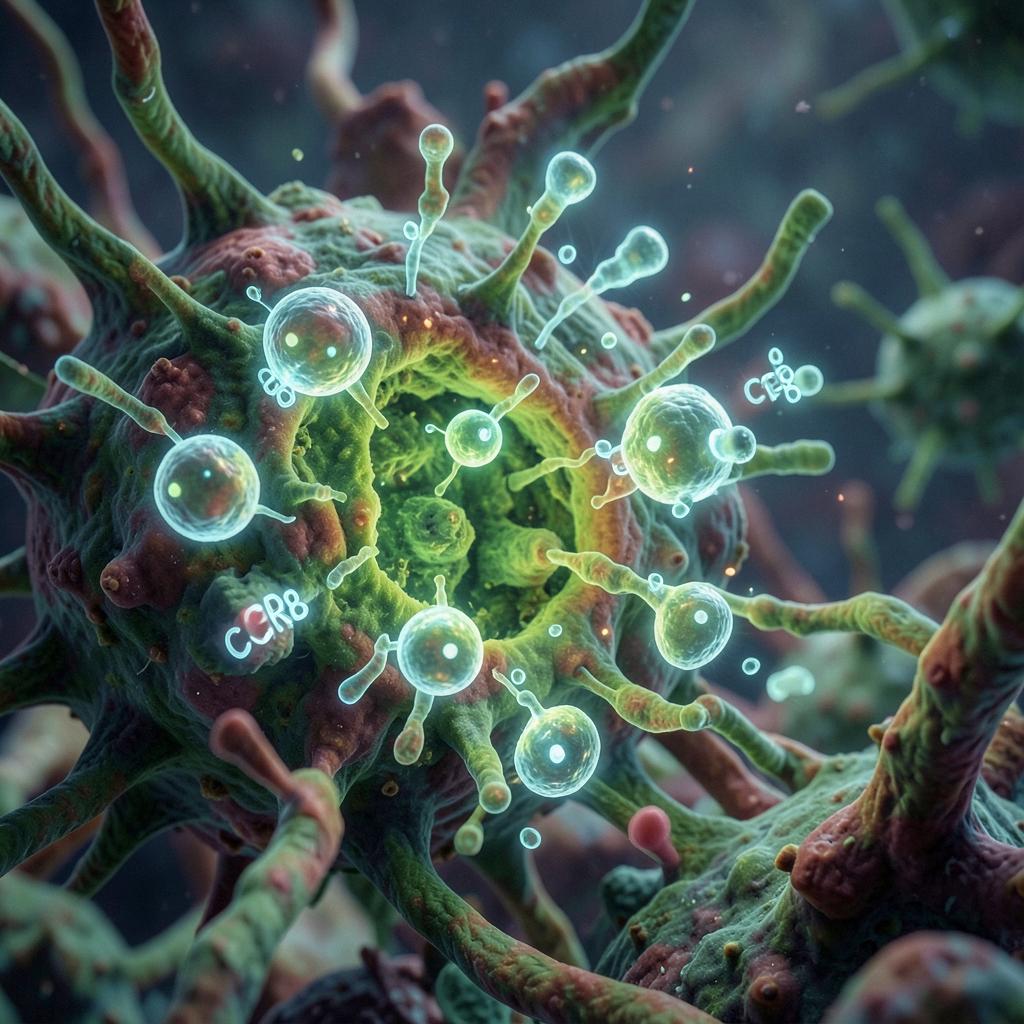
This Nature Communications atlas study (69 patients, nine epithelial cancers) convincingly defines an 88-gene conserved intratumoral Treg signature and four Treg subsets, and uses scTCR-seq to show CCR8+ effector Tregs share ~6% of clones with other intratumoral Treg subsets but ~14% with lymph-node/NAT Tregs and ~10% with conventional T cells, implicating lymph nodes as a key source of tumor effector Tregs Caveats: the primary lineage analysis rests on only three NSCLC patients and is inferential, not fate-mapped.
Long Explanation
Evidence-Based Review: Molecular Heterogeneity and Clonal Origin of CCR8+ Effector Tregs
Scope and design. The study integrates public scRNA-seq from nine epithelial cancers (NSCLC, breast, colorectal, renal, ovarian, endometrial, esophageal, HCC, iCCA) covering 69 patients, 671,163 CD45+ leukocytes, and 12,418 Treg cells, validated by 34-parameter spectral flow cytometry in BC/NSCLC cohorts (82 samples across blood, NAT, tumor, LN) and coupled scRNA/TCR-seq from matched NSCLC tissues .
Key findings (reported). (1) A conserved signature of 88 genes—37 in all nine tumors, 51 in ≥8 of 9—is upregulated in intratumoral Tregs, including known targets (CCR8, TIGIT, CTLA4, TNFRSF18) and under-recognized candidates (CD59, SIRPG, UCP2, PKM). (2) Four Treg subsets: CCR7+ quiescent, CCR8+ effector, CD161+ (KLRB1+), and intermediate—with effector Tregs most suppressive in vitro and predicting worse NSCLC recurrence-free survival, while CD161+ Tregs predict better outcome. (3) Clonally, effector Tregs share only ~6% of clones with other intratumoral Treg subsets, but ~14% with LN/NAT Tregs (majority LN-only) and ~10% with Tconv, supporting a lymph-node origin model .
Critical appraisal. Strengths: multi-tumor cross-validation of transcriptomics with spectral flow cytometry, ex vivo differentiation of quiescent Tregs toward CCR8+ effector phenotype, TRUST4-based TCR reconstruction from bulk RNA-seq as orthogonal confirmation, and public code/data . Weaknesses: the decisive scTCR lineage claim derives from only three NSCLC patients (replication in a 231-patient dataset is indirect); lineage direction is inferred from pseudotime and clone-sharing, not genetic fate-mapping—Tconv–Treg TCR overlap could reflect shared precursor differentiation or antigen-driven parallel activation rather than interconversion; CCR8 was only trending (not significant) in HCC and iCCA, tempering 'universal' CCR8 targeting claims; authors themselves note sample-size bias for DEG identification and insufficient metastatic vs non-metastatic LN numbers.
Therapeutic context. The findings matter because anti-CCR8 depleting antibodies are in early clinical trials with reported antitumor activity. This work predicts that post-depletion resistance could arise from LN-derived precursor replenishment—an actionable, testable concern. Mechanistically, CCR8 is a functional chemokine receptor: it binds CCL18 with Ki ~1 nM , modulates macrophage TLR4 crosstalk , and is expressed outside tumors (gastric cancer, IgG4-related disease), so depletion safety cannot be assumed from Treg specificity alone. Soluble CCR8 analogues preserving antibody epitopes (KD 77–857 nM) now enable pharmacologic characterization , and murine CCR8 antagonism shifts tumor Tregs toward a less suppressive phenotype in liver cancer models .
What would change the conclusion. Murine fate-mapping showing in-situ (not LN) origin of effector Tregs, or failure to reproduce the 88-gene signature in independent multi-center cohorts, would substantially weaken the LN-precursor model. Directionality of Tconv↔Treg conversion remains genuinely unresolved—the authors acknowledge this honestly.
Author Reviews:
Feedback:
Updated: September 24, 2026
BGPT Paper Review
Study Novelty
80%
Consolidates known CCR8+ effector Treg biology (CCR8, TIGIT, ICOS markers were established) but delivers genuinely new elements: a pan-cancer 88-gene conserved signature, CD161+ Treg subset characterization across nine tumors, and single-cell-resolved TCR evidence placing effector Treg origin in tumor-draining LNs rather than intratumoral Treg differentiation.
Scientific Quality
80%
Rigorous multi-modal design with orthogonal validation (scRNA-seq + spectral flow + TRUST4 bulk TCR), published in Nature Communications with data/code availability. Red flags are modest: BMS preclinical funding and author consulting ties (declared), only three patients in the decisive scTCR-seq dataset, pseudotime-based inference without fate-mapping, and HCC/iCCA failing significance for CCR8.
Study Generality
80%
Nine epithelial cancer types plus healthy tissue references provide broad pan-cancer applicability, though all are epithelial solid tumors and lineage analysis is NSCLC-specific, limiting scope of the clonal-origin claim.
Study Usefulness
80%
Directly informs ongoing anti-CCR8 depletion trials by predicting LN-precursor-mediated resistance mechanisms and proposing new targets (CD59, SIRPγ, UCP2) within the 88-gene signature; clinically actionable for combination immunotherapy design.
Study Reproducibility
70%
Public GEO datasets, deposited GitHub code, and detailed parameters (Scanpy, DESC, Scirpy versions documented) support reproduction; however, primary flow cytometry cohorts are single-institution and the three-patient matched TCR dataset limits independent confirmation of the central clonal claim.
Explanatory Depth
70%
Provides mechanistic framing (BATF/IRF4/RELB regulons, Slingshot/STREAM trajectories, TCR clonal tracking) but the deepest question—causal origin of effector Tregs—is answered inferentially rather than experimentally, and signals driving LN Treg activation remain unknown.
We'll email you the results when your analysis is finished.
Hypothesis Graveyard
CCR8+ effector Tregs differentiate in situ from intratumoral quiescent Tregs: largely falsified by the ~6% intratumoral clonal sharing vs ~14% LN/NAT sharing, though in-situ conversion is not fully excluded given low clone-detection power.
CCR8 marks a tumor-exclusive Treg population; weakened by HCC/iCCA non-significance and known CCR8 expression in COPD macrophages, gastric cancer, and IgG4 disease.

 Explore by Goal
 Quick Explanation
 Long Explanation
 Top Data Sources
 Ask a Follow-Up
 Key Insight
 Keep Exploring
 Hypothesis Graveyard
 Potential Experiments
 Discussion
