Check whether claims match experiments, exact reported results, and stated limitations.Know what the science actually supports before you trust the answer.
Press Enter ↵ to review paper
Explore by Goal
"The scientist only imposes two things, namely truth and sincerity, imposes them upon himself and upon other scientists."
- Erwin Schrödinger
Quick Explanation
Copied
This 2024 PAHTEI paper by Jamalzade and Hajiyeva is a descriptive overview of durability-enhancement methods for reinforced concrete marine hydrotechnical structures (HPC mixes, corrosion inhibitors, GFRP, coatings, cathodic protection, self-healing concrete, smart sensors). While conceptually sound and comprehensive in scope, it reports no verifiable experimental data, sample sizes, or statistical results, limiting its scientific rigor and reproducibility despite its practical relevance to marine infrastructure design .
Long Explanation
Paper Review: Methods of Increasing Durability of Reinforced Concrete Marine Hydrotechnical Structures
Authors: Ilkin Jamalzade (Master student) & Irada Hajiyeva (Associate Professor), Department of Oil and Gas Transportation and Storage, Azerbaijan State Oil and Industry University. Published: March 28, 2024, PAHTEI (Proceedings of Azerbaijan High Technical Educational Institutions), Vol. 38, Issue 03.
Scope and Stated Aims
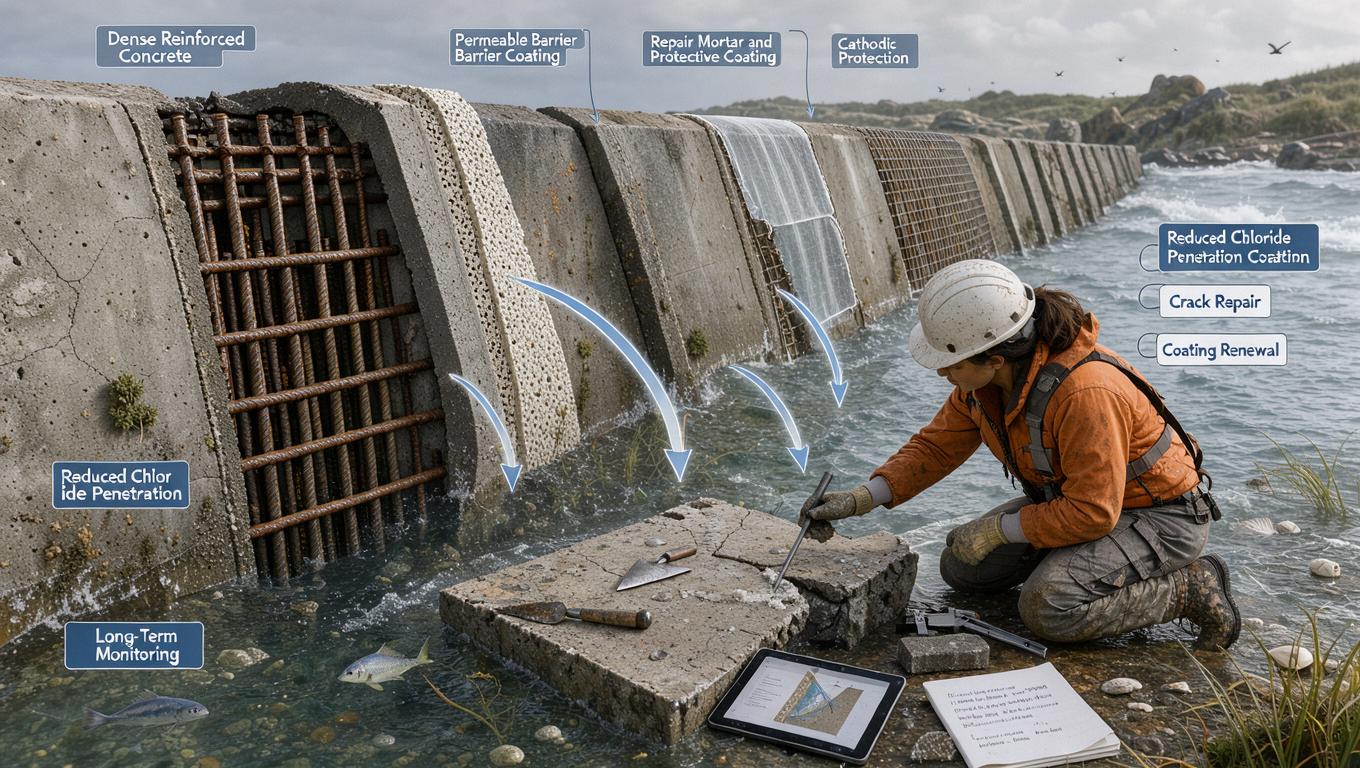
The paper aims to evaluate innovative methods for increasing the durability of reinforced concrete structures constantly exposed to the marine environment. It identifies strategies including high-performance concrete (HPC) mixes with fly ash and silica fume, corrosion inhibitors, surface treatments, stainless steel and glass fiber-reinforced polymer (GFRP) rebar, protective coatings, cathodic protection systems, self-healing concrete, nano-material coatings, and smart structural-health monitoring sensors . The narrative is structured around degradation mechanisms (saltwater corrosion, freeze-thaw cycling, biological degradation), material and technology comparisons, climate-change adaptation, and sustainability considerations.
Reported Data
The only quantitative content is a degradation-factor table (Table 1) presenting relative impact percentages on structural integrity: saltwater corrosion 75%, freeze-thaw cycles 60%, biological degradation 50%; plus an ecological-materials usage table (recycled concrete 30%, solar-powered installations 25%, rainwater collection 40%, local materials 50%) sourced from Azerbaijani government/ecology portals rather than peer-reviewed engineering studies. No compressive-strength values, corrosion rates, chloride diffusion coefficients, service-life predictions, or experimental error bars are reported.
BGPT note: These percentages lack stated measurement methodology, sample sizes, or uncertainty, and should be treated as unsourced categorical estimates rather than empirical findings.
Methodological Assessment
Methods described but not substantiated: The paper states that specimens were submerged in artificial seawater per ASTM D1141-98, subjected to wet-dry cycles, and assessed via electrochemical half-cell potential, linear polarization resistance, and compressive strength testing . However, no actual results from these tests appear anywhere in the text.
Missing critical elements: No sample counts, mix proportions, curing regimes, control groups, replicate statistics, or data tables for the claimed experiments.
Reference quality concerns: The 10-item reference list contains journal titles transliterated into Azerbaijani (e.g., "Qabaqcıl Beton Texnologiyası Jurnalı") that could not be verified as real publications, and several figures are credited to government portal URLs (e-qanun.az, eco.gov.az) and an OpenAI chat URL — a serious scientific-quality red flag.
Reproducibility: With no raw data, parameters, or verifiable experimental records, the claimed experimental findings cannot be independently reproduced.
Strengths and Blind Spots
Strengths include a genuinely useful synthesis of established marine-concrete durability strategies, attention to climate-change adaptation (sea-level rise, extreme weather), and framing of sustainability and life-cycle cost considerations — relevant to regional infrastructure planning. Blind spots: the authors claim "experimental analyses" and "case studies" demonstrating "significant improvement in durability" without presenting any case-study identity, duration, or quantitative outcome. The paper also declares "no limitations that could affect the results" while simultaneously asserting multi-field complexity — an internal inconsistency. The suggestion that self-healing concrete and nanocoatings are ready-adjacent solutions understates their still-maturing deployment status. Confidence in the conceptual overview is moderate; confidence in any empirical claim is low. What would change this assessment: publication of the underlying specimen test data, real journal citations, and named case studies.
Feedback:
Updated: October 28, 2026
BGPT Paper Review
Study Novelty
30%
The content is a standard compilation of well-established marine concrete durability measures (HPC, GFRP, cathodic protection, inhibitors, coatings) with no novel methodology, experimental design, or new theoretical contribution. Self-healing concrete and nano-coatings are mentioned but not advanced beyond existing literature.
Scientific Quality
30%
Serious quality problems: claimed experiments and case studies with no reported data; statistical claims without statistics; references citing unverifiable Azerbaijani-transliterated journal titles; figures sourced from government portals and an OpenAI URL; absence of sample sizes, error bars, or mix proportions. Conceptual coherence is adequate, but empirical rigor is essentially absent.
Study Generality
50%
The topic (marine reinforced-concrete durability) is broadly relevant to civil and coastal engineering, but the paper itself is regionally framed and generic rather than generalizable theory-building.
Study Usefulness
40%
As a regional-language overview it can serve practitioners and students seeking a structured list of durability strategies and standards (ASTM D1141-98, ACI guidance), but its actionable value is limited by the lack of quantitative comparative evidence.
Study Reproducibility
20%
Methods are described (ASTM D1141-98 exposure, electrochemical testing, 28-day curing) but no specimens, mix designs, results, raw data, or statistical outputs are provided, making independent verification impossible.
Explanatory Depth
30%
Mechanisms (chloride-induced corrosion, freeze-thaw, biological attack) are named but not mechanistically explained with chemistry, kinetics, or quantitative models; depth is catalog-style rather than analytical.
We'll email you the results when your analysis is finished.
Hypothesis Graveyard
Assumption that the reported 75/60/50% degradation impacts derive from empirical measurement — no methodology, source data, or measurement basis is given, so these should be treated as illustrative estimates rather than findings.

 Explore by Goal
 Quick Explanation
 Long Explanation
 Top Data Sources
 Ask a Follow-Up
 Key Insight
 Keep Exploring
 Hypothesis Graveyard
 Potential Experiments
 Discussion
