Ask questions across claims linked to experiments, exact results, limitations, and sources.Know what the science actually supports before you trust the answer.
Press Enter ↵ to search evidence
Explore by Goal
"I was taught that the way of progress was neither swift nor easy."
- Marie Curie
Quick Analysis Plan
Copied
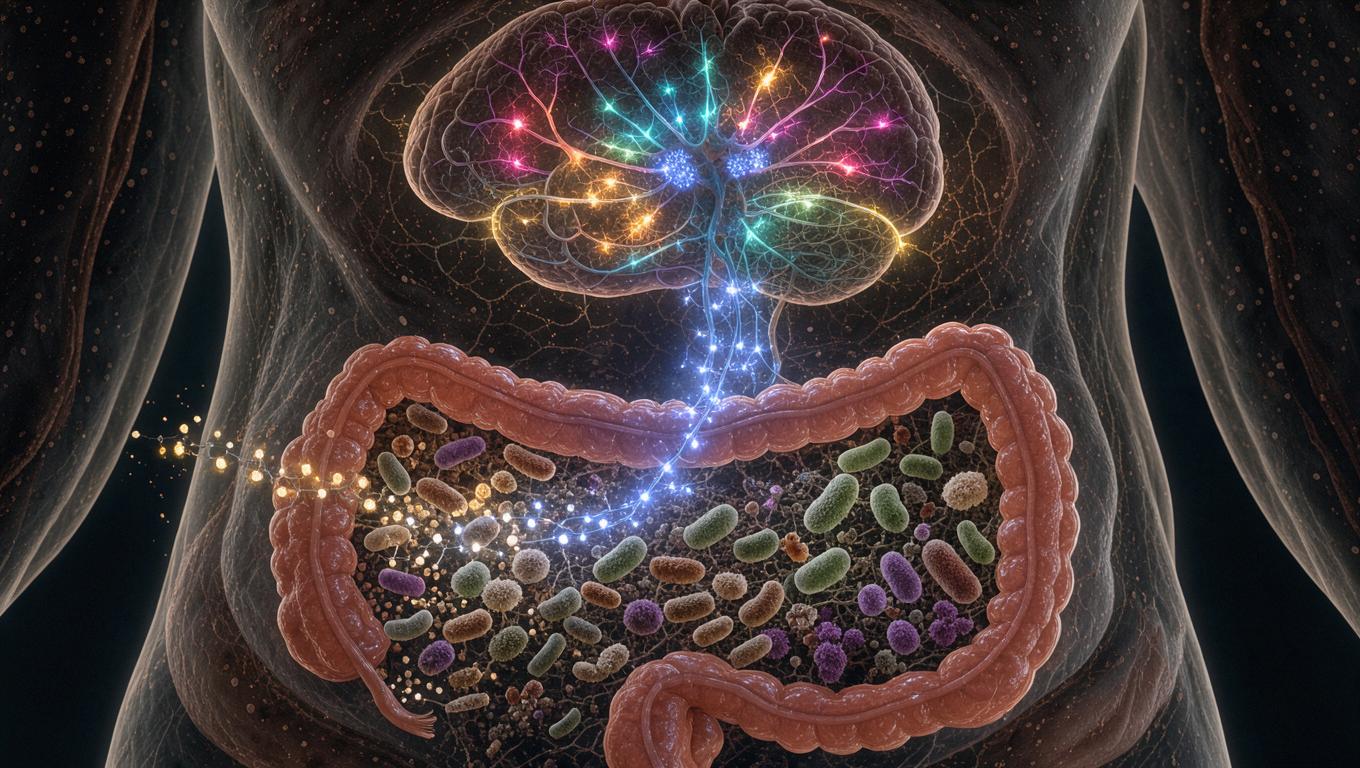
A robust N=240, 12-week mechanistic RCT should pair shotgun metagenomics and LC-MS metabolomics with fMRI reward measures and pre-registered causal mediation, since kynurenine pathway activity is tractable, inflammation-linked, and mechanistically connected to brain function in supplied evidence .
Long Analysis Plan
1. Design & Power Framework
Randomize 240 depressed adults 1:1 to MedDiet vs Western diet for 12 weeks, stratified by baseline MADWS severity, sex, and antidepressant use. Primary outcome: change in reward-circuit fMRI activation (nucleus accumbens/ventral striatum). Mediators: SCFA (acetate, propionate, butyrate) and kynurenine-pathway metabolites (KYN, KYNA, QUIN, 3-HK) from plasma; gut taxa from shotgun metagenomics. Sample size of 120/arm gives ~80% power (α=0.05) to detect fMRI d≈0.36 and mediation indirect-effect d≈0.40, assuming 15% attrition. Provided trials confirm feasibility of 12-week MedDiet vs Western comparisons in adults .
Shotgun metagenomics: nf-core/mag + Snakemake for host-read removal (Bowtie2 vs hg38), taxonomic profiling (MetaPhlAn4/Kraken2-Bracken), functional profiling (HUMAnN3), pathway reconstruction. Track SCFA-producing taxa (Faecalibacterium, Roseburia, Bifidobacterium) and kynurenine-metabolizing taxa (Lactobacillus, Bifidobacterium with kynureninase homologs).
Metabolomics: LC-MS/MS targeted panel for SCFA and KYN metabolites. KP flux directionality is established as measurable across brain/blood compartments .
KP biomarker scoring: Compute KMO/KAT activity ratios analogous to prior clinical KP enzyme assays, where KMO elevation tracked disease state .
3. fMRI Reward Circuitry
Use monetary incentive delay (MID) task pre/post; ROI analysis of nucleus accumbens, ventral tegmental area, and medial prefrontal cortex. Aim for ~0.8mm isotropic multi-band EPI, ~100-120 TRs per run.
Use counterfactual mediation (causal-mediation R package, or Python `statsmodels` + custom bootstrapping) with 5,000 bootstrap iterations; adjust for BMI, age, sex, baseline inflammation (hsCRP), and antidepressant use. Test for moderated mediation by baseline KP activity.
KP manipulation evidence is strongest in mice and tumor/pregnancy models — not directly in depression .
Whether the human gut microbiome directly modulates plasma KYN in adults remains uncertain; IDO1 is inflammatory-driven, so hsCRP-adjusted analyses are essential .
Power to detect triple-mediation (microbiome→metabolite→brain) may be underpowered at N=240; consider secondary pooling or Bayesian hierarchical mediation to reduce multiple-comparison burden.
Assumptions: simulated K/T ratio drawn from plausible human range (~1.3–4.3 μM serum KYN context) assuming 20–25% reduction over 12 weeks on MedDiet; uncertainty is illustrative SD of 0.4, not derived from observed trial data.
Generated scientific data; not direct experimental measurements.
Analysis Wizard
Building a reproducible pipeline that processes shotgun metagenomics, LC-MS metabolomics, and fMRI data from the randomized dietary trial and estimates counterfactual causal mediation linking diet to brain-reward changes.
Get emailed when your analysis is done!
We'll email you the results when your analysis is finished.
Hypothesis Graveyard
Direct microbial kynurenine depletion as the dominant mechanism: supplied evidence shows KP activation is inflammation (IDO1)-driven rather than microbiome-degradation driven in human plasma, so microbial KYN metabolism is likely secondary to systemic inflammatory tone.

 Explore by Goal
 Quick Analysis Plan
 Long Analysis Plan
 Top Data Sources
 Ask a Follow-Up
 Key Insight
 Keep Exploring
 DataGen
 Analysis
 Hypothesis Graveyard
 Discussion
