Check your hypothesis against versioned claims, exact reported results, and stated falsification criteria.Know what falsifiable science actually supports before you trust the answer.
Press Enter ↵ to search evidence
Explore by Goal
"Biology is a science of three dimensions. The first is the study of each species across all levels of biological organization, molecule to cell to organism to population to ecosystem. The second dimension is the diversity of all species in the biosphere. The third dimension is the history of each species in turn, comprising both its genetic evolution and the environmental change that drove the evolution."
- E. O. Wilson
BGPT Odds of True
55%
80% Confidence
The hypothesis has two competing parts: (A) delay retains independent prognostic value after viral-load adjustment, or (B) delay is largely a proxy for baseline progression. No provided evidence contains human H5N1 clinical cohort data with the required covariates. Mechanistic data from organoids showing ~3-log (not sterilizing) oseltamivir suppression supports that residual viral burden at treatment start is prognostically important, favoring partial confounding. Wide bounds reflect complete absence of directly relevant human cohort evidence.
Hypothesis Novelty
35%
The question of whether treatment timing is independently prognostic vs a proxy for disease severity is a well-recognized methodological challenge in observational infectious-disease pharmacotherapy. Similar confounding-by-indication analyses exist for oseltamivir in seasonal influenza. Application specifically to H5N1 with viral-load adjustment adds some specificity but the conceptual framework is established.
Quick Analysis Plan
Copied
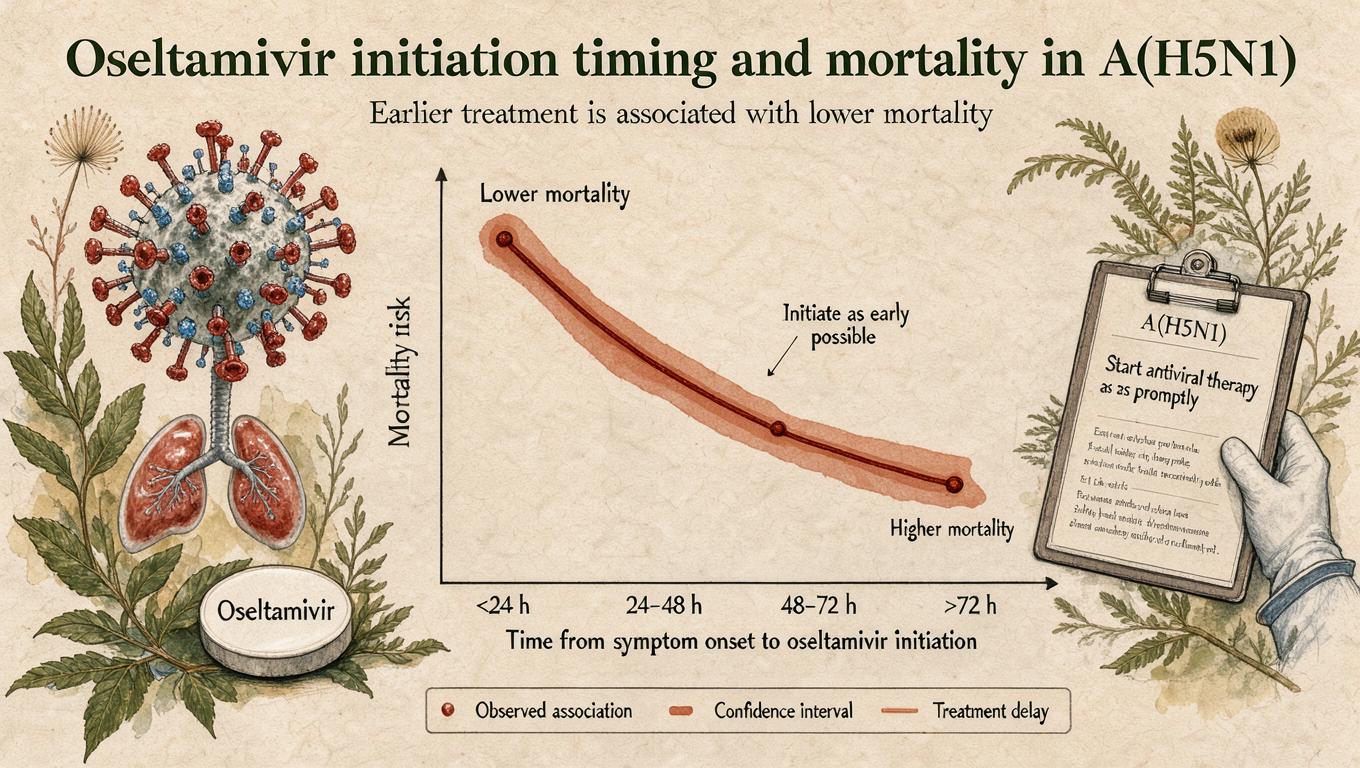
The supplied evidence does not include human A(H5N1) cohort data with paired admission viral loads, treatment timing, and mortality outcomes needed to formally test this confounding hypothesis. Mechanistic evidence from human respiratory organoids shows oseltamivir achieves ~3-log viral reduction when applied, supporting biological plausibility of a treatment-timing effect , but whether delay retains independent prognostic value after viral-load adjustment remains unresolved with current evidence.
Long Analysis Plan
What the Evidence Supports — and What It Cannot Resolve
No provided study reports human A(H5N1) clinical cohort data with admission viral load quantification, treatment-delay intervals, and mortality outcomes analyzed in a multivariable model. This specific data gap means the hypothesis cannot be confirmed or refuted from the available evidence. What can be evaluated is the mechanistic plausibility of a timing-dependent antiviral effect and the causal structure that would generate confounding.
In Vitro Antiviral Potency Context
Human iPSC-derived respiratory organoids infected with two H5N1 strains (cattle-derived TX37 and VN1203) showed that oseltamivir reduced viral titers by ~3.1 log₁₀ PFU/mL at 72 hours, while baloxavir achieved >6.8–7.4 log₁₀ reductions . This ~2.3-fold greater potency of baloxavir over oseltamivir suggests that for less-potent drugs, the residual replicating viral population at treatment initiation is a stronger determinant of outcome — mechanistically supporting the confounding pathway where delay → higher viral burden at treatment start → mortality, independent of any direct harm from delay itself.
Note: Favipiravir was largely ineffective against VN1203-H5N1 (reduction not quantified above 0 in available data). All values are from n=3 organoid replicates and may not extrapolate to in vivo pharmacodynamics.
Causal Structure of the Confounding Question
The hypothesis is fundamentally a causal inference problem: whether treatment delay is an independent causal exposure or a mediator/proxy of baseline disease trajectory. The DAG below organizes the competing pathways.
Conceptual DAG — not empirical data. Blue path: delay operates through viral load at treatment start (mediation). Red dashed: independent direct effect of delay. Grey dashed: latent severity confounds both delay assignment and mortality.
What Is Missing to Resolve This
Answering this requires individual-patient data from H5N1 case series with: (1) quantified respiratory viral load at admission (RT-qPCR Ct values), (2) precise symptom-onset-to-treatment intervals, (3) mortality outcomes, and (4) sufficient sample size for multivariable Cox or logistic regression. Published H5N1 case series (n≈860 cumulative cases globally through 2024) generally lack paired viral-load and timing data at this granularity. The completed trial NCT01231620 (IV zanamivir vs oral oseltamivir in hospitalized influenza) and NCT00334529 (alternative oseltamivir dosing) may contain relevant pharmacodynamic data but detailed results were not provided in the available records.
Assessment
Based on the mechanistic evidence from organoids showing substantial but incomplete viral suppression by oseltamivir (~3-log, not sterilizing), it is biologically plausible that admission viral load is a dominant prognostic factor and that treatment delay acts substantially through this mediator. However, whether a residual independent effect of delay persists after viral-load adjustment is an empirical question the available data cannot answer. Confidence in this assessment is limited by the absence of any H5N1 clinical cohort in the evidence base with the required covariates.
Scanning published H5N1 case-series metadata for records containing paired viral-load, treatment-timing, and mortality fields to assemble a pooled cohort suitable for causal mediation analysis.
Get emailed when your analysis is done!
We'll email you the results when your analysis is finished.
Treatment delay is purely a proxy with zero independent causal effect on mortality: This strong version is unlikely because even after accounting for viral load, delay permits ongoing spread to lower respiratory tract and extrapulmonary sites that admission viral load may not fully capture.
Delayed oseltamivir has no relevance because H5N1 is inherently near-100% fatal regardless of timing: This is falsified by documented survivor series and by the H5N1-SeroDetect data showing substantial numbers of confirmed survivors across clades with durable antibody responses.

 Explore by Goal

 Hypothesis Novelty
 Quick Analysis Plan
 Long Analysis Plan
 Top Data Sources
 Ask a Follow-Up
 Key Insight
 Keep Exploring
 Analysis
 Potential Hypothesis
 Hypothesis Graveyard
 Potential Experiments
 Discussion
