Check a paper's claims against linked experiments, exact results, stated scope, and limitations.Know what falsifiable science actually supports before you trust the answer.
Press Enter ↵ to search evidence
Explore by Goal
"The most beautiful thing we can experience is the mysterious. It is the source of all true art and science."
- Albert Einstein
Quick Explanation
Copied
This 2013 mini-review competently catalogues telomerase's telomere-independent functions—mitochondrial RdRP activity, Wnt transcriptional modulation, apoptosis, and DNA repair—but relies on narrative selection of 81 references without systematic methodology, and its most novel claims (TERT-RMRP RdRP, mitochondrial tRNA-dependent RT) rest on single-lab evidence with limited independent replication as of 2026.
Long Explanation
Core Thesis and Evidence Architecture
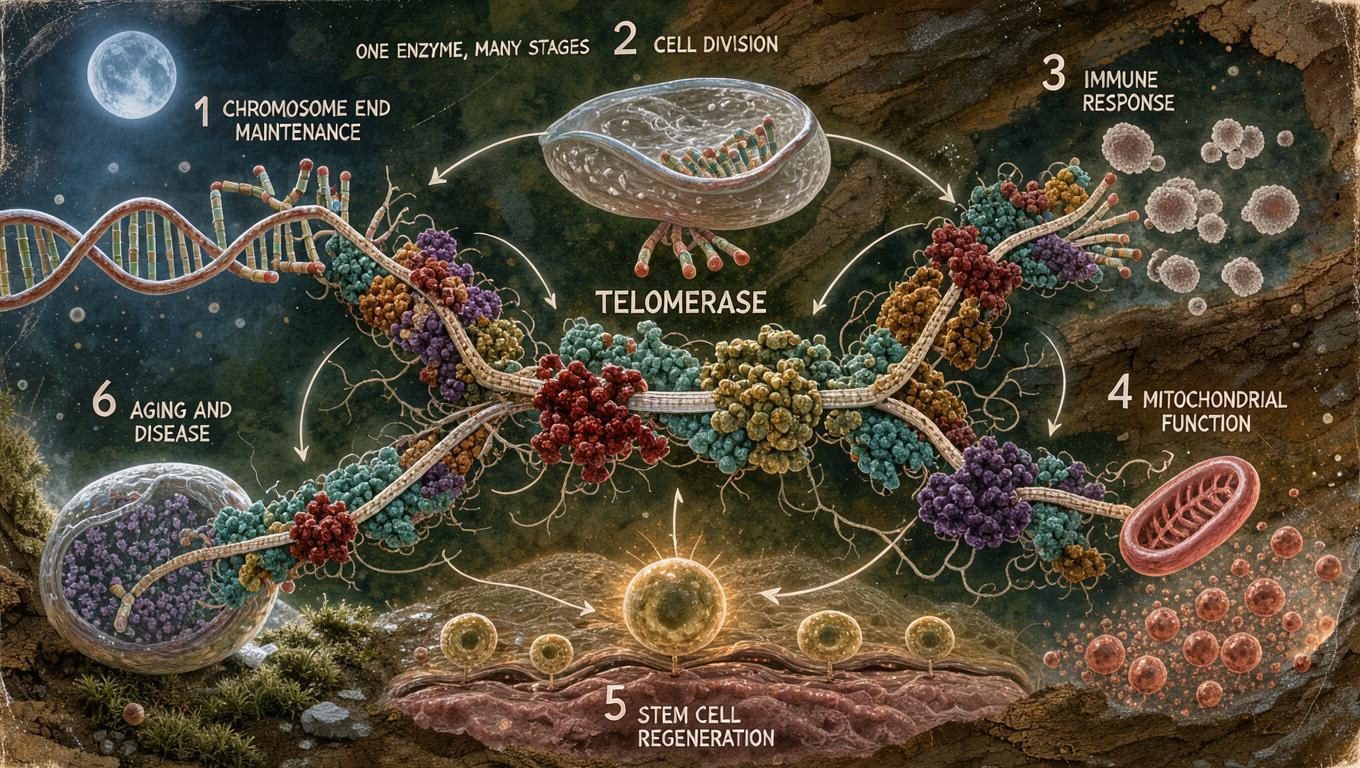
Jaiswal and Kumar argue that telomerase, principally through hTERT, performs multiple telomere-independent functions: mitochondrial RNA-dependent RNA polymerase (RdRP) activity via the TERT-RMRP complex, transcriptional modulation of canonical Wnt/β-catenin signaling, coordination of DNA repair, and regulation of apoptosis. The authors frame TERT as a multifunctional protein rather than solely a telomere-elongating enzyme .
The foundational logic rests on hTERT being the rate-limiting subunit. In HL-60 leukemia cells treated with DMSO, telomerase activity fell from 100% to approximately 10% over four days while hTERT mRNA declined sharply after one day; the other five subunits (hTR, TEP1, hsp90, p23, dyskerin) remained unchanged . If TERT is the regulatable, rate-limiting determinant, then non-canonical TERT functions in mitochondria and transcription become mechanistically plausible.
Reported data from Chang et al. (2002) cited within the reviewed paper; Day 3 value interpolated for visualization. Dashed line indicates that non-hTERT subunit levels remained stable throughout differentiation.
Where the Evidence is Strong vs. Contested
The Wnt/β-catenin transcriptional modulation claim has the strongest independent support, with multiple groups (Park et al., Choi et al., Shkreli et al.) contributing convergent evidence from both mouse and human systems . In contrast, the mitochondrial claims (TERT-RMRP RdRP and tRNA-dependent reverse transcription) derive primarily from two research groups, and the review itself concedes that "there is no direct molecular evidence to explain the role of telomerase in DNA repair."
A disconnect between hTERT expression and enzymatic activity adds complexity the review under-addresses. In prostate cancer, hTERT mRNA was detected in 97.8% of tumors while telomerase activity was present in only 69.6%, indicating posttranscriptional or posttranslational regulation that complicates extrapolating from TERT abundance to TERT function . Later work showed Plk1 kinase stabilizes hTERT protein by inhibiting ubiquitination, adding a phosphorylation-dependent layer absent from the review's framework .
Mechanism unknown; conflicts with anti-apoptotic data
TERT anti-apoptotic (pre-mitochondrial block)
Catalytic-dependent
Multiple labs
Not reconciled with pro-apoptotic claims
TERT in DNA repair
Catalytic (+)
Association-based
Authors concede no direct molecular evidence
Methodological Limitations and Blindspots
Narrative methodology: The 81 references were selected without stated systematic criteria. The authors cite "our unpublished results" for one key claim (TERT depletion causing genome-wide transcriptional response in mouse skin), which cannot be evaluated.
Cross-species conflation: Mouse telomeres (20–50 kb) are substantially longer than human telomeres (10–15 kb), and basal telomerase activity differs between species. Findings from Lck-Tert mice or TERT-transgenic models may not translate directly to human physiology .
Splice variants ignored: The hTERT locus produces multiple isoforms with divergent catalytic and non-catalytic properties, regulated by epigenetic switches including hTAPAS antisense lncRNA . Whether "extracurricular" functions derive from full-length or specific splice forms is not addressed.
ALT tumors omitted: Approximately 20% of advanced carcinomas lack detectable telomerase activity and use alternative lengthening of telomeres . Whether TERT's non-canonical functions operate in ALT-positive tumors (where TERC-dependent activity is absent but TERT protein may persist) is not explored.
Positioning in 2026
The core thesis—that TERT is multifunctional—has been vindicated by subsequent research. The Wnt-TERT axis and chromatin-associated TERT functions have accumulated independent support. However, the mitochondrial subsection remains the least mature: TERT-RMRP RdRP activity has not been broadly replicated by independent groups, and the physiological relevance of mitochondrial tRNA-dependent reverse transcription remains undefined. The review's own conclusion that "tools are needed to study TERT functions in cellular physiological conditions" remains partially valid thirteen years later, particularly for mitochondrial claims. The apoptosis section remains genuinely unresolved, with the review presenting mutually contradictory findings (pro-apoptotic mitochondrial DNA sensitization vs. anti-apoptotic pre-mitochondrial block) without attempting mechanistic reconciliation.
Confidence note: The Wnt and apoptosis-related claims are moderately well-supported by multiple independent sources. The mitochondrial RdRP and tRNA-dependent RT claims rest primarily on one or two laboratories; they should be treated as hypothesis-generating rather than established. The DNA repair claims are the weakest, acknowledged as such by the authors themselves.
Feedback:
Updated: November 21, 2026
BGPT Paper Review
Study Novelty
70%
The synthesis of telomere-independent telomerase functions was emerging but not consolidated in 2013; the mitochondrial RdRP claim (TERT-RMRP) was genuinely novel, though derived from a single lab. The Wnt-TERT connection was already established by 2009, reducing novelty for that pillar.
Scientific Quality
70%
Well-organized narrative review with a useful summary table categorizing catalytic dependence. However, no systematic search methodology, citation of unpublished results, free cross-species mixing, and failure to reconcile contradictory apoptosis findings limit scientific rigor. No prompt injection or fabrication detected.
Study Generality
60%
Covers multiple cell types and organisms (human, mouse, yeast, ciliate) but focuses on cancer cell biology and lacks tissue-specific nuance. The claims are general enough to inform multiple fields (cancer, aging, stem cell biology) but the mechanistic detail is thin for most claims.
Study Usefulness
80%
Consolidated a paradigm shift at a critical moment. The categorization of telomerase activities by catalytic dependence remains a useful framework. Serves as an accessible entry point for understanding TERT's non-canonical roles and identifies clear research gaps.
Study Reproducibility
60%
As a review, reproducibility is judged by whether cited findings are independently replicable. The Wnt claims have multi-lab support; the mitochondrial RdRP and tRNA-dependent RT claims do not. One key claim cites "our unpublished results," which cannot be verified.
Explanatory Depth
80%
The review provides molecular-level mechanistic detail for the Wnt pathway (Frizzled → Dvl → GSK-3β inhibition → β-catenin stabilization → TERT-BRG1-β-catenin complex → target gene activation) and the RdRP pathway (TERT-RMRP → dsRNA → Dicer → 22 nt siRNA → RISC). The apoptosis section is less mechanistic, acknowledged by authors.
We'll email you the results when your analysis is finished.
Hypothesis Graveyard
TERT's anti-apoptotic effect is purely telomere-dependent (i.e., telomere capping prevents DNA damage signaling that triggers apoptosis). This is falsified by Lee et al. 2008 showing TERT promotes survival in telomerase-null contexts and by Zhang et al. 2003 showing protection at a pre-mitochondrial step independent of telomere status.
All telomerase non-canonical functions require the catalytic RT domain. This is contradicted by the paper's own Table 1, which categorizes gene expression regulation and apoptosis-related mt-DNA sensitization as catalytic-independent (–).

 Explore by Goal
 Quick Explanation
 Long Explanation
 Top Data Sources
 Ask a Follow-Up
 Key Insight
 Keep Exploring
 Hypothesis Graveyard
 Potential Experiments
 Discussion
