Examine the evidence base and provenance of specific claims made by authors or groups.Know what the science actually supports before you trust the answer.
Press Enter ↵ to review
Explore by Goal
"The important thing is not to stop questioning. Curiosity has its own reason for existing."
- Albert Einstein
Quick Explanation
Copied
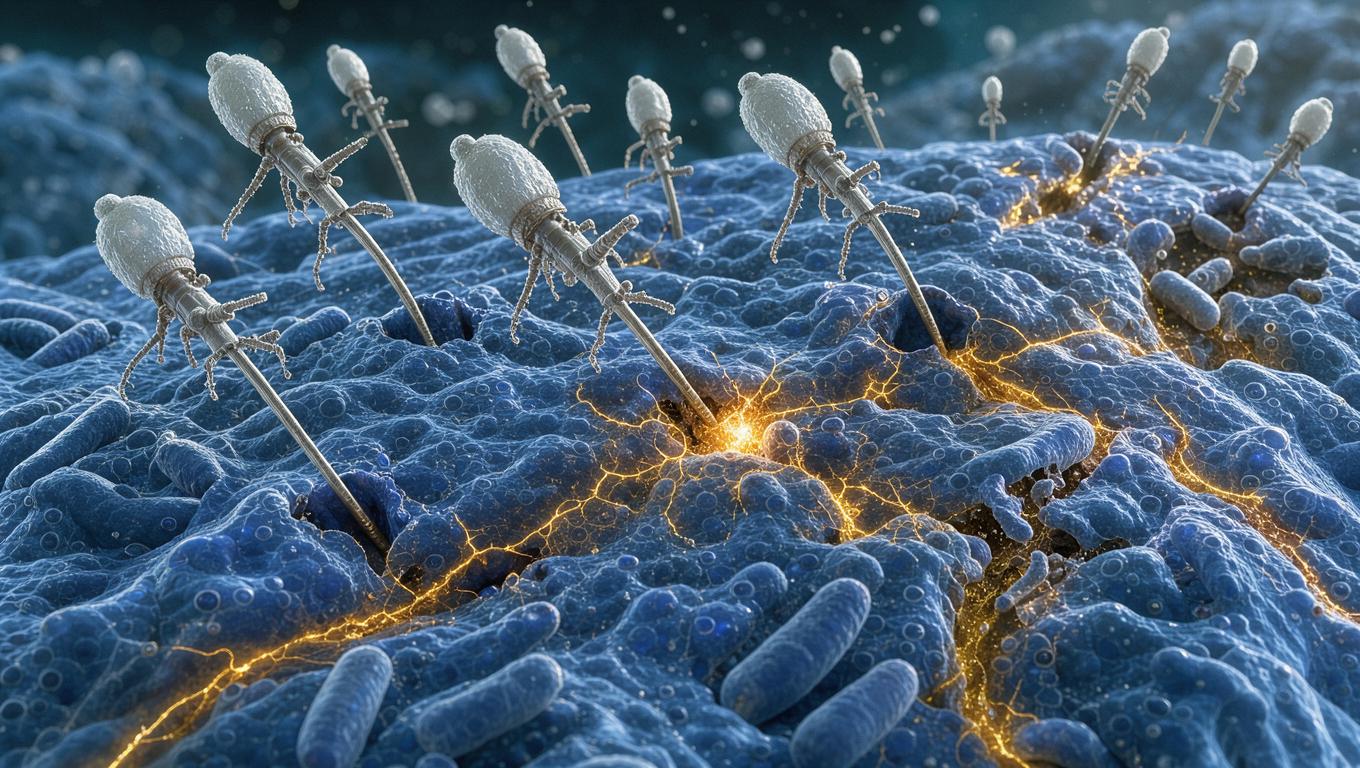
The supplied evidence map contains only one directly attributable study by Catarina Milho (bacteriophage cocktail CT-SA against Staphylococcus aureus biofilms from chronic rhinosinusitis isolates), showing 24-hour biofilm OD600 reductions of ~72–96% across five clinical isolates plus an ATCC control strain. The bulk of the remaining records (EGFR trafficking, glycosylation, kinetic modeling) appear unrelated to a phage-biofilm author profile, so any deeper score rests on very thin, ex-vivo-only evidence with no in vivo or patient-outcome data.
Long Explanation
Evidence map reality check
The records supplied for this author review are heavily mismatched: most concern EGFR biology (LDOC1–clathrin adaptor regulation of EGFR internalization, EGFR copy-number screening, HCV-induced EGFR fucosylation, CIN85 phosphorylation, EGFR kinetic modeling, EGFR aberrations in metastatic cancers) rather than phage–biofilm science. Only three records are phage-related, and just one — the ex vivo chronic rhinosinusitis (CRS) study of a phage cocktail (CT-SA) against Staphylococcus aureus biofilms — plausibly anchors the 'Catarina Milho' profile. I cannot verify the author's full publication history from these records alone; the review below is therefore explicitly evidence-limited.
What the attributable phage-biofilm evidence shows
The CRS ex vivo study treated six isolates (ATCC 25923 plus five clinical isolates CI1–CI5) with the CT8 phage cocktail and measured biofilm OD600 at 24 h vs 48 h. The reported means (± SD) are: ATCC 2.34→0.103, CI1 3.89→0.755, CI2 3.87→0.730, CI3 5.91→1.20, CI4 5.29→1.155, CI5 5.81→1.60. This corresponds to 48-hour biofilm reductions of approximately 96%, 81%, 81%, 80%, 78%, and 72%, respectively — a consistent, dose-consistent lytic effect across genetically diverse clinical isolates, which is a meaningful strength for phage work where strain-specificity often produces narrow coverage. The study also claims potential to prevent resistant-mutant emergence, though no quantitative resistance data were extractable from the record.
Reported observations: substantial biofilm reduction across all six isolates at 48 h, with variability in absolute residual biofilm (0.10–1.60 OD600). BGPT inference: the ~72–96% spread suggests host- or biofilm-maturity-dependent efficacy, and residual biofilm on CI5 (~1.60) indicates incomplete eradication for some isolates — clinically important since CRS biofilms are recalcitrant in situ.
Corroborating phage literature in the record
Two additional phage records contextualize but do not directly credit the author. Commercial phage formulations (Sb-1, PYO) against MRSA required high titers (10^7 PFU/ml) and 5–7 days to eradicate established biofilms, while biofilm prevention succeeded at only 10^4 PFU/ml, and phage cocktails improved survival in Galleria mellonella better than single phages . A separate novel phage (vB_EfaS_ZC1) combined with propolis disrupted vancomycin-resistant E. faecalis biofilms in an ex vivo endodontic dentin model across 50 clinical isolates, with a public genome accession (PP271740) supporting reproducibility .
Critical appraisal, blind spots, and confidence
Strengths: use of patient-derived clinical isolates (not just lab strains), ex vivo relevance to a real disease niche (CRS sinuses), and internally consistent OD600 trajectories. Blind spots: (1) the CRS study lacks in vivo or patient-outcome data — ex vivo biofilm disruption does not establish clinical efficacy; (2) no reported phage-resistance quantification despite a claim about preventing resistant mutants; (3) OD600 is an indirect, turbidity-based readout vulnerable to confounding by cell lysis debris — CFU counts or microscopy would strengthen the conclusion; (4) sample sizes per isolate (replicates not extractable) and absence of reported statistical tests; (5) the evidence map's dominant EGFR content cannot be attributed to this author, so the profile is incomplete. What would change the verdict: attribution of the EGFR records to this author, in vivo phage data from the same lab, or quantitative resistance-frequency data would materially raise the assessment; conversely, inability to link any EGFR records and small-N ex vivo-only phage data would lower it. Confidence in this limited-data review is moderate: the quantitative claims come directly from supplied records, but author attribution is incomplete.
Feedback:
Updated: October 31, 2026
BGPT Author Review
Scientific Quality
50%
The only attributable study uses relevant clinical CRS isolates and reports internally consistent lytic outcomes, but it is ex vivo-only, lacks in vivo validation, lacks quantitative resistance data, and relies on a crude OD600 readout without reported statistics. The evidence map is dominated by EGFR papers that cannot be verified as this author's work, so the true expertise level cannot be established from the supplied records; the score reflects a competent but early-career-looking preclinical phage contribution with unclear scope.
Communication Quality
50%
The extractable data are clearly organized (per-isolate OD600 with SDs), but the record lacks reported statistical tests, replicate counts, effect-size framing, and plain-language interpretation of residual biofilm variability. No direct author prose was supplied, so communication quality is inferred from data reporting structure only and carries high uncertainty.
Author Novelty
50%
Phage cocktails against S. aureus biofilms are an established strategy, and the accompanying MRSA and VRE phage studies show the field already covers similar territory including ex vivo organ models and genomic characterization. Testing clinical CRS isolates adds disease-specific value but is incremental rather than conceptually new.
Scientific Rigor
40%
The attributable study reports no statistical tests, no replicate structure, no CFU or microscopic validation of OD600-based biofilm disruption, and no quantified resistance data despite making resistance-prevention claims. Ex vivo-only design limits generalizability. The heterogeneous and apparently mismatched record set further undermines any assessment of systematic rigor across the author's portfolio.
Generated scientific data; not direct experimental measurements.
Get emailed when your analysis is done!
We'll email you the results when your analysis is finished.
Hypothesis Graveyard
'Phage cocktails broadly eradicate mature biofilms regardless of starting biomass' — contradicted by the CRS data showing residual OD600 of 1.20-1.60 on high-biomass isolates CI3-CI5 after 48 h.
'EGFR copy-number screening predicts mutation status' — falsified by the SISH record showing EGFR mutations in SISH-negative patients, which is why that study concluded copy number is not a useful screening tool.
Science Art
Science Movie
Make a narrated HD Science movie for this answer ($32 per minute)

 Explore by Goal
 Quick Explanation
 Long Explanation
 Top Data Sources
 Ask a Follow-Up
 Key Insight
 DataGen
 Hypothesis Graveyard
 Discussion
