Check a paper's claims against linked experiments, exact results, stated scope, and limitations.Know what falsifiable science actually supports before you trust the answer.
Press Enter ↵ to search evidence
Explore by Goal
"Science is organized knowledge. Wisdom is organized life."
- Immanuel Kant
Quick Explanation
Copied
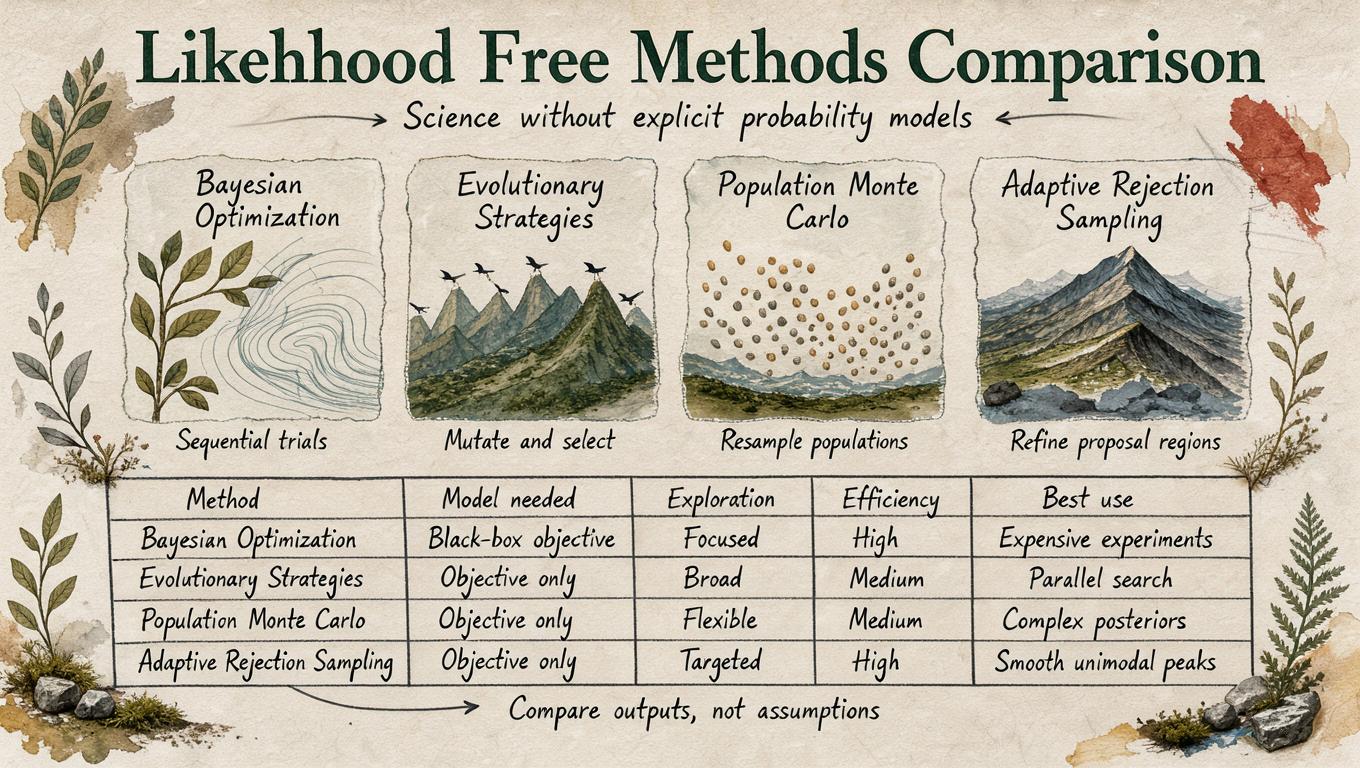
Drovandi and Frazier (2022) deliver the first systematic empirical comparison of likelihood-free Bayesian methods that use the full dataset (distance-based ABC variants) against summary-statistic methods (ABC, BSL), concluding that the best approach is problem dependent but full-data distance approaches are promising and merit further development
Long Explanation
Core contribution. This review-and-comparison paper addresses a live question in likelihood-free Bayesian inference: must practitioners reduce data to low-dimensional summary statistics, or can distance functions computed on the full dataset escape the curse of dimensionality? The authors catalog the full-data distances proposed to date — maximum mean discrepancy (Park et al. 2016), Kullback-Leibler divergence (Jiang 2018), Wasserstein distance (Bernton et al. 2019), energy distance (Nguyen et al. 2020), and Hellinger and Cramer-von Mises distances (Frazier 2020) — and contrast them with ABC's non-parametric kernel approximation and BSL's parametric Gaussian approximation of the summary-statistic likelihood
What the comparison establishes. Summary-statistic methods inherit an information loss whenever the statistic is not sufficient, and selecting good summaries is model- and application-specific. Full-data approaches bypass summary selection and, with infinite computation, can in principle recover the exact posterior — a property summary-statistic methods generally lack. The empirical section (Sect. 4) tests both families on examples of increasing complexity including real data. The headline finding is deliberately measured: the best approach is problem dependent, but full-data distance methods are promising and warrant further development
Critical assessment. Strengths: a genuinely systematic head-to-head comparison that was previously missing in the literature; released code (github.com/cdrovandi/ABC-dist-compare) improves reproducibility; the scope covers scalar observations (yi ∈ R), which the authors transparently flag as a limitation relaxable only for some approaches. Weaknesses to weigh: the empirical evidence is a handful of examples, not a benchmark suite, so generalization to high-dimensional or structured (multivariate, time-series, spatial) data is uncertain; computational cost comparisons across distances with different tunable bandwidths/tolerances are sensitive to implementation choices; and BSL's Gaussian assumption can fail for skewed or discrete summaries, which may understate or overstate method rankings depending on the example. The authors' own framing — that the ultimate question is whether full-data approaches can mitigate the curse of dimensionality enough to outperform data reduction — is answered only empirically, not theoretically, so the conclusion rests on the specific examples chosen. Confidence in the problem-dependent verdict: high (it is well supported); confidence that any single distance dominates: low (the paper does not claim this).
What would change the conclusions. Demonstrating a full-data distance with provable dimension-robust posterior concentration, or showing summary-statistic sufficiency on the tested examples, would shift the balance; conversely, broader benchmarks where full-data methods degrade badly would strengthen the case for summaries.
Feedback:
Updated: November 21, 2026
BGPT Paper Review
Study Novelty
70%
First systematic comprehensive comparison of full-data distance-based likelihood-free methods versus summary-statistic methods; individual methods were known, but the systematic head-to-head review and empirical comparison is new.
Scientific Quality
80%
Rigorous, transparent, code-released review with a measured problem-dependent conclusion; limitations are the small number of examples, scalar-observation restriction, and lack of theoretical dimension-robustness guarantees.
Study Generality
70%
Applies broadly to any field using implicit/generative models with intractable likelihoods (genetics, ecology, cosmology), though empirical evidence is limited to scalar-data examples.
Study Usefulness
80%
Directly guides practitioner method choice between ABC, BSL, and full-data distances; released code lowers adoption barriers; identifies open research directions.
Study Reproducibility
80%
Computer code publicly released at github.com/cdrovandi/ABC-dist-compare; methods are standard statistical algorithms with clearly described settings.
Explanatory Depth
70%
Provides clear mechanistic explanation of why ABC suffers from high-dimensional summary estimation (non-parametric curse) while BSL's parametric Gaussian form tolerates more dimensions but still suffers; theoretical posterior-recovery analysis is only qualitative.
We'll email you the results when your analysis is finished.
Hypothesis Graveyard
The hypothesis that Gaussian-copula or high-dimensional BSL uniformly beats ABC because it tolerates more summary dimensions is weakened by the paper's finding that BSL 'ultimately suffers from the same curse' of dimensionality.
The hypothesis that full-data methods will dominate because they can recover the exact posterior in the infinite-compute limit is tempered: at realistic compute budgets the authors find the best approach is problem dependent, so finite-sample behavior, not asymptotic guarantees, governs practice.

 Explore by Goal
 Quick Explanation
 Long Explanation
 Top Data Sources
 Ask a Follow-Up
 Key Insight
 Keep Exploring
 Hypothesis Graveyard
 Potential Experiments
 Discussion
