Analyze how experimental results and claims are presented, scoped, and limited in a paper.Know what the science actually supports before you trust the answer.
Press Enter ↵ to analyze
Explore by Goal
"Science is the acceptance of what works and the rejection of what does not. That needs more courage than we might think."
- Jacob Bronowski
Quick Explanation
Copied
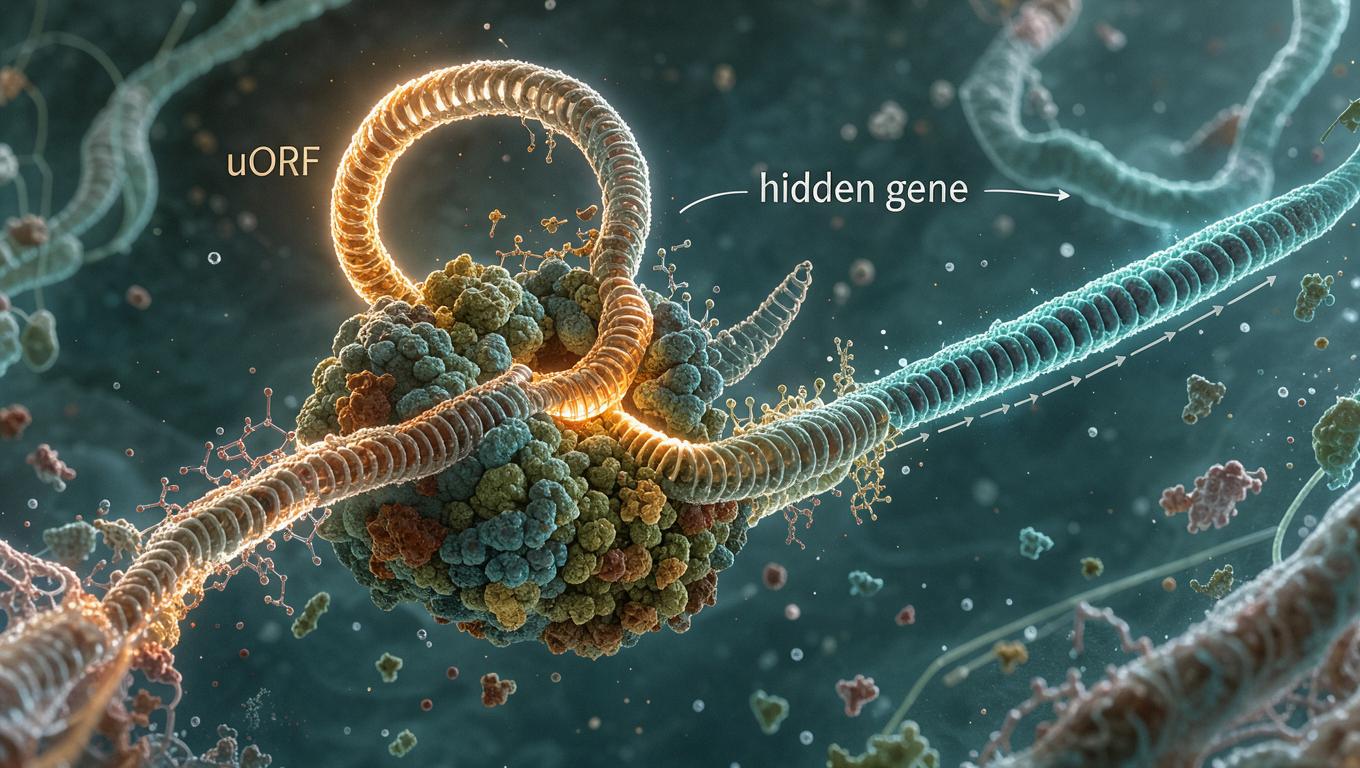
Baniulyte and Wade (eLife 2024) show that the 8-codon uORF toiL upstream of the E. coli topAI toxin-antitoxin operon acts as a broad translational-stress sensor: ribosome-targeting antibiotics (tetracycline, retapamulin, spectinomycin, tylosin, erythromycin) stall ribosomes at different positions within toiL, unmasking the topAI ribosome-binding site and relieving Rho-dependent premature termination.
Long Explanation
Mechanism: a multi-sensor uORF
The paper demonstrates that Rho-dependent transcription termination within the topAI coding region is a consequence of translational repression: mutating rho caused ~7-fold higher expression of a topAI-lacZ transcriptional fusion, and mutating four pyrimidine-rich rut residues caused a 4-fold increase only in wild-type cells. An 8-codon uORF (toiL) in the 171-nt 5' UR was validated by stop-codon mutagenesis, and its Shine-Dalgarno disruption fully abolished antibiotic induction, while start-codon mutation reduced induction 12–110-fold, indicating that active toiL translation is required for regulation .
Evidence for antibiotic-specific stalling positions
Using modified ermCL-based stalling reporters, the authors localize stalling: tetracycline and retapamulin stall at the toiL start codon (tetracycline Ribo-seq shows a peak at +18, consistent with start-codon stalling), tylosin at Val5 (abolished by Val5→Leu), and erythromycin near the termination codon. Spectinomycin induces more diffusely. Chloramphenicol, whose sequence-specific stalling favors Ala/Ser/Thr contexts absent from toiL, did not induce topAI — a concordant negative control . Unlike other multi-antibiotic uORFs (cplR, vmlR, vga(A)) where all sensed antibiotics stall at start codons, toiL integrates stalling at multiple positions, making it a distinctive broad-spectrum translational-stress sensor .
Critical assessment
Strengths: multiple orthogonal methods (genetic selection, ChIP-qPCR, qRT-PCR, SHAPE-seq, Ribo-seq, stalling reporters); raw data deposited (E-MTAB-8365, E-MTAB-12242); negative controls (chloramphenicol, ermCL reporter specificity) strengthen causal inference. Limitations: (1) Only one E. coli K-12 strain and plasmid-borne reporters are used; native chromosomal expression levels and species generality are untested. (2) Some antibiotics reported to induce topAI mRNA previously (gentamicin, kanamycin) showed no effect here at the tested concentrations; the authors acknowledge concentration-dependence limits. (3) Induction magnitude ranges from ~250–4000-fold across antibiotics, but exact per-antibiotic fold changes beyond retapamulin (~600-fold) are not tabulated in the retrieved text, limiting quantitative cross-antibiotic comparison. (4) The biological function of topAI-yjhQP induction under antibiotic stress remains speculative — the authors themselves note this is an open question, unusual for toxin-antitoxin systems whose genes typically encode resistance functions. (5) The mechanism by which tetracycline stalls initiating ribosomes is explicitly speculative. (6) SHAPE-seq used only 2 treated vs 3 untreated replicates with a modest, statistically significant but small reactivity change at the topAI Shine-Dalgarno. (7) The Rut overlapping an actively translated uORF is mechanistically unresolved (two competing models offered). The mechanism is well supported; ecological/physiological significance remains the weakest link.
Context in uORF biology
toiL contrasts with vertebrate uORFs, which are generally modest repressors governed by transcript-wide features , and with plant CPuORF metabolite sensors . toiL's design — ribosome stalling anywhere along its length disrupts a single repressive hairpin — is an elegant, hard-to-vary explanation for its broad sensing capacity.
Author Reviews:
Feedback:
Updated: October 29, 2026
BGPT Paper Review
Study Novelty
90%
First demonstrated bacterial uORF that senses multiple mechanistically distinct ribosome-targeting antibiotics via stalling at different positions within the uORF, unlike prior multi-antibiotic uORFs that all stall at start codons.
Scientific Quality
80%
Multiple orthogonal methods, deposited raw data, and appropriate controls support the mechanism. Weaknesses: single strain, plasmid-only reporters, small SHAPE-seq replicate numbers, unresolved physiological function, and speculative tetracycline-stalling mechanism.
Study Generality
70%
Establishes a generalizable architectural principle (uORF spanning a repressive hairpin enables multi-input sensing), but demonstrated in one E. coli gene and strain.
Study Usefulness
70%
Provides a framework for discovering other broad-spectrum translational-stress sensors and antibiotic-responsive uORFs; the authors note >5-fold Ribo-seq induction for several uORF-associated genes under tetracycline.
Study Reproducibility
80%
Detailed plasmid/strain lists, raw sequencing data deposited (E-MTAB-8365, E-MTAB-12242), and complete materials and methods facilitate replication.
Explanatory Depth
80%
Mechanistic chain from antibiotic → ribosome stalling position → hairpin disruption → translation derepression → Rho termination relief is well traced; tetracycline start-codon stalling mechanism and Rut-overlapping-uORF paradox remain unresolved.
We'll email you the results when your analysis is finished.
Hypothesis Graveyard
topAI induction confers antibiotic resistance directly — unlikely because TopAI inhibits topoisomerase I, not translation; the authors explicitly note this mismatch.
toiL is purely an antibiotic sensor evolved under antibiotic pressure — implausible in environmental E. coli where antibiotic concentrations are typically sub-therapeutic; non-antibiotic stalling ligands are more plausible selective drivers.

 Explore by Goal
 Quick Explanation
 Long Explanation
 Top Data Sources
 Ask a Follow-Up
 Key Insight
 Keep Exploring
 Hypothesis Graveyard
 Potential Experiments
 Discussion
