Ask questions across claims linked to experiments, exact results, limitations, and sources.Know what falsifiable science actually supports before you trust the answer.
Press Enter ↵ to search evidence
Explore by Goal
"Biology sees right and wrong as the same color in different light."
- Delia Owens
Quick Explanation
Copied
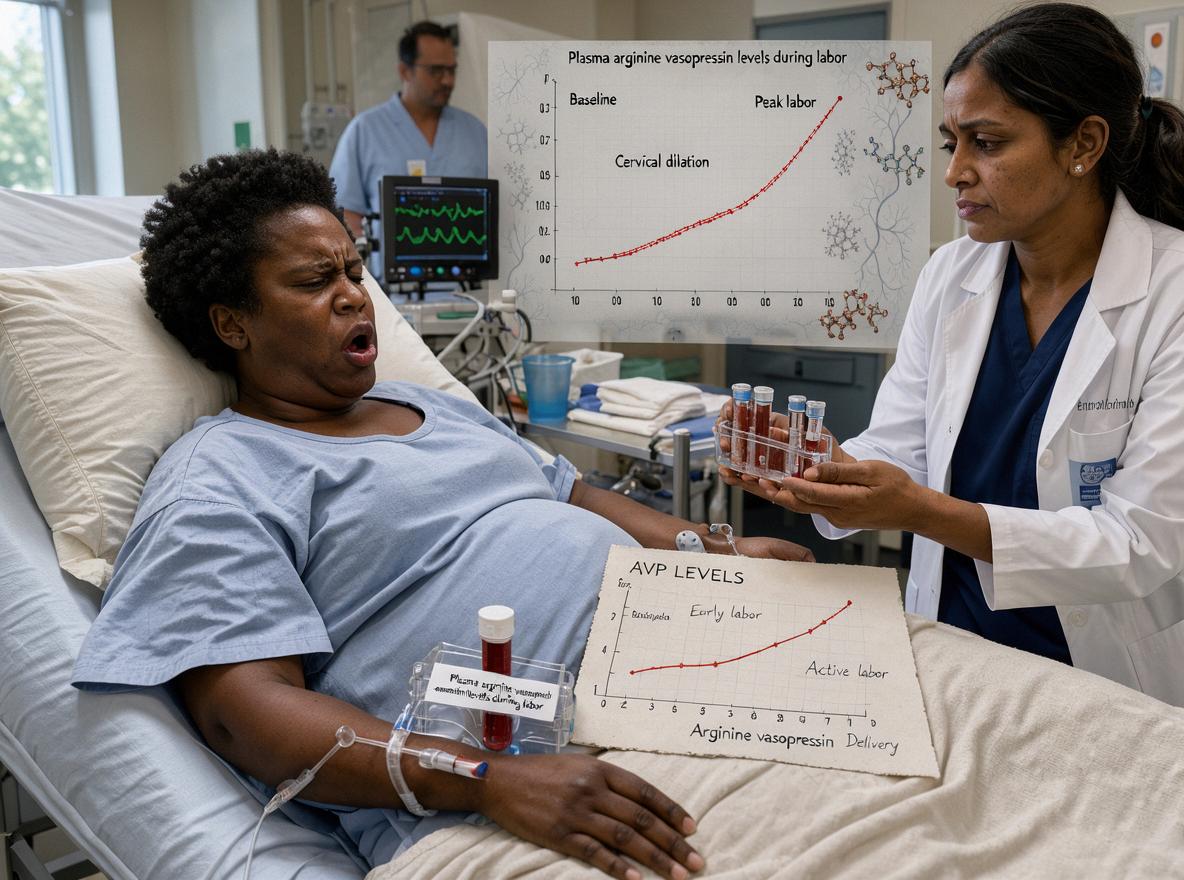
This small 1985 observational study (n=30) found plasma AVP was lower in laboring women given glucose-solution water loads (0.7 pg/ml) than controls, correlated negatively with infusion volume (r=-0.66) and positively with serum sodium (r=0.61), arguing against inappropriate AVP secretion as the cause of intrapartum hyponatremia
Long Explanation
What the study actually showed
Singhi and Parshad tested Tarnow-Mordi's speculation that vasopressin (AVP) responds inappropriately (i.e., fails to fall) to a water load during labor, which would explain the dilutional hyponatremia seen with intrapartum glucose infusion. They measured plasma AVP by radioimmunoassay in 30 term vaginal deliveries: 10 women given 5–10% glucose for hydration (GW, mean 868±426 ml), 10 given glucose as an oxytocin vehicle (OT, 910±360 ml), and 10 controls receiving no intravenous fluid
PAVP was significantly lower in both infused groups (GW 0.7±0.4 pg/ml; OT 0.7±0.6 pg/ml; P<0.05), AVP correlated positively with serum sodium (r=0.61, P<0.01) and osmolality (r=0.52, P<0.05), and negatively with glucose volume infused (r=-0.66, P<0.01). Maternal and cord sodium/osmolality were lower in infused groups, though exact control values were not reported
Critical appraisal
Reported: lower AVP with glucose infusion and intact osmolality-AVP coupling — a plausible, internally consistent result.
Interpretation leap: the oxytocin-antidiuretic hypothesis is speculation, untested here; no urine output or free water clearance data were collected.
Key limitations: allocation was dictated by clinical indications, not randomization (women needing oxytocin differ physiologically from controls — confounding by indication); n=10/group is small; the exact control-group PAVP, sodium, and osmolality values were not provided, preventing independent verification of the
Feedback:
Updated: November 17, 2026
BGPT Paper Review
Study Novelty
30%
In 1985 the hypothesis (Tarnow-Mordi's) was established; the paper tests a speculated mechanism rather than introducing a new concept.
Scientific Quality
40%
Proper RIA validation and correlations reported, but no randomization, no exact control values, no urine/fractional excretion data, and the central alternative mechanism (oxytocin) was asserted rather than measured.
Study Generality
40%
Niche single-center obstetric physiology question; results are consistent with general osmoregulatory physiology, adding only incremental understanding.
Study Usefulness
50%
Usefully refuted the inappropriate-AVP hypothesis and pointed toward oxytocin; historically relevant to intrapartum fluid choice, but limited direct clinical guidance.
Study Reproducibility
40%
Methods (RIA kit, osmometer, flame photometry) are described, but no raw data, no data availability, incomplete control values.
Explanatory Depth
40%
Correlational physiology only; the oxytocin mechanism is proposed without measurement, so mechanistic depth is limited.
We'll email you the results when your analysis is finished.
Hypothesis Graveyard
Inappropriate AVP response to water load during labor: directly tested and rejected by lower, appropriately suppressed AVP in infused groups.
Oxytocin RIA cross-reactivity artifact inflating PAVP: dismissed because the assay cross-reacted <0.01% with oxytocin, but modern assays would be needed to confirm at these low pg/ml levels.

 Explore by Goal
 Quick Explanation
 Long Explanation
 Top Data Sources
 Ask a Follow-Up
 Key Insight
 Keep Exploring
 Hypothesis Graveyard
 Potential Experiments
 Discussion
