Check each claim against its linked experiments, results, and falsification criteria.Know what the science actually supports before you trust the answer.
Press Enter ↵ to check claims
Explore by Goal
"Two possibilities exist: either we are alone in the Universe or we are not. Both are equally terrifying."
- Arthur C. Clarke
Quick Explanation
Copied
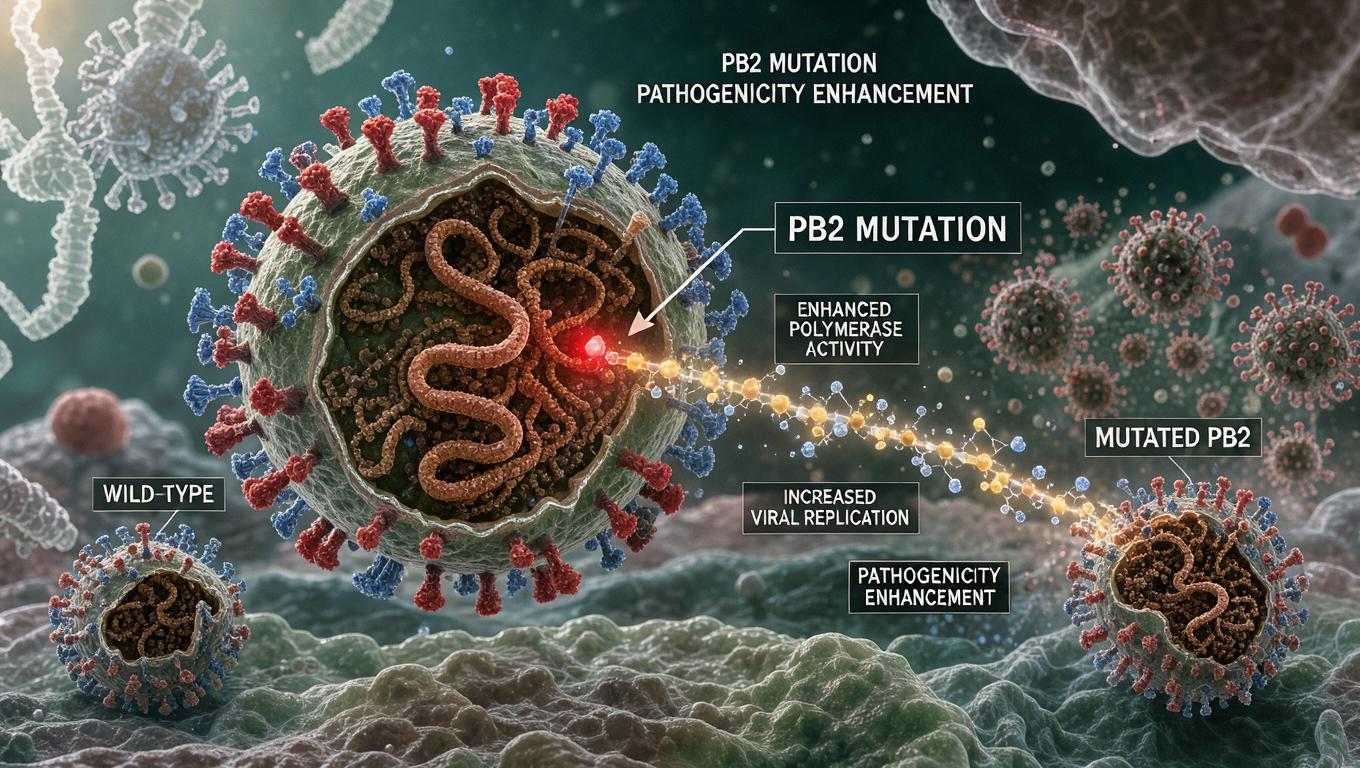
This 2017 Scientific Reports study shows that introducing PB2-E627K — but not Q591K or D701N — into a non-zoonotic duck H7N9 virus (A/duck/JX/3286/2009) increases polymerase activity, lung titers (~10^4 vs 10^2–10^3 TCID50 at day 3), cytokine induction, and weight loss in mice, implying PB2 mutations, not lineage background, drive mammalian pathogenicity . However, the finding is lineage-dependent: analogous PB2 mutations did not change canine H3N2 virulence, cautioning against over-generalization .
Long Explanation
What the Study Demonstrated
Using reverse genetics on the duck virus A/duck/JX/3286/2009 — phylogenetically distant from the zoonotic 2013 H7N9 lineage — the authors introduced three PB2 mammalian-adaptation mutations (Q591K, E627K, D701N). In 293T minigenome assays, all three enhanced polymerase activity at 33°C and 37°C, but 591K and 701N enhanced less dramatically at 33°C. In A549 cells, only 627K clearly improved replication. In BALB/c mice (n=6 per group, two independent experiments), 627K alone caused significant weight loss with severe bronchial necrosis and alveolitis, higher day-3 lung titers (~10^4 vs 10^2–10^3 TCID50/100 µL), and elevated TNF-α, IP-10, MCP-1 and MIP-1α — while no group showed mortality and day-6 titers were equivalent .
The authors explicitly note the cytokine-pathogenicity link is associative, not causal, and that six additional PB2 amino-acid differences between duck and human H7N9 could confound the 591K/701N comparison — a limitation they did not resolve.
Interpretation and Cross-Lineage Context
The central claim — that PB2 627K matters more than the zoonotic genetic background — is consistent with the broader literature: PB2 627K/701N are recognized mammalian adaptation markers across H7N9 waves , and in H5N1, 627E-to-627K reversion in mammals is NP-gene-dependent, showing epistatic context matters . A key counterpoint: in canine H3N2, the same mutations enhanced polymerase activity yet changed nothing for virulence . The paper's six-mouse groups, single duck strain, BALB/c-only model, and t-test-only statistics (no ANOVA/multiple-comparison correction) limit inferential strength; a fatal limitation is that 591K/701N polymerase gains in vitro did not translate in vivo, which the authors flag honestly.
What Would Change This Conclusion
Falsification would require: (1) showing 627K fails to enhance duck H7N9 virulence when the six additional PB2 differences are controlled by reciprocal chimeras; (2) demonstrating lung titers do not precede weight loss (early day-1/2 titers were never measured — the authors themselves speculate about this gap); or (3) reproducing null virulence effects in ferrets or guinea pigs, since mice poorly model H7N9 human disease.
Author Reviews:
Feedback:
Updated: October 27, 2026
BGPT Paper Review
Study Novelty
40%
PB2 627K's virulence role was already established in H5N1, H9N2 and zoonotic H7N9 by the same group; the novelty is testing it in a phylogenetically distinct duck H7N9 background.
Scientific Quality
60%
Controlled reverse-genetics design with replicated in vivo groups, but small n=6, no ANOVA/multiple-comparison correction, no early timepoint titers, and single strain/mouse strain limit statistical and external validity.
Study Generality
50%
Generalizes the 627K marker across H7N9 lineages but findings are strain-, host-, and temperature-specific; the canine H3N2 null result shows limited portability of such conclusions.
Study Usefulness
70%
Useful for pandemic-risk surveillance: non-zoonotic duck H7N9 can gain mammalian virulence from one mutation, informing avian-virus risk screening and PB2-based risk markers.
Study Reproducibility
70%
Detailed plasmid-based methods, defined doses, CULATR ethics number, and standard assays; no raw data repository, but protocols are conventional and replicable.
Explanatory Depth
60%
Links polymerase activity, replication, cytokines and histopathology mechanistically, but causality between cytokines and weight loss is explicitly associative and the 591K/701N in vivo null mechanism remains unexplained.
Aligning PB2 sequences from duck and zoonotic H7N9 to map the six additional amino-acid differences and predict their epistatic effects on polymerase function.
Get emailed when your analysis is done!
We'll email you the results when your analysis is finished.
Hypothesis Graveyard
'PB2 mutations uniformly enhance mammalian virulence' — falsified by canine H3N2 null results and the duck 591K/701N in vivo nulls; effect is gene-context-dependent.
'Cytokine dysregulation is the primary driver of H7N9 weight loss' — weakened here because all groups induced cytokines yet only 627K caused weight loss.

 Explore by Goal
 Quick Explanation
 Long Explanation
 Top Data Sources
 Ask a Follow-Up
 Key Insight
 Analysis
 Hypothesis Graveyard
 Potential Experiments
 Discussion
