Check whether claims match experiments, exact reported results, and stated limitations.Know what the science actually supports before you trust the answer.
Press Enter ↵ to review paper
Explore by Goal
"The saddest aspect of life right now is that science gathers knowledge faster than society gathers wisdom."
- Isaac Asimov
Quick Explanation
Copied
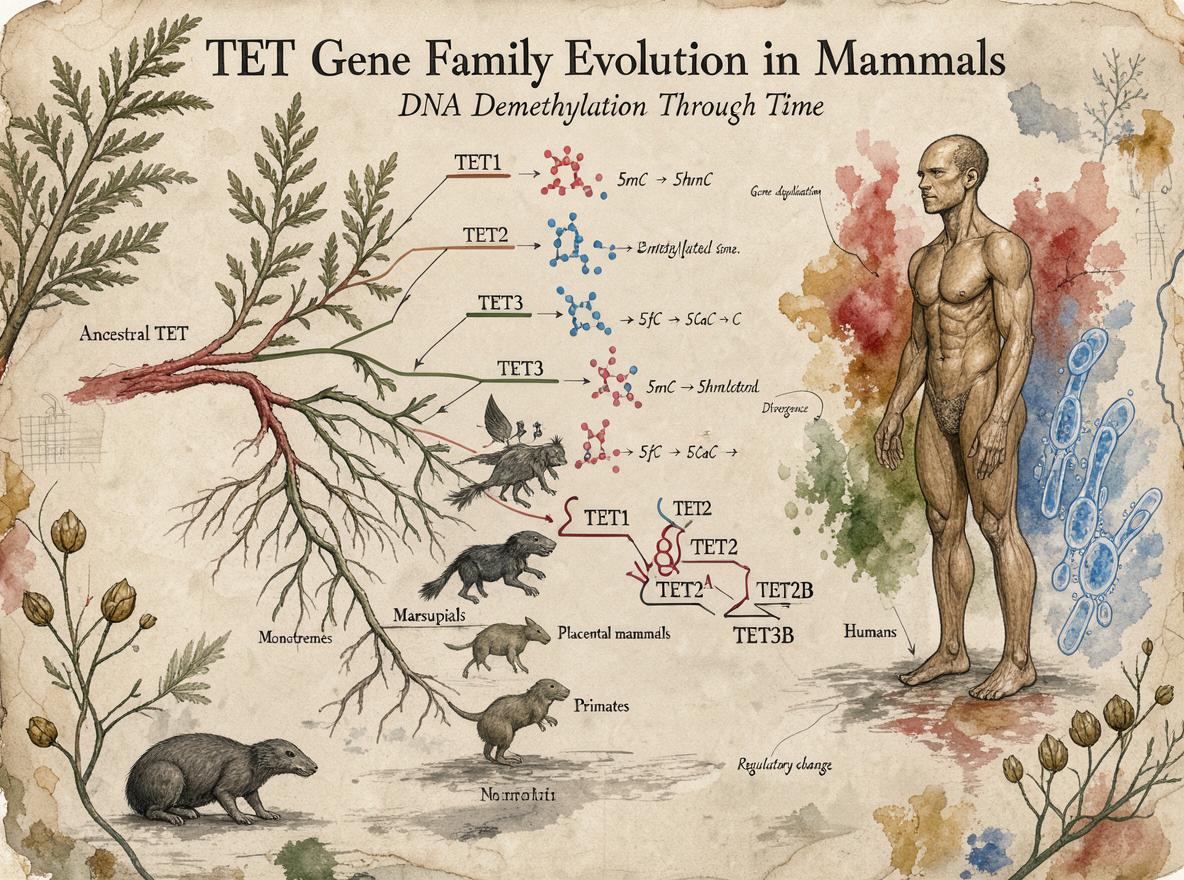
Akahori et al. (2015) provide a solid, multi-method evolutionary analysis of 130 mammalian TET sequences showing predominantly purifying selection (M0 ω: TET1 0.385, TET2 0.346, TET3 0.115) with episodic positive selection in TET1/TET2 but not TET3, and five surface-exposed positively selected residues in the TET2 catalytic core [PDB 4NM6]. The central limitation is the absence of any functional validation of the inferred adaptive sites, so the adaptive-regulation hypothesis remains conjecture.
Long Explanation
What the paper shows. Using 130 curated mammalian sequences (≥39 species per paralog) from GenBank and Ensembl Compara, the authors analyzed TET1, TET2 and TET3 separately after GARD found no recombination breakpoints (KH test, p = 0.01). Codon-based estimates under model M0 indicate pervasive purifying selection, with a strikingly lower ω for TET3 (0.115) than TET1 (0.385) or TET2 (0.346). Under the PAML M8 model, TET1 (3.8% of sites, 2ΔlnL = 21.22, p < 0.001) and TET2 (2.2%, 2ΔlnL = 41.27, p < 0.001) showed significant positive selection, while all site-model comparisons for TET3 were non-significant or negative. To reduce false positives, sites were called only when at least three of six methods (PAML M8 plus Datamonkey FEL, FUBAR, MEME, REL, SLAC) agreed, yielding 34 codons in TET1, 29 in TET2, and 13 in TET3. No positively selected sites occur in the CXXC DNA-binding domain, consistent with strong constraint there .
Branch-site and structural evidence. Using Guindon's stochastic branch-site framework (Fitmodel, M3+S2 best-fitting for all paralogs), 25% of TET1 and 17% of TET2 sites were assigned to an ω3 class >1 (1.34 and 1.54 respectively), whereas TET3's ω3 was only 1.07 with 9% of sites — interpreted as relaxed rather than positive selection . Mapping five positively selected TET2 catalytic-core residues (1203S, 1204S, 1205S, 1892N, 1312L) onto the human TET2–DNA crystal structure shows all lie on the protein's outer surface, none overlapping catalytic residues — supporting the authors' speculation that selection acted on interaction interfaces rather than enzymatic chemistry . The functional importance of TET constraint is corroborated by knockout work showing TET-mediated demethylation is essential for reprogramming .
Critical caveats. (1) No functional assays test any of the inferred sites — the surface-exposure argument is plausible but unverified; the authors themselves concede the cancer-variant overlap (TET2 positions 123, 817, 1204, 1762, 1811 in myeloproliferative neoplasms) is not established as statistically significant . (2) GARD's null result does not guarantee absence of recombination, which can confound site-model inference. (3) Sampling mirrors genome availability (mammalian-biased), and only coding regions were analyzed, excluding regulatory evolution. (4) ω values barely above 1 and modest site proportions mean the 'adaptive' signal is moderate, not dramatic. What would falsify the central claim: stricter models (e.g., BUSTED/MEME re-analysis with updated alignments), or mutagenesis showing the five surface residues do not affect TET2 interactions.
Feedback:
Updated: October 28, 2026
BGPT Paper Review
Study Novelty
70%
First dedicated codon-level selection survey across all three mammalian TET paralogs with structural mapping onto the just-released TET2 crystal structure; conceptually it applies well-established dN/dS and branch-site methodology to a new gene family, hence not groundbreaking.
Scientific Quality
80%
Rigorous multi-method consensus calling (6 methods, ≥3 agreement), recombination screening, appropriate LRTs, and co-authorship of the Fitmodel developer. Red flags are mild: moderate ω values barely >1, no multiple-testing adjustment across methods, no experimental validation, and GARD absence of recombination is not definitive proof.
Study Generality
70%
Findings generalize to understanding functional divergence of DNA-demethylation machinery across mammals, but conclusions are confined to coding sequence and available mammalian genomes.
Study Usefulness
70%
Provides a hypothesis-generating map of candidate adaptive residues in TET2's interaction surface and a benchmark dataset for later evolutionary epigenetics work, though no direct clinical or experimental payoff.
Study Reproducibility
70%
Methods are detailed (MAFFT, trimAl, PAL2NAL, PhyML, PAML 4.8, Datamonkey, Fitmodel) with accession lists in supplement; but no scripts/parameters repository and alignment-derived posterior lists limit exact replication.
Explanatory Depth
70%
Explains the TET1/TET2 vs TET3 divergence pattern with convergent/divergent substitution analysis and structural plausibility, but the mechanistic link between surface residues and altered regulation remains speculative.
Reproducing the paper's workflow: retrieving TET1/2/3 orthologs, aligning, screening recombination, and running codon-selection tests to verify which paralog sites show dN/dS > 1.
Get emailed when your analysis is done!
We'll email you the results when your analysis is finished.
Hypothesis Graveyard
'Positive selection on TET2 catalytic residues altered 5mC oxidation efficiency' — rejected because none of the five selected residues overlaps catalytic residues and all are surface-exposed, making direct chemistry change unlikely.
'TET gene family expansion post-dated mammalian radiation' — contradicted by the paper's own finding that TET1/2/3 orthologs are present across ≥39 mammalian species, dating duplications before mammalian diversification.

 Explore by Goal
 Quick Explanation
 Long Explanation
 Top Data Sources
 Ask a Follow-Up
 Key Insight
 Keep Exploring
 Analysis
 Hypothesis Graveyard
 Potential Experiments
 Discussion
