See what field and modeling studies actually reported, with every claim linked to its source.Know what the science actually supports before you trust the answer.
Press Enter ↵ to search claims
Explore by Goal
"In nature, nothing exists alone."
- Rachel Carson
Quick Analysis Plan
Copied
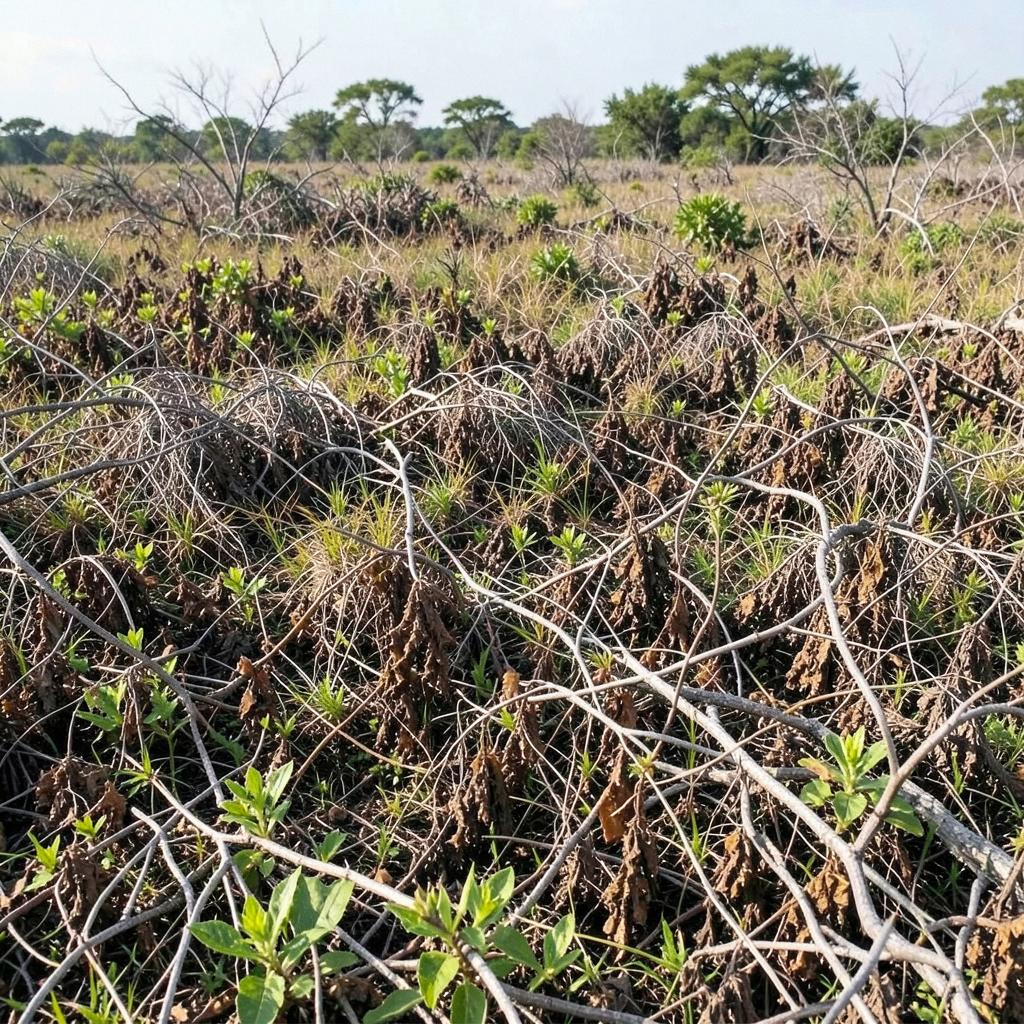
Terrestrial invasive plants reduce native plant cover and diversity, homogenize communities, alter soil chemistry and microbial communities, and persist via decade-long seedbanks — mechanisms documented across riparian, grassland, forest, and coastal systems that are directly relevant to the Texas Gulf Coast's similar habitats .
Long Analysis Plan
Documented Impacts Relevant to the Texas Gulf Coast
The supplied evidence does not include Texas-specific studies, so the issues are inferred from mechanistically analogous systems. Four impacts are well-supported:
Biodiversity loss and community homogenization: Fallopia knotweed invasion reduced native plant cover and richness in riparian patches, with summer Fallopia cover increasing ~tenfold and native diversity declining most under F. japonica and F. × bohemica . Similarly, dense Alnus alnobetula encroachment cut species richness from 47.6 ± 1.0 to 25.6 ± 1.1 per 225 m² plot (ANOVA F = 106.9, p ≤ 0.001), converging communities toward competitive strategists .
Soil and microbial alteration: The invasive herb Impatiens parviflora significantly restructured soil yeast communities (170 samples), increasing hydrolytic Trichosporon species and decreasing typical soil taxa like Cryptococcus podzolicus . Fallopia patches also correlated with distinct soil chemistry (higher pH for F. japonica; higher nitrogen forms for F. sachalinensis) .
Context-dependent effects — a key caution: The nitrogen-fixer Melilotus officinalis facilitated other species in sparse vegetation while acting as only a weak competitor in prairie, showing invader impacts are habitat-dependent and sometimes facilitative .
Extreme control difficulty: Opuntia prickly pears maintain seedbanks up to 20 years, germinate ~80% under optimal conditions, and resist herbicide uptake via thick waxy cladodes, requiring integrated management .
Note on evidence scope: None of the cited studies were conducted in Texas; the Fallopia, Alnus, Melilotus, Impatiens, and Opuntia findings come from Poland, the French Alps, Badlands National Park, Central Russia, and global reviews respectively. Local Gulf Coast species (e.g., Chinese tallow, privet) are not covered by these records, and salt-marsh SOC effects of invasive Spartina are coastal rather than terrestrial . Texas-specific impact quantification would require local survey data.
Building a reproducible Python pipeline that ingests the supplied invasion plot datasets, runs multivariate ordination and diversity analyses, and generates comparative visualizations of invasive impacts across habitat types.
Get emailed when your analysis is done!
We'll email you the results when your analysis is finished.
Hypothesis Graveyard
'All invasive plants uniformly reduce native diversity' — falsified by Melilotus facilitation in sparse vegetation and Spartina's site-specific positive SOC effects.
'Biocontrol alone suffices for woody/cactus invaders' — the Opuntia review shows biocontrol efficacy is climate- and density-dependent, requiring integrated approaches.
Science Art
Science Movie
Make a narrated HD Science movie for this answer ($32 per minute)

 Explore by Goal
 Quick Analysis Plan
 Long Analysis Plan
 Top Data Sources
 Ask a Follow-Up
 Key Insight
 Analysis
 Hypothesis Graveyard
 Discussion
