Analyze how experimental results and claims are presented, scoped, and limited in a paper.Know what the science actually supports before you trust the answer.
Press Enter ↵ to analyze
Explore by Goal
"The cosmos is within us. We are made of star-stuff. We are a way for the universe to know itself."
- Carl Sagan
Quick Explanation
Copied
This 2016 Bioorganic & Medicinal Chemistry Letters study reports that the biflavonoid fukugetin inhibits human kallikreins KLK1-KLK7, with KLK2 (IC50 3.2 μM) and KLK1 (5.7 μM) most potently inhibited via a mixed-type (linear partial competitive) mechanism supported by kinetic parameters (KLK2 Ki 1.6 μM; KLK1 Ki 3.6 μM) and docking/MD simulations [paper DOI 10.1016/j.bmcl.2016.01.039]. The kinetic evidence is solid but modest potency, lack of selectivity data beyond IC50 profiling, and unvalidated computational poses limit impact.
Long Explanation
Core Evidence: Kinetics and Mechanism
Using recombinant human KLK1-KLK7 expressed in a baculovirus/insect-cell system with FRET substrates (Abz-KLRSSQ-EDDnp and Abz-KLYSSQ-EDDnp), the authors found fukugetin — a naringenin–luteolin biflavonoid isolated from Garcinia brasilensis — inhibited all seven tested kallikreins, with the strongest effects on KLK2 (IC50 3.2 μM) and KLK1 (5.7 μM) .
The mechanistic analysis is the paper’s strongest contribution. For KLK1 and KLK2, Km rose and Vmax fell with inhibitor concentration (KLK1: Km 0.65→1.12 μM, Vmax 450→160 μM/s; KLK2: Km 0.62→1.20 μM, Vmax 226→79 μM/s), with β = 0, confirming linear partial competitive inhibition. Derived Ki values were 3.6 μM (KLK1) and 1.6 μM (KLK2), with α factors of 1.6 and 2.3 respectively .
Computational Analysis: Strengths and Internal Tension
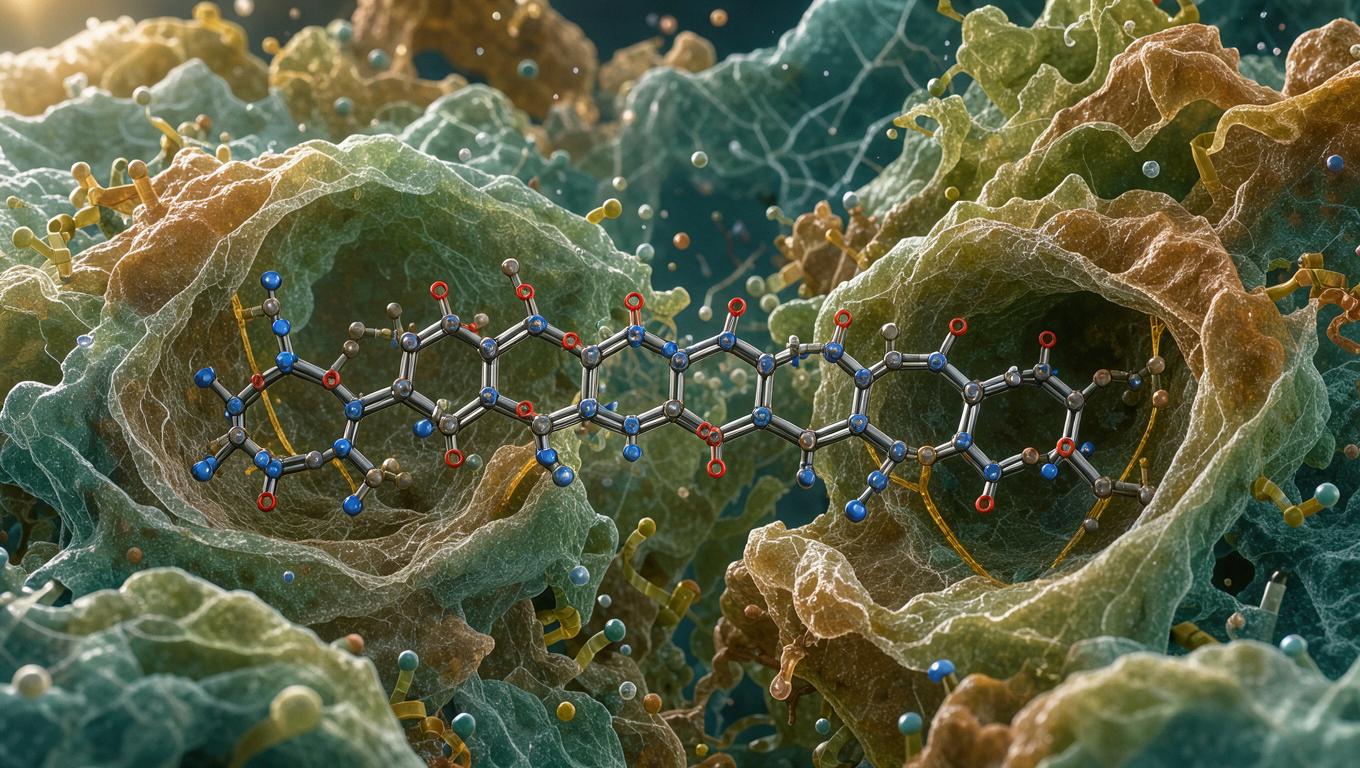
AutoDock blind docking placed fukugetin near the substrate pocket in three clusters (binding energies -8.9, -8.5, -6.5 kcal/mol). Subsequent 20 ns MD with MM/GBSA gave ΔGbind of -26.0 (pose 1: naringenin half in S1, luteolin half in S2), -25.4 (pose 2: S1′/S2′ pockets), and -10.4 kcal/mol (pose 3, which drifted from the pocket). Notably, MM/PBSA contradicted the ranking — giving +16.8 kcal/mol for pose 1 and favoring pose 2 — and the authors attributed the preferred pose 2 to the free-enzyme state while conceding an allosteric site on the enzyme–substrate complex cannot be excluded . This method-level disagreement (MM/GBSA vs MM/PBSA) is honestly reported but leaves the binding-mode assignment genuinely uncertain — the two methods disagree by >40 kcal/mol for pose 1, which is larger than the entire signal being interpreted.
Critical Appraisal
Strengths: Proper mixed-type kinetic framework (Segel equations for α/β/Ki), triplicate measurements with SEM, orthogonal plot confirmation (Eadie-Hofstee), and previously validated expression/purification pipeline (SDS-PAGE, N-terminal sequencing, mass spectrometry) .
Blind spots and caveats: (1) No counterscreen against unrelated serine proteases (trypsin, chymotrypsin, plasma kallikrein), so “KLK inhibitor” claims rest only on the seven-enzyme panel — broad inhibition of KLK3/5/6/7 at 12-16 μM suggests poor selectivity that could extend to off-targets. (2) Fukugetin’s slow-binding, reversible behavior against cysteine proteases (papain, cruzain) is cited as prior art but slow-binding controls were not re-performed here, so pre-incubation equilibrium assumptions in the kinetic model are untested. (3) The mixed-type claim rests on β = 0, yet the docking models bind fukugetin within the substrate-recognition region — a purely competitive mechanism would also fit; no direct structural evidence (X-ray/cryo-EM) resolves this. (4) No cell-based or in vivo data; no plasma-protein binding or solubility assessment for a large, poorly soluble biflavonoid. (5) Single funding source (FAPESP) disclosed with no competing interests declared; replication data and raw trajectories were not deposited. These gaps do not invalidate the kinetic core but cap translational significance.
What Would Change the Conclusion
Counter-screening showing fukugetin is a broad flavonoid protease inhibitor (likely, given known pan-assay interference tendencies of polyphenols such as aggregation or redox activity) would reframe the finding as nonspecific. Conversely, a co-crystal structure confirming a defined mixed-type pose, or selective KLK2 inhibition in a physiological context, would substantially elevate the work.
Feedback:
Updated: November 01, 2026
BGPT Paper Review
Study Novelty
70%
First report of a biflavonoid as a mixed-type KLK inhibitor; prior group work covered competitive natural-product KLK inhibitors and fukugetin's cysteine-protease activity, so the novelty is incremental-extension rather than breakthrough.
Scientific Quality
70%
Rigorous kinetic framework with triplicates and orthogonal plot confirmation, but MM/GBSA vs MM/PBSA disagreement, no counterscreens, no structural validation, and 10-16 μm IC50s across most KLKs weaken impact. No prompt-injection or data-integrity red flags detected.
Study Generality
60%
Findings are specific to KLK1-KLK7 enzymology but the mixed-type framework and docking workflow transfer to other serine protease inhibitor studies.
Study Usefulness
70%
Provides a validated kinetic starting point (Ki 1.6-3.6 μM) and putative binding poses for fukugetin optimization, though potency and selectivity are too weak for direct therapeutic relevance.
Study Reproducibility
70%
Enzyme sources, substrates, buffer conditions, inhibitor concentrations, and software versions are reported; raw data and MD trajectories were not deposited, and the reference [16] method for extraction is cited but not detailed.
Explanatory Depth
70%
Mechanistic depth is good at the kinetic level (α/β parameters, partial competitive classification) but structural explanation is speculative due to contradictory free-energy methods and absence of experimental structure.
Fitting mixed-type inhibition equations to the reported KLK1/KLK2 Km-Vmax data to independently verify α, β, and Ki values and quantify parameter uncertainty.
Get emailed when your analysis is done!
We'll email you the results when your analysis is finished.
Hypothesis Graveyard
That fukugetin is a purely competitive KLK inhibitor like the group's prior natural-product hits — falsified by the convergent Lineweaver-Burk intersection above the x-axis and the nonzero α factors for both KLK1 and KLK2.

 Explore by Goal
 Quick Explanation
 Long Explanation
 Top Data Sources
 Ask a Follow-Up
 Key Insight
 Keep Exploring
 Analysis
 Hypothesis Graveyard
 Potential Experiments
 Discussion
