Analyze how experimental results and claims are presented, scoped, and limited in a paper.Know what the science actually supports before you trust the answer.
Press Enter ↵ to analyze
Explore by Goal
"The biology of mind bridges the sciences – concerned with the natural world – and the humanities – concerned with the meaning of human experience."
- Eric Kandel
Quick Answer
Copied
This 2014 narrative review (340 references, Frontiers in Endocrinology) credibly synthesizes three mechanistic axes—low-grade inflammation/macrophage polarization, insulin resistance/IGF signaling, and adipose hypoxia—linking obesity to carcinogenesis, with an estimated 15–20% of US cancer deaths attributable to excess adiposity . Its main weakness is narrative (non-systematic) design: literature selection bias, BMI limitations, and heterogeneous cancer-site evidence—especially contradictory prostate and lung findings that the authors themselves flag.
Long Answer
Mechanistic Architecture of the Review
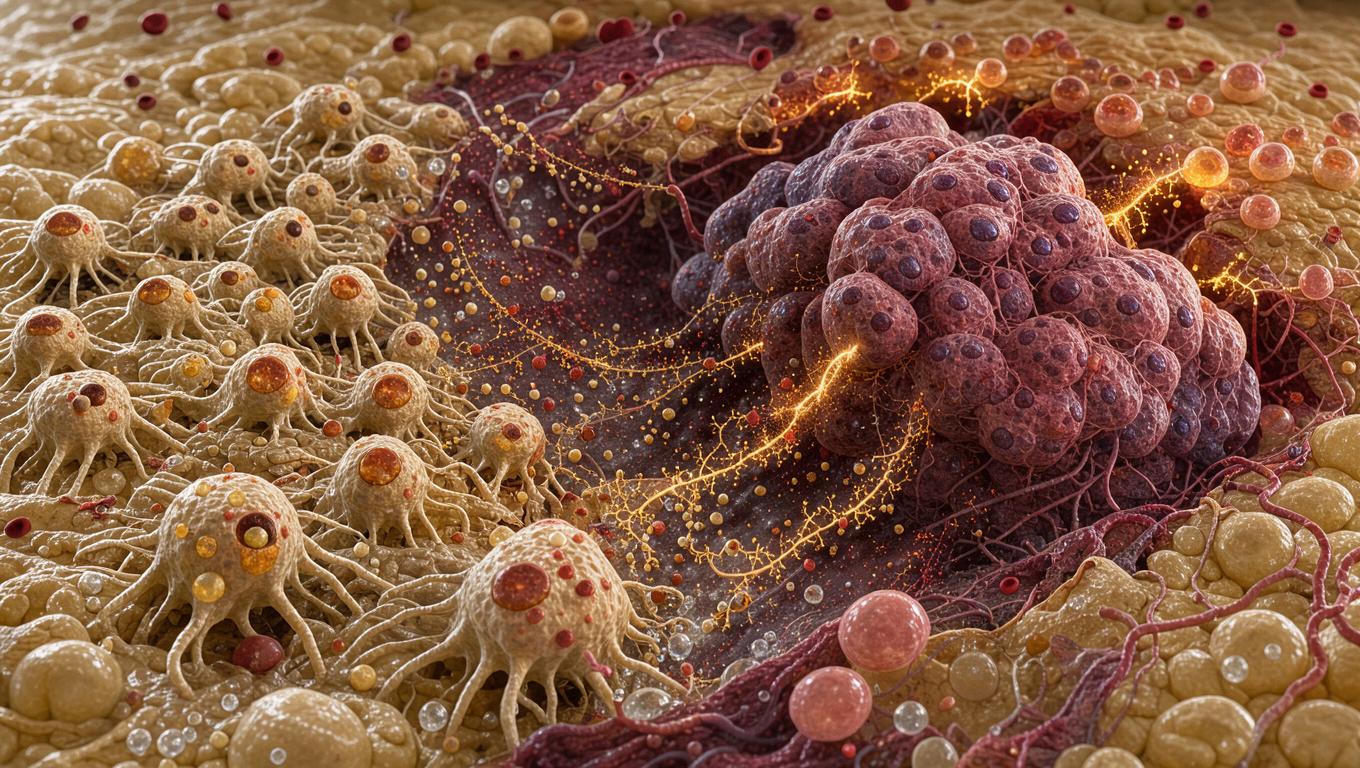
The review organizes obesity–cancer biology around adipose tissue as an active endocrine/inflammatory organ rather than a passive lipid depot . Three pillars are proposed: (i) inflammatory switching of adipose tissue macrophages from anti-inflammatory M2 to pro-inflammatory M1, driving NF-κB, TNF-α, IL-6, and Wnt/β-catenin signaling; (ii) insulin resistance with compensatory hyperinsulinemia lowering IGFBP-1/2 and raising bioavailable IGF-1, a mitogenic/anti-apoptotic stimulus; and (iii) adipose hypoxia stabilizing HIF-1α and inducing VEGF-driven angiogenesis. This framework aligns with independent syntheses framing adiposity as an inflammatory determinant of disease risk .
Values as reported in the review text: 15–20% of US cancer deaths attributed to overweight/obesity; ~30% of colon cancer cases attributed to BMI >22.5 kg/m²; ~threefold postmenopausal breast cancer risk in obese women; and the Swedish Obese Subjects (2,010 surgery vs 1,037 matched controls) finding of fewer first-time cancers after surgery, women only . Bars are unit-heterogeneous and shown for scale comparison only.
Critical Appraisal
Strengths: breadth (340 references), mechanistic specificity (AdipoR1/R2–AMPK axis, leptin JAK/STAT–PI3K/Akt cascades), and honest acknowledgment of contradictions—the review explicitly notes null and even protective obesity associations for prostate cancer and an inverse BMI–lung cancer association after smoking adjustment . The leptin discussion is supported by mechanistic cell data showing leptin induces genotype-dependent chemokine production and macrophage activation in preneoplastic (ApcMin/+) colon epithelial cells—MIP-2 and CXCL18 up to 30-fold, with macrophage NO production rising from 6.6 to 46.0 mM with 50 ng/mL leptin-conditioned media .
Weaknesses: as a narrative review it has no systematic search, no effect-size synthesis, and cites mostly observational associations—confounding (reverse causation, smoking, HRT) is noted but not quantified. BMI is criticized by the authors themselves, yet remains the exposure in most cited studies. The visfatin insulin-mimetic claim rests partly on a partially retracted paper (Fukuhara 2005/2007 retraction noted in the text) . Human leptin data are heterogeneous, and a dedicated review concludes colon-cancer leptin associations vary by tissue measurement type and Apc genotype, demanding integrated rather than single-axis inference . Animal-to-human translational uncertainty (e.g., mouse Apc models, HFD Adipoq-knockout polyp data) is underweighted relative to the confident conclusion tone.
Falsifiability: the framework is falsifiable via well-powered cohorts showing adiposity metrics (beyond BMI) do not predict cancer after adjustment, or via pathway blockade trials failing to modulate tumorigenesis. Modern adipose-derived extracellular-vesicle biomarker work (e.g., VAT-enriched TGFBI, 4.87-fold vs SAT) offers testable, tissue-specific extensions of the review's secretome hypothesis .
Bottom line (moderate confidence): a well-sourced, mechanistically rich synthesis whose epidemiological backbone is observational and whose cancer-site evidence is genuinely heterogeneous; its therapeutic claims (bariatric surgery benefit in women only, SOS trial) should be treated as hypothesis-generating, not established .
Feedback:
Updated: October 30, 2026
BGPT Paper Review
Study Novelty
60%
Synthesis (2014) of already-established mechanisms (inflammation, insulin/IGF, hypoxia); integrates macrophage-polarization framing and adipokine breadth but introduces few genuinely new concepts.
Scientific Quality
70%
Well-referenced (340 refs) and self-critical about contradictions (prostate, lung, visfatin retraction), but narrative rather than systematic: no meta-analytic synthesis, observational backbone, heterogeneous cancer-site evidence.
Study Generality
80%
Covers multiple tumor types (breast, colorectal, prostate, endometrial, hepatic) and cross-cutting mechanisms applicable broadly to obesity-related carcinogenesis.
Study Usefulness
70%
Useful as a mechanistic map and prevention-oriented synthesis (lifestyle, bariatric surgery), though no quantitative risk models or prioritized targets are delivered.
Study Reproducibility
40%
No primary data; reproducibility is limited to the cited studies, whose quality varies; narrative citation selection cannot be independently replicated.
Explanatory Depth
80%
Deep mechanistic detail across signaling cascades (NF-κB, JAK/STAT, PI3K/Akt, AMPK, HIF-1α, Wnt/β-catenin) linking adipose dysfunction to tumorigenesis.
Comparing adipokine and inflammatory pathway gene signatures across VAT/SAT datasets to quantify obesity-cancer mechanistic overlap and rank druggable candidate nodes.
Get emailed when your analysis is done!
We'll email you the results when your analysis is finished.
Hypothesis Graveyard
'Obesity uniformly increases all cancer risk' — falsified by the review's own cited inverse BMI–lung cancer association (smoking-adjusted) and protective/neutral prostate findings.
'Leptin is a straightforward pro-tumorigenic hormone' — human data are heterogeneous and effects are genotype- and tissue-measurement-dependent, per the colon-cancer leptin review.

 Explore by Goal
 Quick Answer
 Long Answer
 Top Data Sources
 Ask a Follow-Up
 Key Insight
 Keep Exploring
 Analysis
 Hypothesis Graveyard
 Potential Experiments
 Discussion
