Check each claim against its linked experiments, results, and falsification criteria.Know what the science actually supports before you trust the answer.
Press Enter ↵ to check claims
Explore by Goal
"The finding of the double helix thus brought us not only joy but great relief. It was unbelievably interesting and immediately allowed us to make a serious proposal for the mechanism of gene duplication."
- James Watson
Quick Explanation
Copied
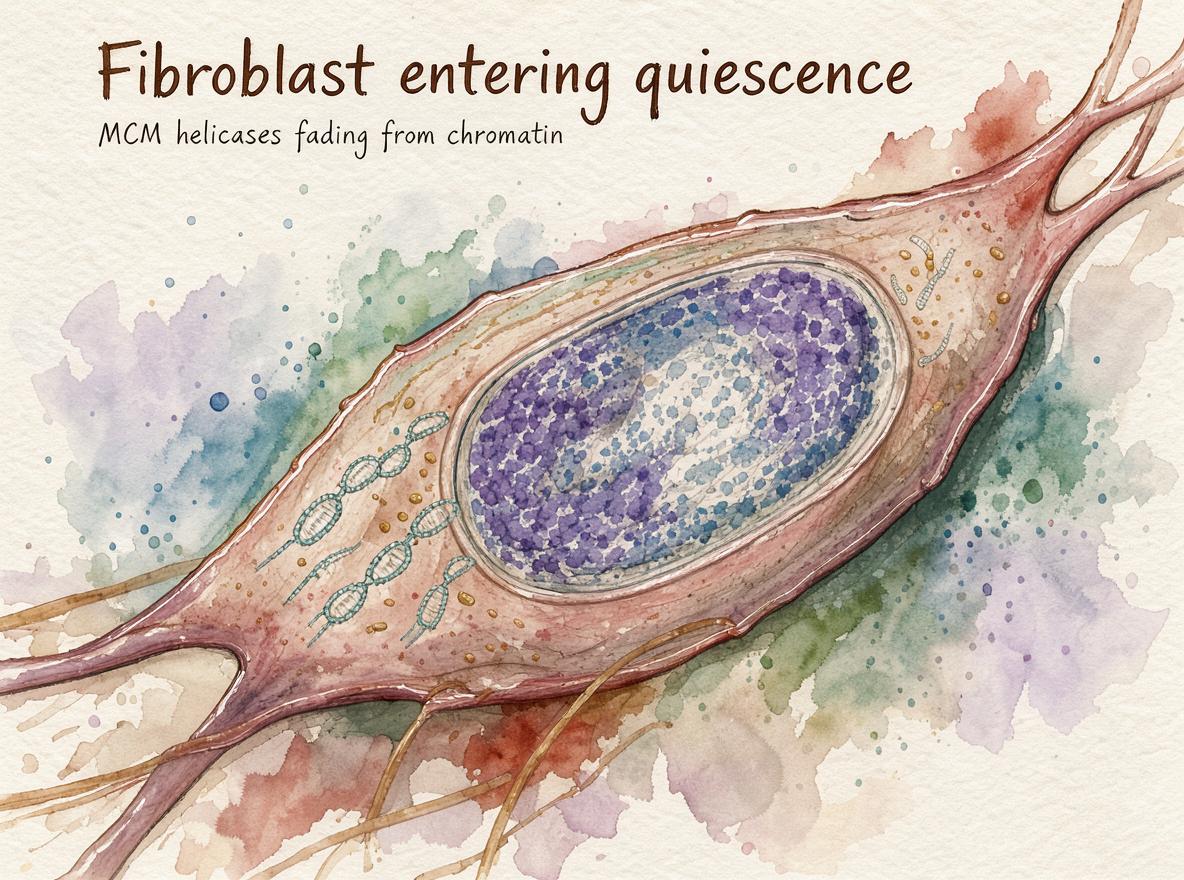
This 2004 EMBO Journal study by Xouri, Lygerou, Nishitani, Nurse and Taraviras provided the first demonstration that the licensing factors Cdt1 and geminin are coordinately down-regulated at both RNA and protein levels when primary fibroblasts enter G0 quiescence, and are re-induced before S phase upon serum re-addition . It also showed consistent Cdt1 over-expression in cancer-derived cell lines, a finding later validated by transgenic mouse data linking Cdt1 excess to lymphoma in p53-null backgrounds .
Long Explanation
What the paper established
Xouri and colleagues asked whether Cdt1 — the essential MCM-loading factor — and its inhibitor geminin are transcriptionally silenced when cells exit the cycle into quiescence. Using primary human fibroblasts, serum-starved NIH3T3 cells, in situ hybridization and immunohistochemistry in developing mouse gut, plus a panel of cancer-derived cell lines, they showed that: (1) both proteins and their mRNAs drop on G0 entry; (2) Cdt1 re-accumulates before S phase with geminin trailing 3–6 h behind; (3) both localize to the proliferative compartment of fetal gut epithelium; and (4) Cdt1 is consistently over-expressed in cancer lines at RNA and protein level, with heterogeneous Cdt1:geminin ratios .
The timing asymmetry they observed (geminin lagging Cdt1) was mechanistically prescient: subsequent work showed Cdt1 is actively destroyed in S phase by CRL4(Cdt2)–PCNA, so its availability in G1 depends on both transcriptional and proteolytic programs , and FOXO3 was later found to stabilize Cdt1 by blocking that same PCNA/DDB1/Cul4 pathway — implying quiescence exit involves a proteasome-level switch, not just transcription .
Critical assessment
Strengths. The study correctly anticipated the now-central idea that excess licensing capacity (Cdt1) drives oncogenesis — validated by Cdt1 transgenic mice developing lymphoma without p53 , and by licensing-marker immunohistochemistry in renal cell carcinoma where Mcm2/geminin/Ki67 stratify grade and prognosis .
Limitations. The "over-expression" claim rests on comparing a small set of established cancer lines to a single primary fibroblast background; culture adaptation and p53/Rb pathway status were not controlled, so cell-line adaptation may partly explain elevated Cdt1 rather than tumor-specific dysregulation. The transcriptional mechanism was asserted but no promoter analysis or ChIP was performed. Distinguishing mRNA down-regulation from the overlapping S-phase proteolytic degradation pathway (DDB1–CUL4A–ROC1, published contemporaneously ) was not fully resolved in this paper. The authors' own later reviews treat G0 down-regulation as transcriptional, but the proteolytic component (PCNA/CRL4-Cdt2) discovered afterwards means the full exit mechanism was incomplete . Finally, quantitative replication licensing follows-ups showed excess Cdt1 also slows fork elongation — a dose-dependent harm the 2004 paper did not anticipate .
The graph shows independent, later clinical data supporting the paper's central thesis: replication licensing factors rise with tumor grade. Values are reported means from Pan et al. 2005, not data from the reviewed paper itself.
What would change the conclusions
If matched primary-tumor/normal-pair analyses found Cdt1 mRNA elevation driven by culture adaptation rather than tumor biology, the cancer over-expression claim would need revision; conversely, single-cell RNA sequencing of fresh tumors showing cell-cycle-independent Cdt1 excess would strengthen it. The mechanistic transcriptional claim would be falsified if Cdt1 exit were shown to be purely proteolytic — a real possibility given FOXO3/PCNA findings .
Feedback:
Updated: November 01, 2026
BGPT Paper Review
Study Novelty
80%
In 2004, demonstrating that Cdt1 and its inhibitor geminin are transcriptionally silenced in G0 and over-expressed in cancer lines was among the first links between licensing-factor dysregulation and malignancy; the concepts are now textbook, hence not 9-10.
Scientific Quality
70%
Careful multi-assay approach (western, Northern, ISH, IHC) with strong authorship, but small sample sizes, one primary-cell comparator, no promoter-level mechanism, and cell-line culture adaptation as an uncontrolled confounder limit quality to 7.
Study Generality
80%
Cell-cycle exit and licensing are universal across metazoans; findings generalize from fibroblasts and mouse gut to broad cancer biology, later confirmed in transgenic models and RCC biomarker cohorts.
Study Usefulness
80%
Directly catalyzed the Cdt1-as-oncogene research program and licensing-factor biomarker development (Mcm2/geminin staining in clinical pathology); mechanistic follow-ups built on its G0-exit framework.
Study Reproducibility
70%
Standard synchronized-fibroblast, serum-starvation and immunoblot/Northern methods are reproducible, but no raw data repository exists and the cancer-line panel comparison lacks documented matched controls, capping reproducibility at 7.
Explanatory Depth
60%
Descriptive and correlative at the transcriptional level; the paper asserts transcriptional control without promoter or ChIP data, and the proteolytic (CRL4-Cdt2/PCNA, FOXO3) dimension was discovered only later.
Generated scientific data; not direct experimental measurements.
Get emailed when your analysis is done!
We'll email you the results when your analysis is finished.
Hypothesis Graveyard
Geminin alone prevents re-replication in quiescent cells — falsified by the finding that Cdt1 excess causes re-replication even in the presence of geminin when CRL4-Cdt2 is inactivated; geminin is necessary but not sufficient.
'Over-expression' in cancer lines simply mirrors faster proliferation — weakened by RCC data showing Mcm2 rises with grade beyond proliferation rate and by transgenic lymphoma in p53-null mice not explained by doubling time alone.

 Explore by Goal
 Quick Explanation
 Long Explanation
 Top Data Sources
 Ask a Follow-Up
 Key Insight
 Keep Exploring
 DataGen
 Hypothesis Graveyard
 Discussion
