Before you submit, tie each manuscript statement to experiments, exact reported results, and sources.Know what the science actually supports before you trust the answer.
Press Enter ↵ to check claims
Explore by Goal
"If you thought that science was certain - well, that is just an error on your part."
- Richard Feynman
Quick Explanation
Copied
Achilleas S. Frangakis is a senior structural biologist whose career helped launch cellular cryo-electron tomography and who continues producing high-novelty work on bacterial DNA-conduits and antibody-driven podocyte injury, with an OpenAlex h-index of 48 and ~9,613 citations ().
Long Explanation
Scientific strengths: methodology leadership with an unusual ability to spot structural surprises
Frangakis co-authored the landmark 2002 Science cryo-electron tomography study visualizing macromolecular architecture inside intact eukaryotic cells — a paper now cited 859+ times and a foundation of in-cell structural biology (). He also built durable computational tools: anisotropic-diffusion denoising for tomograms (432+ citations, ) and the KerDenSOM3D neural-network classifier that compensates for missing-wedge artifacts and outperformed prior sub-tomogram classification in template-matching (). The 2011 study itself flags residual template bias and misalignment-driven misclassification — appropriate epistemic caution from the author.
In a 2026 preprint, Frangakis' team combines cryo-ET, STED-PAINT, and long-read genomics to show A. baumannii cell-envelope conduits carry ~2 nm filaments consistent with dsDNA, and that interstrain co-culture yields recombinant clones with contiguous donor-derived chromosomal stretches up to 1.1 Mbp; DNase, purified-DNA controls, and absence of complete conjugation systems argue against transformation or canonical conjugation (). Key caveats the authors themselves report: only a small fraction of cells form conduits, mild lysis ('ghosting') was needed for imaging, the ~2 nm filament diameter is not definitive proof of DNA identity, some double-resistant clones arose from independent secA point mutations rather than transfer, and HGT was tested in only one strain pair with no genetic manipulation of conduit formation — meaning a causal conduit→transfer link is still inferential.
Translational breadth: glomerular disease
A second 2026 preprint applies cryo-ET (65 reconstructions) to anti-nephrin podocytopathy in mice, revealing progressive slit-diaphragm remodeling: dome-shaped bending, CCMAs >200 nm, and 2–3-fold actin-mat volume increases linking antibody binding to nephrotic syndrome (). Limitations include a mouse model, regional sampling bias, pseudotime-inferred progression, and prep artifacts.
Bibliometric and critical assessment
OpenAlex reports 125 works, 9,613 citations, and h-index 48, with peaks tied to the 2002 Science paper and the highly cited 2012 exosomal miRNA paper in Nature Cell Biology (1,318 citations) — evidence of both technical-method influence and collaborative biological impact (). Notably, his chromatin work argued against the textbook 30-nm fiber in mitotic chromosomes (430+ citations) — he has a track record of publishing falsifying, not merely confirming, results (). Blind spots: two recent preprints carry the same zero-incoming-citation status and have not passed peer review or replication; the conduit HGT claim depends on correlative imaging–genetics without a genetic determinant of conduit formation identified. What would change this assessment: genetic ablation abolishing both conduits and megabase transfer, or failure of independent labs to reproduce the SC2151/SC1846 recombination pattern.
Feedback:
Updated: October 07, 2026
BGPT Author Review
Scientific Quality
80%
h-index 48, ~9,613 citations, co-author of a foundational 2002 Science cryo-ET paper and multiple high-impact method and concept papers (30-nm chromatin refutation, Mycoplasma proteome organization, desmosome architecture). Strong record of both building methods and publishing falsifying results. Deductions: recent flagship claims (bacterial conduits) rest on correlative evidence without a genetic determinant or direct molecular proof of DNA in conduits, and key recent work is unreviewed preprint material.
Communication Quality
70%
Papers supply clear schematics, quantitative ranges, and honest limitations sections (e.g., explicitly reporting that ~2 nm filament diameters are only 'consistent with' DNA and that ghosting was required). Accessible collaboration style spanning microbiology, nephrology, and cardiology. Deduction: findings frequently require expert cryo-ET literacy to interpret, and mechanistic claims are sometimes pitched ahead of causal evidence.
Author Novelty
90%
Repeatedly opened new fields: cellular cryo-ET of intact eukaryotic cells, sub-tomogram classification with neural networks, and now megabase-scale conduit-mediated bacterial DNA transfer — a genuinely novel HGT mechanism. The nephrin cryo-ET application is also a first of its kind in podocyte pathology.
Scientific Rigor
80%
Strong controls in the conduit study (DNase, purified-DNA, monoculture controls, long-read sequencing) and explicit reporting of negative aspects (secA point-mutant clones, low conduit frequency). Deductions: no genetic manipulation of conduit formation, filament identity unproven, one strain pair tested, and pseudotime-based progression inference in the nephrin study; some findings remain unreplicated.
We'll email you the results when your analysis is finished.
Hypothesis Graveyard
That the 30-nm chromatin fiber is the universal basic unit of mitotic chromatin compaction — directly refuted by in-situ cryo-EM with Frangakis as co-author.
That megabase bacterial DNA transfer necessarily requires conjugation machinery — the conduit data suggest a conjugation-independent route, though absence of complete canonical systems alone is not conclusive.

 Explore by Goal
 Quick Explanation
 Long Explanation
 Top Data Sources
 Ask a Follow-Up
 Key Insight
 Keep Exploring
 Hypothesis Graveyard
 Potential Experiments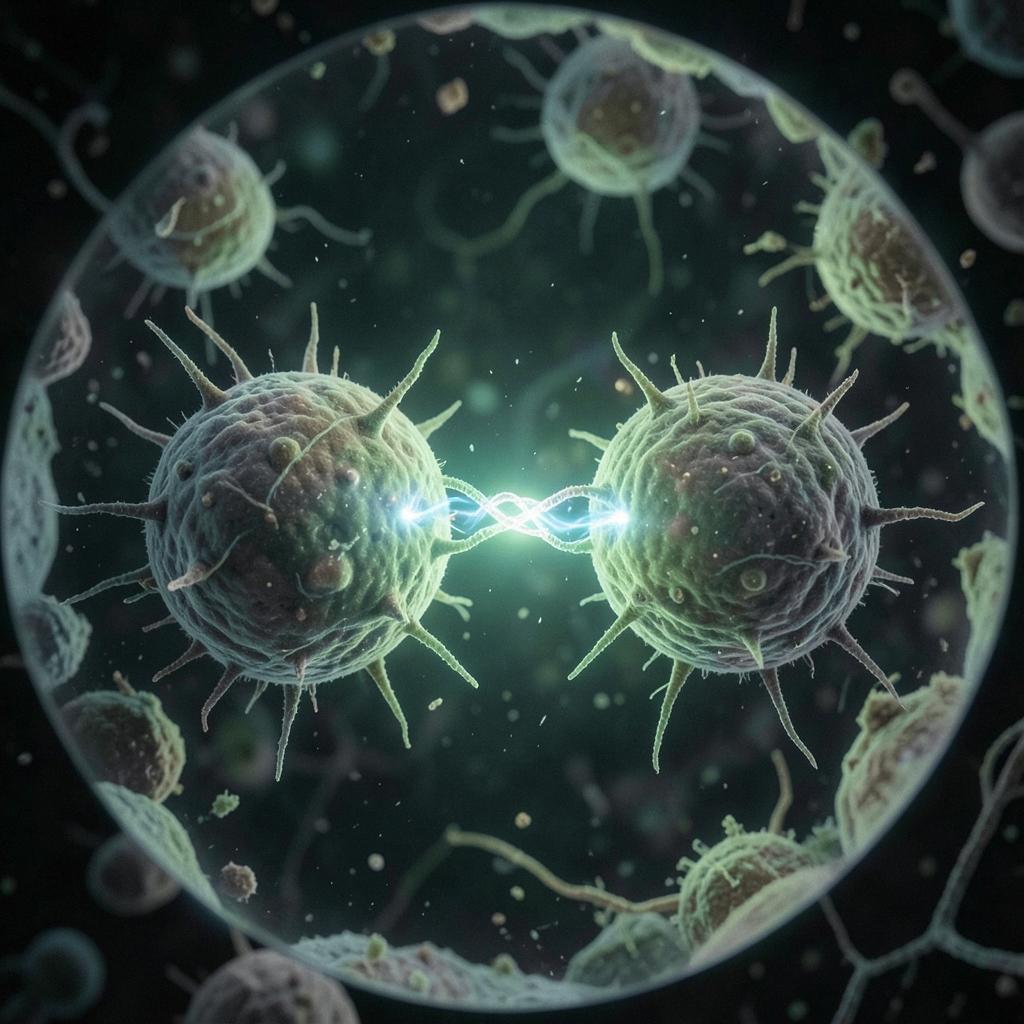
 Discussion