Ask questions across claims linked to experiments, exact results, limitations, and sources.Know what falsifiable science actually supports before you trust the answer.
Press Enter ↵ to search evidence
Explore by Goal
"The scientist only imposes two things, namely truth and sincerity, imposes them upon himself and upon other scientists."
- Erwin Schrödinger
Quick Analysis Plan
Copied
A rigorous chordoma bioinformatics/coding/analysis plan should integrate retrospective surgical-outcome data (survival, margins, recurrence), differential-diagnosis pipelines, and targeted-therapy evidence, since conventional chemotherapy is largely ineffective and surgical margin quality plus tumor volume drive recurrence risk.
Long Analysis Plan
1. Clinical Evidence Base
Sacral chordoma resection (n=71) yields 5-year overall survival of 91%, falling to 66% at 10 years and 44% at 15 years, with 47% local recurrence (mean 3.8 years) and 34% lung metastasis; complications occurred in 80.9% of patients, with 41.2% infections, and risk was driven by prior intralesional surgery, inadequate margins, and large tumor volumes (mean 535 cm³) . Skull base series (n=238) achieved gross total resection in only 11.8%, with 3/5/7-year OS of 81%/76%/71% and PFS of 51%/45%/31% . Older skull base data (n=64) showed total/near-total excision in 56.25% but high morbidity (13 CSF leaks, 5 meningitis, 5 deaths) .
Note: curves come from different cohorts and follow-up windows; they are descriptive, not directly comparable.
2. Coding / Analysis Plan
Data curation: Harmonize retrospective cohorts (sacral, skull base, mobile spine) into a structured schema (patient, stage, margins, volume, recurrence, survival); use pandas + lifelines for Kaplan-Meier and Cox modeling of margin status and tumor volume as in the source studies.
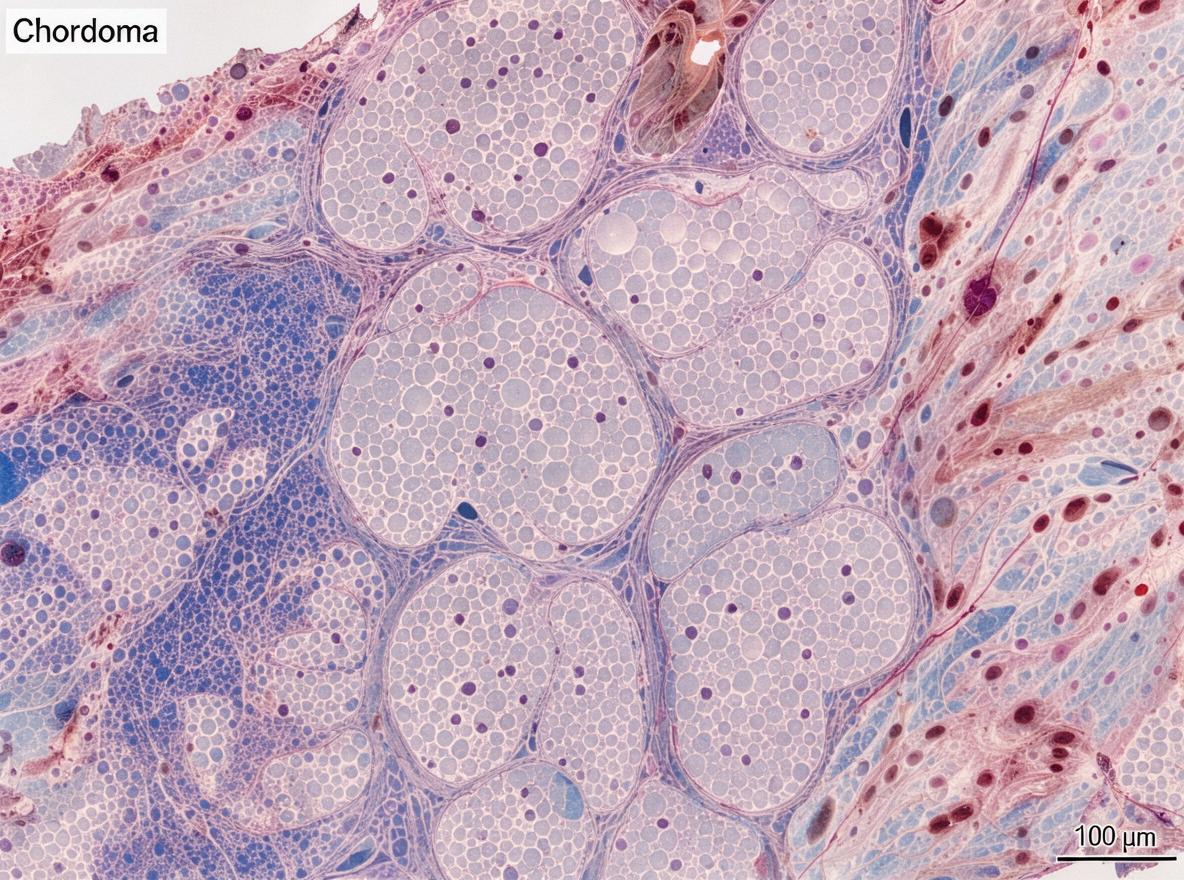
Differential diagnosis module: Imaging (CT/MRI) plus histopathology feature tables to separate chordoma from mimics such as craniopharyngioma, which was misdiagnosed as clival chordoma before biopsy .
Therapy landscape: Build a trial-tracking pipeline for advanced disease; conventional chemotherapy is largely ineffective while imatinib, sorafenib, and immunotherapy show promise in limited series .
Paediatric subgroup: Model paediatric chordoma separately; fewer than 300 cases reported, mean age ~10 years, better prognosis than adults but more aggressive under age 5 .
3. Limitations and Blindspots
All primary evidence is retrospective and non-randomized, spanning decades of evolving surgical technique; sample sizes are small for a rare tumor, and the mobile-spine AOSpine dataset reports only individual-level exemplars (two patients shown) rather than full cohort statistics, limiting generalizability . No randomized prospective data exist in the supplied sources; conclusions about margin effects rest on observational associations, and confounders (comorbidity, technique drift) were not controlled. What would change this picture: prospective multi-institutional cohorts showing margin status does not affect recurrence, or molecular classifiers superseding anatomic staging.
Building a survival analysis pipeline for chordoma cohorts, modeling local recurrence and overall survival by margin status, tumor volume, and anatomic site from the extracted retrospective data.
Get emailed when your analysis is done!
We'll email you the results when your analysis is finished.
Hypothesis Graveyard
Conventional chemotherapy as a backbone for advanced chordoma: falsified by review evidence showing it is largely ineffective, shifting focus to tyrosine-kinase inhibitors and immunotherapy.
Complete resection is routinely achievable for skull base chordoma as in sacral cases: contradicted by the 238-patient series where GTR was achieved in only 11.8%.

 Explore by Goal
 Quick Analysis Plan
 Long Analysis Plan
 Top Data Sources
 Ask a Follow-Up
 Key Insight
 Keep Exploring
 Analysis
 Hypothesis Graveyard
 Potential Experiments
 Discussion
