Analyze how experimental results and claims are presented, scoped, and limited in a paper.Know what the science actually supports before you trust the answer.
Press Enter ↵ to analyze
Explore by Goal
"The greatest enemy of knowledge is not ignorance, it is the illusion of knowledge."
- Stephen Hawking
Quick Explanation
Copied
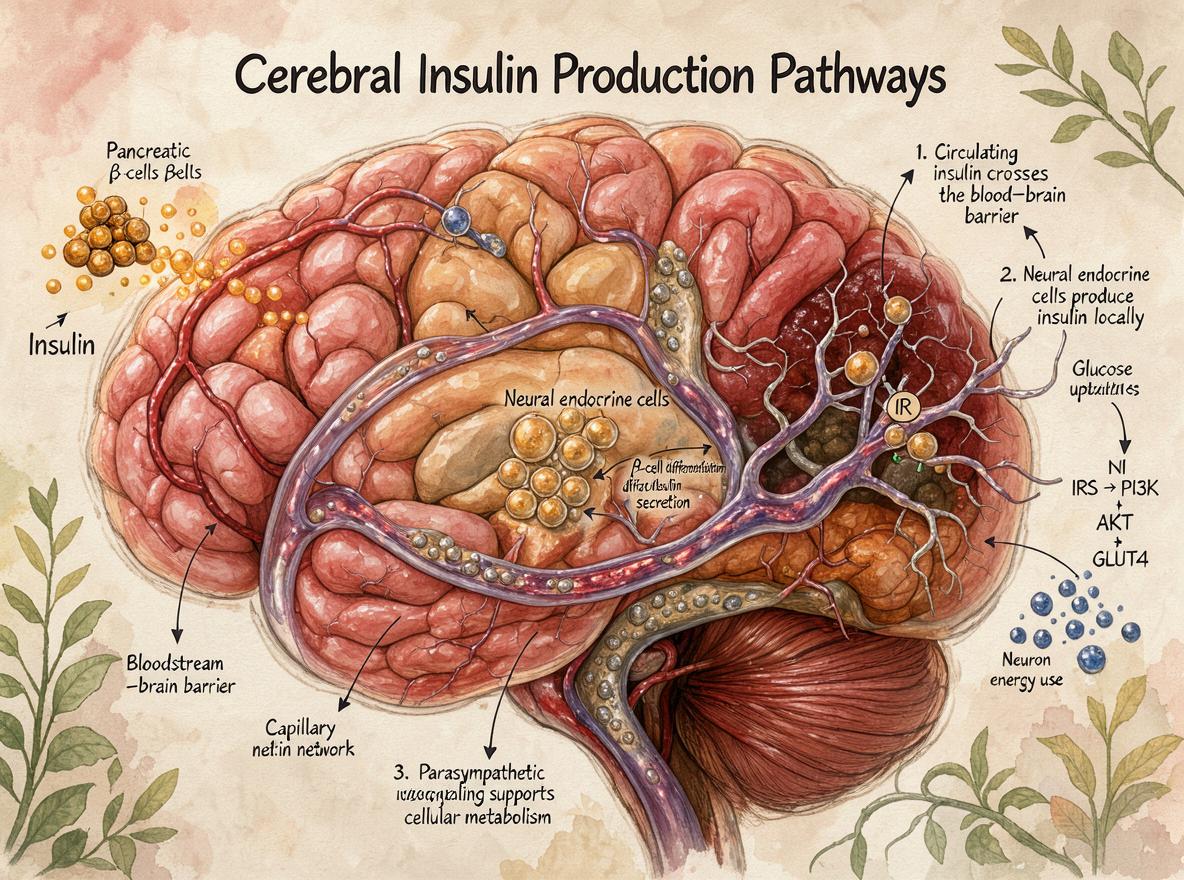
This 2004 review by William A. Banks argues that cerebral insulin is almost entirely blood-derived, entering the CNS through a saturable, dynamically regulated blood-brain barrier transporter, so that CNS insulin functions largely as a counter-regulatory signal to peripheral insulin .
Long Explanation
What the paper claims
Banks' 2004 review synthesizes mouse, rat, and dog evidence that little or no insulin is produced in the CNS, making cerebral insulin dependent on a saturable blood-brain barrier (BBB) transporter of pancreatic origin . The decisive experiment was elegant: human insulin infused into mice suppressed endogenous murine insulin in blood, and murine insulin fell in brain in tandem, implying all CNS insulin is blood-derived .
Key mechanistic arguments
Saturation at physiological levels: the transporter is partially saturated at euglycemia, suggesting its role is physiological signaling, not hypoglycemia defense .
Counter-regulatory role: CNS insulin lowers serum insulin, raises glucose, suppresses appetite, and mice lacking neuronal insulin receptors become obese .
Regional variation: olfactory bulb transport is 2-8x faster than whole brain; occipital cortex shows no transport in ICR or SAMP8 mice .
Unresolved transporter identity: Banks candidly notes it is untested whether the BBB transporter is the insulin receptor itself, citing examples (IL-1, leptin, EGF) where transporter and receptor differ . Modern structural work confirms the insulin receptor is a dynamic, multi-state machine, but does not by itself resolve whether it mediates transcytosis .
Regulation of transport (reported qualitative directions)
Condition
Reported effect on transport
Source cited in paper
Neonatal period
Increased
Frank et al., 1985
Fasting
Decreased
Strubbe et al., 1988
Hibernation
Abolished
Florant et al., 1991a
Hyperglycemia (acute)
Abolished
Banks et al., 1997b
Obesity
Decreased
Kaiyala et al., 2000
Diabetes mellitus (STZ/alloxan)
Increased
Banks et al., 1997b
Lipopolysaccharide
Increased (NO-opposed, PG-independent)
Xaio et al., 2001
Dexamethasone
Decreased
Baura et al., 1996
Alzheimer's disease / aging
Decreased
Craft et al., 1998; Frolich et al., 1998
The LPS finding generated a testable causal hypothesis: enhanced BBB insulin entry raises CNS insulin, which opposes peripheral insulin action, potentially explaining sepsis-associated insulin resistance . Note this is the author's inference, not demonstrated causation in septic patients.
Critical appraisal
Strengths: the review integrates a coherent 40-year literature, explicitly resolves the old CNS-synthesis controversy, and proposes falsifiable mechanisms (dexamethasone-driven hyperphagia, sepsis insulin resistance). Limitations: much evidence is rodent/canine; the Alzheimer's and obesity claims rest on CSF/serum correlations, which the paper itself earlier warned can be confounded (correlation ≠ transport causation) . The paper honestly flags its own biggest gap: transporter identity. What would falsify the framework: dissociating CSF from serum insulin under conditions where transport is expected, or identifying a CNS insulin source capable of physiological signaling .
Feedback:
Updated: October 31, 2026
BGPT Paper Review
Study Novelty
70%
For 2004, consolidating evidence that CNS insulin is exclusively blood-derived and framing BBB transport as a regulated signaling mechanism was a meaningful conceptual advance, though the underlying transport data largely predated the review.
Scientific Quality
80%
Well-sourced (77 references), honest about the untested transporter identity and correlation-vs-causation pitfalls. Weaknesses: reliance on animal models, some Alzheimer's/obesity claims rest on indirect correlations, and no quantitative meta-analysis.
Study Generality
80%
The regulated-transporter framework generalizes to other peptide hormones (leptin, amylin, cytokines) and links BBB physiology to obesity, diabetes, infection, and neurodegeneration.
Study Usefulness
80%
Provided a mechanistic foundation later used in intranasal insulin and Alzheimer's research; the counter-regulatory and LPS hypotheses remain experimentally actionable.
Study Reproducibility
60%
As a review it reports others' methods; primary studies were pharmacokinetic mouse/rat assays with described protocols, but no shared data and some findings (e.g., regional occipital cortex null transport) await independent replication.
Explanatory Depth
70%
Deep mechanistic synthesis at the physiological level, but stops short of molecular identity of the transporter and lacks kinetic modeling of regional transport differences.
We'll email you the results when your analysis is finished.
Hypothesis Graveyard
Brain synthesizes its own insulin to explain CNS-peripheral dissociation: largely falsified by the species-specific immunoassay cross-species infusion data showing tandem decline of endogenous murine insulin in brain with human insulin infusion.
The BBB insulin transporter is simply the insulin receptor co-opted for transport: remains plausible but untested; parallels with leptin/IL-1/EGF transporters differing from their receptors argue against assuming identity.

 Explore by Goal
 Quick Explanation
 Long Explanation
 Top Data Sources
 Ask a Follow-Up
 Key Insight
 Keep Exploring
 Hypothesis Graveyard
 Potential Experiments
 Discussion
