Analyze how experimental results and claims are presented, scoped, and limited in a paper.Know what the science actually supports before you trust the answer.
Press Enter ↵ to analyze
Explore by Goal
"A gene is a long sequence of coded letters, like computer information. Modern biology is becoming very much a branch of information technology."
- Richard Dawkins
Quick Explanation
Copied
Solini's 2016 Acta Diabetologica review was prescient on cardiovascular/renal benefit but predicted class effects later proven inconsistent across agents (e.g., VERTIS CV null MACE), and its optimistic safety framing understated amputation, fracture, and DKA concerns later confirmed in CANVAS and other trials.
Long Explanation
What the Review Claimed — and Where Later Evidence Tested It
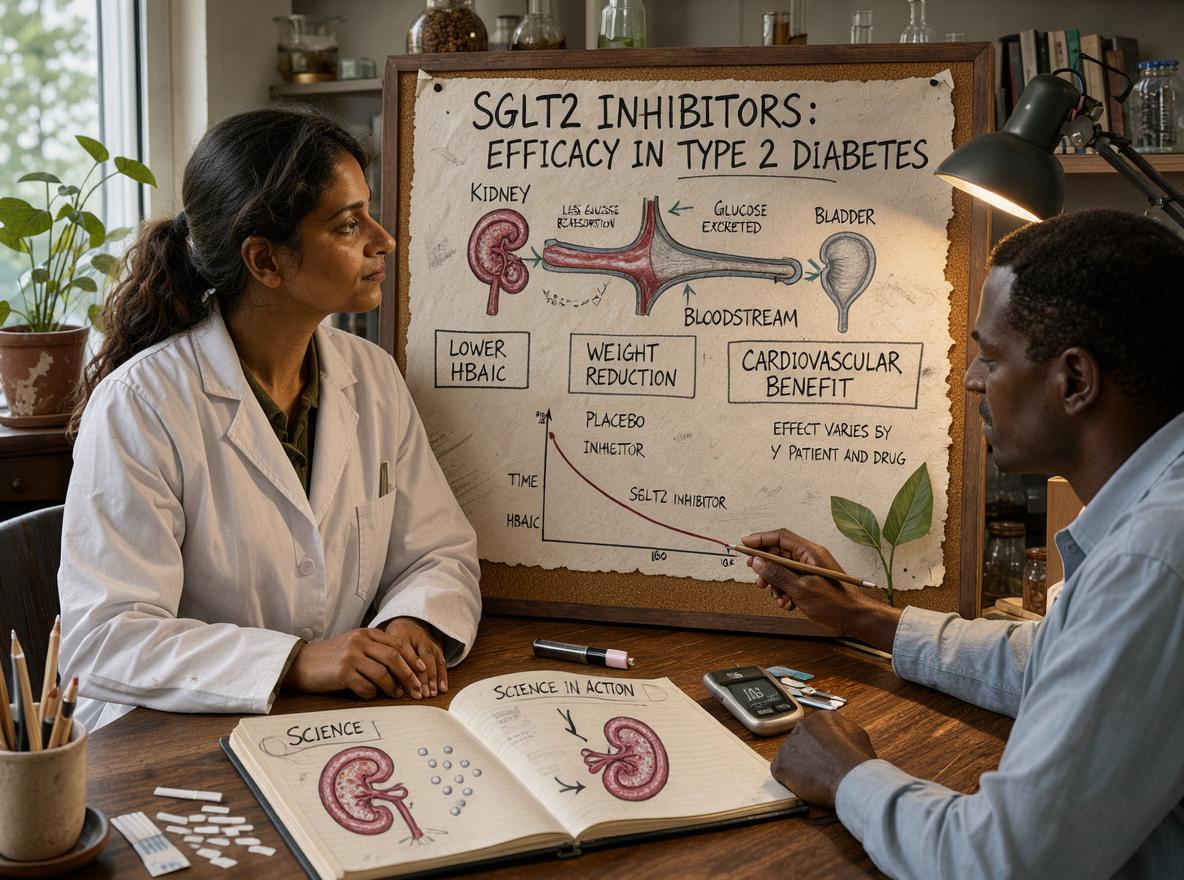
The review, published April 2016 (received January 2016), synthesized efficacy data for dapagliflozin, canagliflozin, and empagliflozin: mean HbA1c reduction ~0.8%, stable glycemic durability to 4 years, weight loss (~2-3 kg), systolic BP reduction ~-4.0 mmHg in a meta-analysis of 27 trials (~13,000 participants), low hypoglycemia risk, and the landmark EMPA-REG OUTCOME result (n=7020; primary endpoint 10.5% vs 12.1%; RRR 14% for MACE, 38% CV death, 35% HF hospitalization, 32% all-cause death) . The author explicitly flagged the class-effect question as unresolved — a stance vindicated by subsequent trial heterogeneity.
The kidney section was speculative in 2016 but has aged well: renal composite HRs across subsequent trials cluster at 0.53-0.81, with empagliflozin, dapagliflozin, and canagliflozin showing consistent renoprotection while ertugliflozin's CI crossed 1.0 .
Critical Weaknesses and Blind Spots
Class-effect overreach: The review's therapeutic algorithm recommendation treated SGLT2 inhibitors largely as interchangeable. VERTIS CV later showed no significant MACE reduction for ertugliflozin, and the cardioprotective magnitude varies by agent — a nuance the review only partially anticipated .
Safety optimism: Bone effects (canagliflozin fracture signal) were discussed, but amputation risk — later a CANVAS concern — was absent. Euglycemic DKA was framed as confined to identifiable high-risk profiles (insulin-treated, alcohol use, dehydration), which subsequent real-world data suggests was too narrow .
Glycosuria ceiling: The review honestly explored why SGLT2 inhibitors only remove 30-50% of filtered glucose, citing SGLT1 compensatory capacity — a mechanistic insight still current .
Evidence Quality Assessment
As a narrative review, the work is a well-timed synthesis rather than a primary study; ~71 references, no declared conflicts (though most efficacy trials were industry-sponsored by Boehringer Ingelheim/Janssen/AstraZeneca — a sponsorship bias inherited from the cited trials rather than created by the author). The prescient elements (renal tubuloglomerular feedback, weight-loss plateau via compensatory energy intake) outweigh its dated recommendations. Confidence: moderate for clinical conclusions, high for pharmacology sections.
Feedback:
Updated: November 01, 2026
BGPT Paper Review
Study Novelty
60%
Timely 2016 synthesis shortly after EMPA-REG; consolidated known evidence rather than introducing new mechanisms, but was among early reviews to flag the class-effect question.
Scientific Quality
70%
Well-referenced narrative review with honest mechanistic discussion; limited by dependence on industry-sponsored trials and absence of post-2016 safety signals (amputation).
Study Generality
70%
Covers pharmacology, efficacy, safety, CV outcomes, and renal considerations for the whole T2DM population, though framed as a drug-class overview.
Study Usefulness
70%
Practically useful for 2016-era clinical positioning; partially superseded by later CVOTs, kidney outcome trials, and guideline evolution.
Study Reproducibility
50%
Narrative reviews cannot be independently reproduced without a stated search strategy; none is reported, and included-trial selection criteria are implicit.
Explanatory Depth
70%
Strong mechanistic treatment of renal glucose handling, splay, SGLT1 compensation, and energy-intake compensation for weight loss; CV mechanism table remains speculative.

 Explore by Goal
 Quick Explanation
 Long Explanation
 Top Data Sources
 Ask a Follow-Up
 Key Insight
 Keep Exploring
 Hypothesis Graveyard
 Discussion
